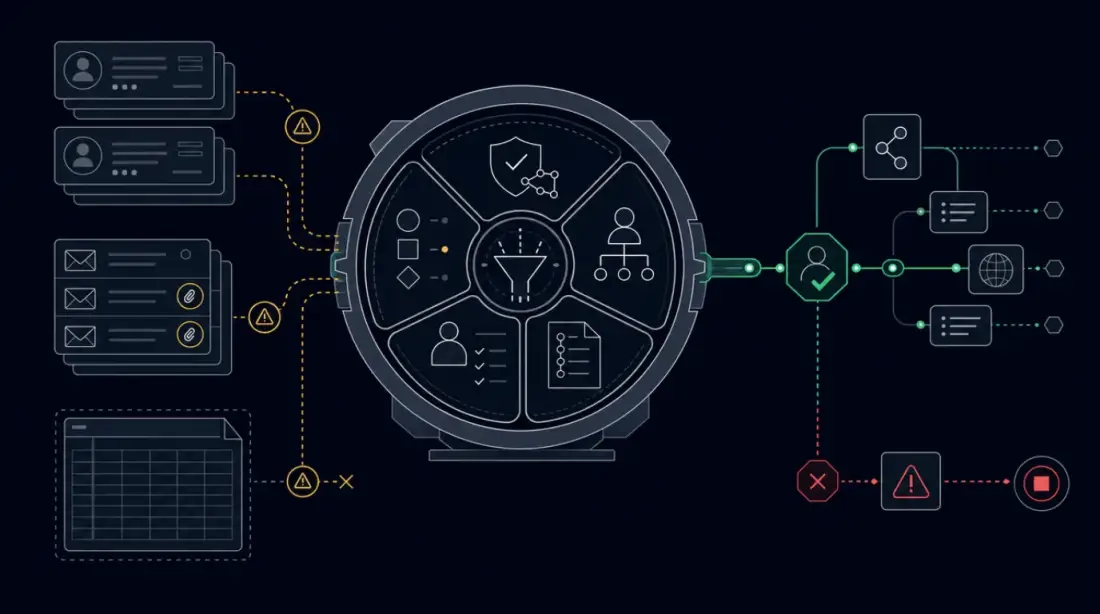
The AI Agent Roadmap: From Experimental Scripts to Sovereign Assets
How SMEs transition scattered AI experiments into secure, managed, and documented automations instead of accumulating shadow AI risk.
Contents
How SMEs transition scattered AI experiments into secure, managed, and documented automations instead of accumulating shadow AI risk.
Share this article
The Script That Suddenly Runs Sales
The transition from a useful experiment to a risky operational dependency often happens silently in mid-sized businesses. It begins with a pragmatic solution: Tim, the founder of a DACH-based B2B technical service provider with 38 employees, writes a simple script. This script exports about 180 inbound leads per week into a CSV file, sends them to a public API of a Large Language Model (LLM), and pre-sorts the inquiries by urgency. It saves hours of manual work.
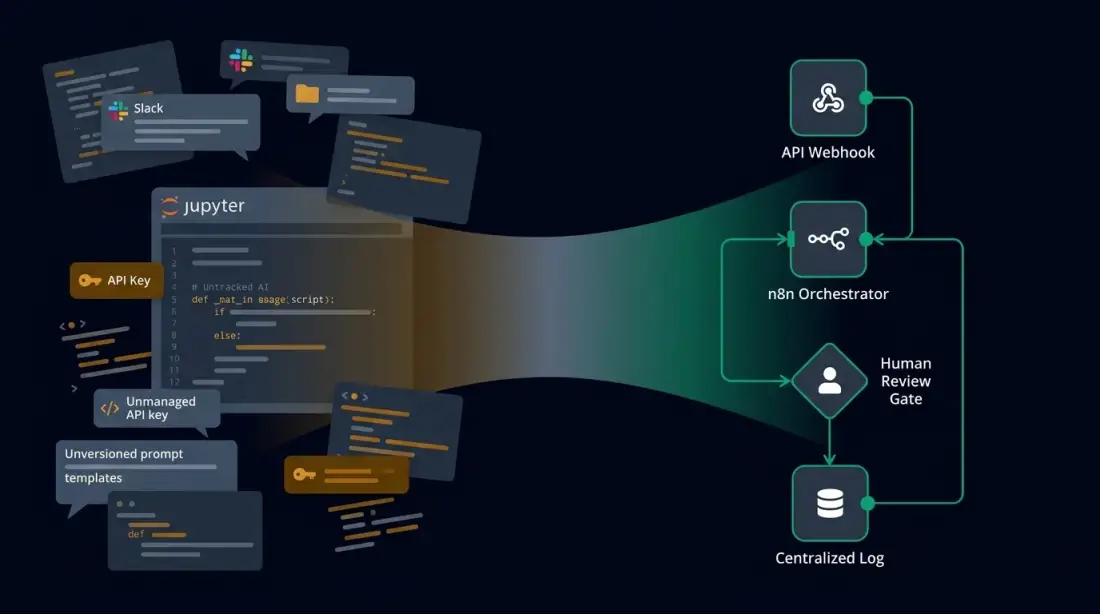
Six months later, this routine has become a cornerstone of daily business. The sales team relies entirely on the pre-sorted lead pipeline. However, the script still runs on Tim's private laptop. It uses his personal API key, the prompt structure is undocumented, API execution errors are not logged, and there is no fallback workflow. If Tim's laptop fails or the API endpoint changes, lead triage stops immediately.
The 2025 University of Melbourne and KPMG study surveyed more than 48,000 people in 47 countries. That does not mean 48,000 employees or a representative SME sample. Its findings include reliance on unchecked AI output at work. For your business, the practical question is which tools are used and where human review is needed.
For small and medium-sized enterprises (SMEs), this means informal AI use is already a reality. The challenge is not to ban experimentation, but to identify valuable workflows early and migrate them into a manageable, secure operating architecture.
The Experiment Is Not the Problem – Missing Ownership Is
Experimentation is crucial for technological progress. However, an individual experiment turns into an operational vulnerability the moment it crosses any of the following thresholds without governance:
- Data Sensitivity: The workflow reads or processes personal customer data, internal financial reports, or employee files.
- Action Risk: The output prioritizes business tasks, drafts customer-facing communication, or attempts to write status updates back to production systems.
- Operational Dependency: Multiple team members rely on the outputs daily without knowing how the process works.
- Infrastructure Fragility: The process depends on private credentials, local scripts, or undocumented prompt templates.
To clarify the boundary between a passing experiment and a stable operational asset, businesses can look to established frameworks. The NIST AI Risk Management Framework (NIST AI RMF Playbook) specifies in its core "Map" function that the context, intended purpose, system boundaries, human oversight roles, and lifecycle responsibilities must be clearly documented.
A sovereign business asset requires clear answers to fundamental operating questions: Who is the business owner responsible for the outcome? What data flows where? What controls prevent incorrect actions? And what is the technical fallback path if a connection fails?
SME Diagnostic Checklist
Ask these four questions of every active AI workflow:
- Does the process run on a company server or on an individual employee’s workstation?
- Can credentials and API keys be rotated centrally without breaking the execution code?
- Is the exact prompt template versioned and accessible to the team?
- Is there a log record of when the workflow ran and what data was transmitted?
The Cost of Shadow AI in SMEs
Operating informal AI scripts carries concrete operational consequences. When a service provider like the one in this scenario handles approximately 450 support emails per month using unstructured AI drafts, several friction points emerge:
- Data Without a Leading Source: If a prompt lacks a strict connection to internal reference documents, the model hallucinates details. The time the team spends correcting these drafts eats up the efficiency gains.
- Prompts Without Version Control: If an internal service policy changes, every prompt template must be updated manually. Without version control, different team members operate under varying quality baselines.
- Decisions Without Logs or Reviews: When errors occur, it is impossible to determine whether the LLM was poorly instructed, the API delivered corrupted data, or the employee accepted the draft without checking.
Security is also at stake. The OWASP Foundation lists risks like Prompt Injection (manipulating model behavior via external inputs), Sensitive Information Disclosure (accidentally releasing private data), and Excessive Agency (allowing the agent unchecked read/write permissions) in the OWASP Top 10 for LLM Applications.
In SME operations, excessive agency is a practical threat: a script receives direct write access to the CRM to update lead statuses. If triage fails, leads are archived incorrectly, and potential revenue is lost silently.
The Roadmap: Keep, Contain, Rebuild, or Retire
Businesses need a simple classification model to organize scattered scripts. Each experiment should be evaluated by its risk profile and business value and placed into one of four categories:
- Keep (as Experiment): The process uses only public data (e.g., summarizing industry news), has no action risk, and is used manually by a single person.
- Contain: The solution is useful but accesses sensitive data. It must be restricted to a defined group of users and forbidden from triggering automated actions.
- Rebuild: The process provides high business value, is critical to operations, and is used regularly. It must be migrated to a controlled, structured workflow infrastructure.
- Retire: The process provides no measurable value, presents high risks to sensitive data, or duplicates existing software capabilities.
The Decision Model at a Glance
| Data Class | Action Level | Frequency | Owner | Evidence (Logs) | Decision |
|---|---|---|---|---|---|
| Public | No action | Occasional | Individual User | No logs needed | Keep (Local Tool) |
| Internal / Customer | Draft (Manual review) | Daily | Department | Basic audit trail | Contain (Shared Environment) |
| Customer Data | CRM status / API | Hourly | Process Owner | Detailed execution log | Rebuild (Sovereign Asset) |
| Contracts / Financial | Direct execution | Real-time | None | No logs | Retire (High risk) |
The AI Act distinguishes roles, uses, and risk classes. A workflow's business importance alone does not create high-risk logging or oversight duties. The Commission's updated timeline gives 2 December 2027 for Annex III and 2 August 2028 for covered product systems. Assess the actual applicability; the proposed inventory is first an operational tool.
From Script to Sovereign Asset
How does this transition work in practice? Let us look at how this service provider restructured its lead triage workflow.
Originally, Tim exported CSV files manually, processed them via a private script on his laptop, and shared the results informally. There was no logging, monitoring, or error handling.
The new, sovereign process separates data flow, decision-making, and actions:
graph TD
    A[CRM Inbound Lead] -->|API Webhook| B(n8n Workflow)
    B -->|Filter: Personal Data| C[Secure Data Transmission]
    C -->|LLM API / Prompt version v1.2| D[AI Classification]
    D -->|Draft & Summary| E[Approval Interface / Elena]
    E -->|Correction / Approval| F[Human Review Gate]
    F -->|API Update| G[CRM Status Update]
    B -->|Execution Metadata & System Error Handler| H[Central Logging]
    H -->|Weekly Review| I[Marie / Process Optimization]
Technical Guardrails of the New Workflow
- API Integrations Over Manual Work: Data is fetched via secure API webhooks, eliminating manual file exports and private scripts.
- n8n Orchestration: The workflow is coordinated by a central n8n instance, providing a visible, structured automation layer.
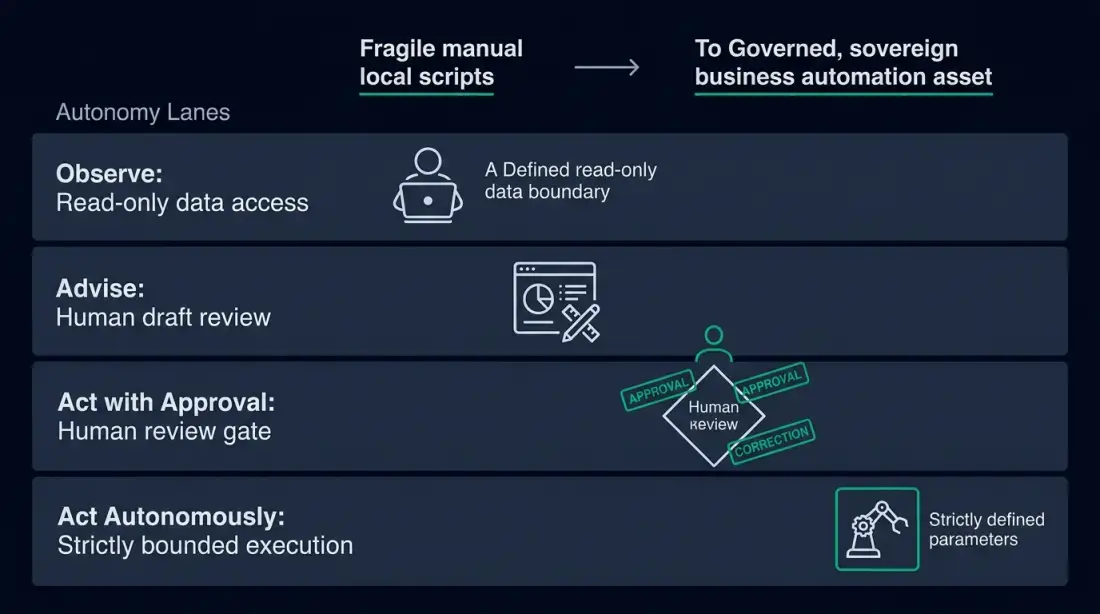
- Human-in-the-Loop: Elena (sales lead) reviews the AI classification and draft response in a dashboard. The CRM status is only updated after her explicit approval. Automated sending is disabled.
- Grounded Logging: Every execution is logged with input sources, model versions, processing times, and review actions. n8n supports this via native executions tracking and error handling workflows. If an API call fails, an error trigger alerts Jonas (developer) through an internal channel.
By implementing this architecture, the company can swap LLM providers, version prompts centrally, and trace data paths. They own the workflow rather than renting convenience from a single provider.
How Planfold Makes AI Automation Operable
Planfold helps mid-sized businesses turn fragile, undocumented scripts into reliable digital infrastructure. We apply our three-step methodology:
1. Plan (Audit and Architecture)
We audit your active AI experiments, data flows, API keys, and review points. Together, we decide which tools to contain and which to rebuild. We define the tasks: what systems the automation may read, what actions are prohibited, and who owns the process.
2. Unfold (Build and Integrate)
We rebuild the workflow in a controlled environment, using n8n as a flexible orchestration layer integrated with your APIs. The systems are deployed to match your business requirements – whether managed or self-hosted in a DACH-based cloud using containerized environments. Sandro Maier brings personally evidenced CKA, CKAD, and LFCS credentials; the badges are available on Credly.
3. Resonate (Operate and Optimize)
A digital process is only as good as its daily operations. We build monitoring dashboards, track API error rates, and establish weekly reviews to refine prompts and models. We also build in portability: your workflows and prompts are versioned as code, allowing you to export and run them on your own infrastructure at any time.
We do not provide legal counsel, GDPR certifications, or compliance audits. We deliver the operational and technical infrastructure that serves as evidence for your internal audits and compliance readiness.
The Next Step: A 90-Minute AI Asset List
You do not need to audit your entire business overnight. Start with a focused assessment:
- Inventory (60 minutes): Meet with department leads. List every process where employees currently use AI tools (e.g., summarization, translation, code generation, drafting emails).
- Risk Mapping (20 minutes): For each entry, identify the most sensitive data class processed (e.g., customer details, financials) and the maximum action allowed (e.g., direct email sending vs. read-only summaries).
- Selection (10 minutes): Pick one high-value process currently running on private credentials or undocumented scripts, and target it for structured migration.
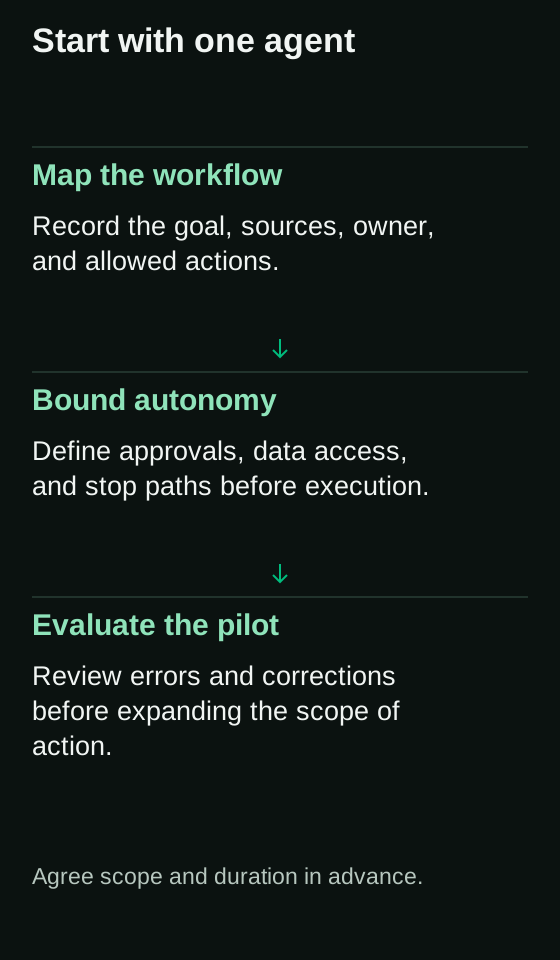
By compiling this list, you lay the foundation for your AI roadmap, moving from passive observation to active control of your digital operations.
Plan. Unfold. Resonate.
Related Posts
When a Foreign Government Gates Your AI Access: Sovereign AI Procurement as a Board-Level Risk for SMEs

The Economics of Open-Weight AI: Why Self-Hosting Now Makes Business Sense for SMEs