The Economics of Open-Weight AI: Why Self-Hosting Now Makes Business Sense for SMEs
Open-weight models have nearly reached frontier quality, and rented AI keeps getting more expensive. This guide shows SMEs when self-hosted AI pays off economically and legally — beyond benchmarks and hype.

Contents
Open-weight models have nearly reached frontier quality, and rented AI keeps getting more expensive. This guide shows SMEs when self-hosted AI pays off economically and legally — beyond benchmarks and hype.
Share this article
The token bill nobody saw coming
A 30-person DACH consultancy had perfected a prototype in its back office: an assistant feature that turned internal research notes into client-ready summaries. Running on a large closed model's API, the feature ran stably for three months — until one month's invoice landed several times above the expected range. A faulty prompt loop had silently generated millions of extra tokens in the background. The vendor offered no hard cost cap, only a dashboard that nobody watched regularly.
This scenario is illustrative, not a measured customer case and not a benchmark. It captures the moment AI becomes a financial risk rather than a tool for an SME. The feature was not throttled because it failed on quality. It was scaled back because its price had become unpredictable. That is exactly where the real question of AI economics begins: not "which model is best?" but "who controls cost, data location, and exit?".
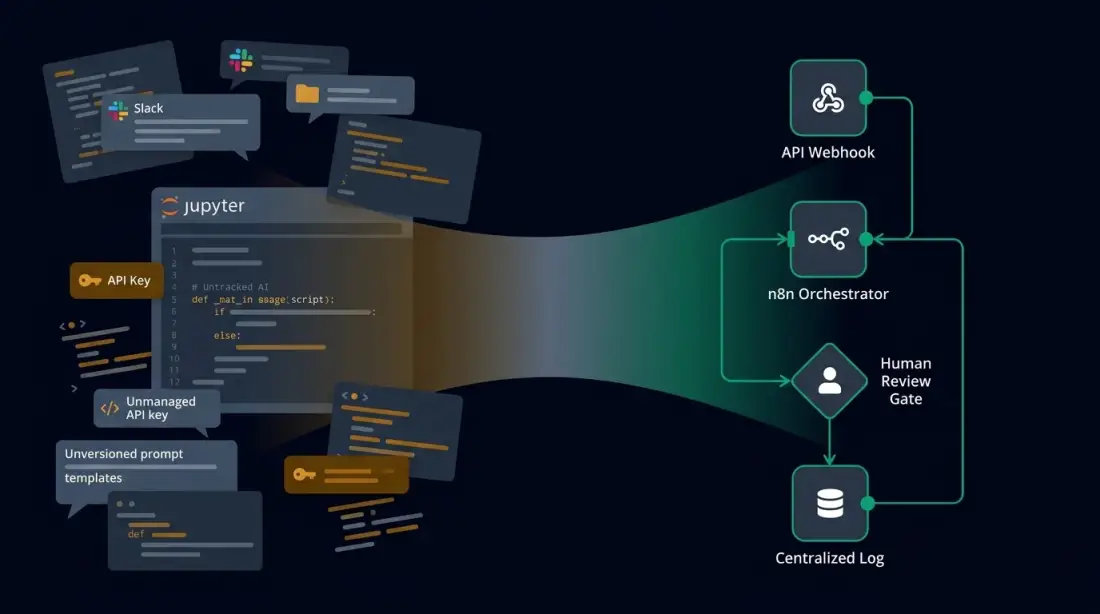
Many SMEs took the easy path through 2024 and 2025: rented APIs with usage-based billing, plus seat-based AI bundles folded into existing software contracts. That delivers capability fast. It does not build an operating base. When the next invoice spikes or the next contract changes its terms, there is no off-ramp. The AI capability exists — control over cost, data location, audit trail, and exit does not.
What AI economics means for an SME
AI economics for an SME is not a benchmark comparison. It is the question of how AI stands financially and legally inside the company: as a rented capability with usage-based billing, or as an owned, self-hosted capability with predictable cost. Three terms shape this decision.
Usage-based billing means every token the model processes is billed proportionally. That is the standard way to consume AI today. It is flexible, because you pay for what you use. It is also unpredictable, because a faulty loop, a growing use case, or a careless prompt drives the bill with no hard stop.
Seat-based bundles mean AI features are integrated into existing software packages and spread across the whole contract run for every seat — including people who barely use them. That lowers the barrier to entry, but it makes the whole suite more expensive and harder to step back to a smaller plan.
Self-hosted AI means an open-weight model runs on your own or sovereign infrastructure. Cost shifts from volatile token billing to predictable infrastructure — GPU capacity, Kubernetes operations, orchestration. In return, the company gets real data sovereignty and an exit key: the model and prompts remain company-owned artifacts.
One honest point holds across all three paths: AI capability alone is not business value. Only an operating layer — who may read what, who reviews, where data sits, what stays in the log, how you exit — turns a cheap or powerful API into a controlled, repeatable, accountable capability. Most SMEs lack exactly that layer.
The hidden costs of rented AI
The obvious bill is the token bill. The costlier ones are those that do not appear monthly on the dashboard. They surface only when a contract renews or a data flow is audited.
Token volatility: Usage-based billing means peak load passes straight through. A popular internal feature, a new team, or a faulty loop multiply consumption with no advance warning. The AI budget becomes an estimate rather than a planned figure.
Mid-contract term changes: Vendors change usage terms and data-processing paths even within a contract term. A DACH services firm — illustratively — discovers its AI assistant has been sending customer-adjacent queries to an endpoint outside the agreed data region, breaching its own data-processing agreement. No self-hosted fallback was ever configured.
Seat bundling at renewal: Microsoft announced a global list-price and packaging update for commercial Microsoft 365 suites on December 4, 2025, effective July 1, 2026, folding additional AI and security capabilities into the suites. The exact percentage impact varies per SKU — independent sources cite a very wide range — but the verified pattern is clear: AI features are funded through higher bundle prices and metered billing. An SME ends up paying for AI seats across the whole company that only a few people use, with no clean smaller plan in reach.
Data sovereignty as a premium: Data residency is not a self-service feature; it is a paid option. OpenAI charges a ten percent uplift on regional processing (data residency) endpoints for models released on or after March 5, 2025 — concrete evidence that vendors price data residency as a premium. Self-hosted AI on DACH infrastructure makes exactly that premium unnecessary, because inference runs where the data is supposed to live.
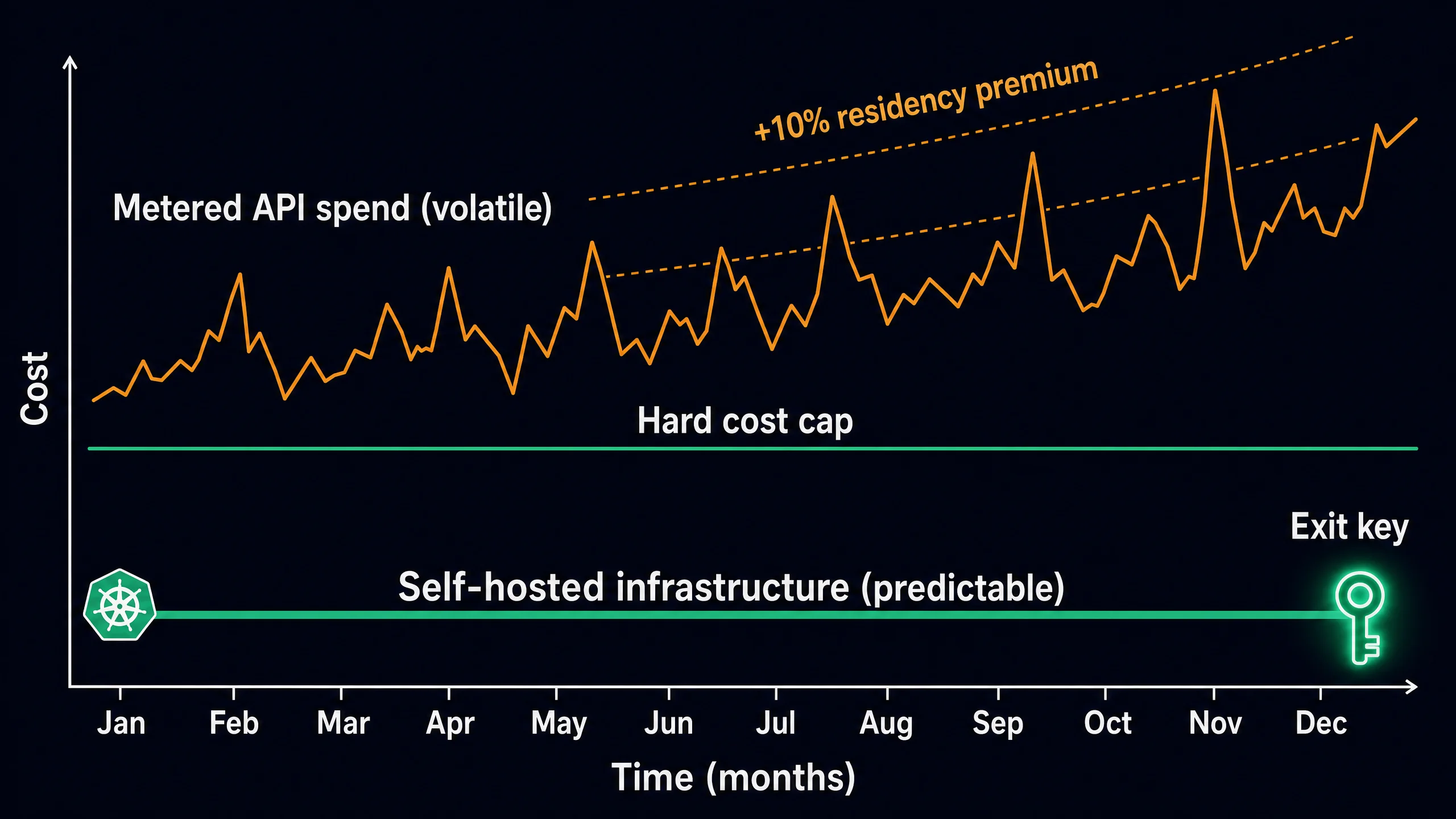
Lock-in with no exit: If you only ever rented AI, you own nothing when the vendor changes the price, the region, or model availability. There are no weights to re-host, no prompts as your own artifact, no exit path. The classic lock-in pattern hits the AI layer — except that here, sensitive data is involved too.
Five warning signs your AI is renting you
Before an SME makes an expensive architecture decision, practical signals help that recur in your own operations. Five warning signs indicate the AI is renting the business rather than empowering it.
- Usage-based billing with no hard cap. There is a dashboard, but no stop mechanism that halts conclusively at a defined cost mark.
- Data leaves the agreed region. Neither is it documented where inference runs nor where request data flows — and the contract does not cover the actual data path.
- AI seats nobody chose. The suite got more expensive because AI features were bundled in, not because the team requested them.
- No audit trail. Nobody can later reconstruct which model version ran, what was suggested, who approved or corrected it, and why.
- No exit path. There is no plan for how the capability could keep running on different infrastructure, with a different model, or without the current vendor.
Ignore these signals and you relive the same pattern as unchecked SaaS sprawl, only on the more sensitive AI layer: capability grows, controllability shrinks. That uncontrolled AI is exactly what a governed, self-hosted path is meant to replace.
What changed in the second quarter of 2026
Until 2025, the honest answer to "is an open model good enough?" was usually: yes for simple tasks, less so for demanding enterprise workloads. In the second quarter of 2026 that shifted noticeably — and this shift is the foundation that makes "self-host?" worth discussing economically at all.
Looking at the vendor-neutral AI Arena Text leaderboard (operated by Arena Intelligence, the successor to LMSYS Chatbot Arena; snapshot from June 25, 2026, 661 models), a sober reading holds: nine of the top ten models remain closed. The strongest open or open-leaning model sits about 21 Elo points, roughly 1.4 percent, behind first place. On quantitative and coding tasks, open weights now rank in the top tier. At the absolute frontier — and on creative and instruction-following tasks — the field remains closed-led.
The concrete takeaway: it is not accurate to say open models are "now the best" or "have completely caught up." What is accurate: open weights have closed the gap to single-digit to low-double-digit percent on many tasks, making self-hosting credible for a growing set of real workloads.
This quality shift is reinforced by a concrete cost shift. Per the official pricing pages — DeepSeek for cheap open-weight inference, OpenAI for the closed frontier — the output cost of a million tokens on the closed frontier model is a multiple of what an open-weight model charges. The measured ratios range from roughly 34x to over 100x per output token. And if you want data residency on the closed vendor, you additionally pay the mentioned ten percent uplift. Open weights are not free — they need infrastructure and operations. But the cost ratio has shifted so visibly that "self-host?" pays off economically for the right workloads.
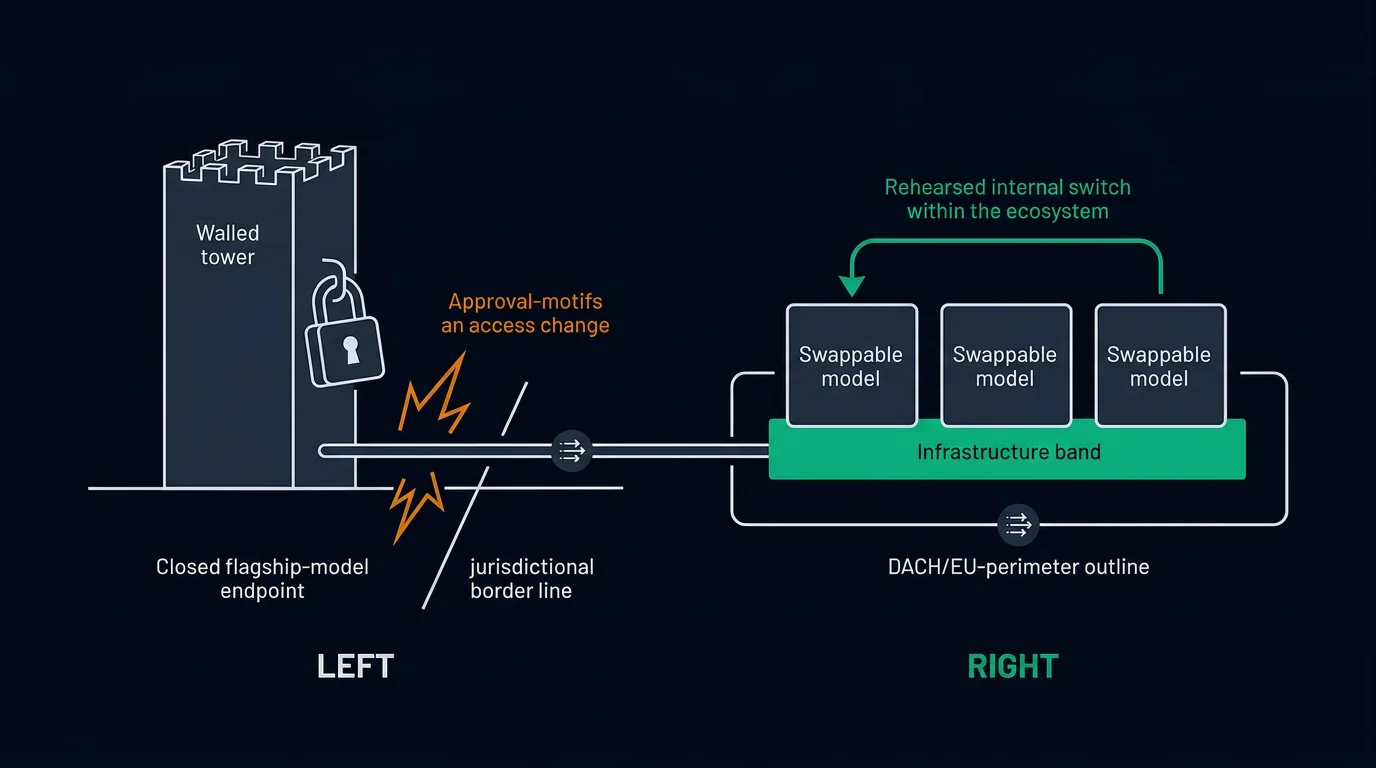
The real point, though, is this: a cheap open API endpoint wins on cost, but not on data sovereignty. The data still leaves the DACH region. Only self-hosting on sovereign infrastructure combines predictable cost with real data sovereignty and an exit key. It is exactly this distinction — cost versus sovereignty — that every SME must understand before it decides.
Rent, buy, or self-host: a decision grid for SMEs
Three economic paths are available, and only one delivers real data sovereignty. The decision depends less on the best model than on the sensitivity, volume, and predictability of the specific workload.
1. Rent a closed frontier. Highest unit cost per token, data leaves the DACH region (with a residency premium), no exit key. Reasonable for workloads that need the absolute frontier, have low volume, or must be experimented on quickly.
2. Rent open weights as an API. Cheap per token, but still rented — data still leaves the DACH region. Good for cheap experimentation and low volumes, unsuitable when data sovereignty is mandatory.
3. Self-host open weights on DACH infrastructure. Predictable infrastructure cost plus real data sovereignty plus an exit key — but it requires an operating layer: GPU capacity, Kubernetes, inference serving, orchestration through n8n, human review gates, logging, and a residency check. Pays off for sensitive, high-volume, recurring workloads.
| Criterion | Closed API | Open API | Self-hosted (DACH) |
|---|---|---|---|
| Cost per token | highest | very low | predictable, fixed |
| Data sovereignty | no (premium possible) | no | yes |
| Cost predictability | low (metered) | low (metered) | high (infrastructure) |
| Exit key | no | no | yes |
| Operational effort | minimal | minimal | significant (GPU, k8s, ops) |
| Best for | frontier, low volume | experiment, low volume | sensitive, high-volume, recurring |
What self-hosting actually requires is not downloadable diffusion knowledge, but an operating layer. Open weights must be served: an inference layer, GPU capacity sized to peak load, Kubernetes as a portable runtime, an orchestration layer — typically n8n — connecting workflow, human review, and logging, plus residency and cost control. Real limits matter too: patching, model updates, GPU economics, and the question of when renting is smarter — at low or unpredictable volume, or when the absolute frontier is needed. An SME does not have to operate a whole AI platform; it can lift one workload onto its own stack.
The thesis is therefore not "open weights are free." It is: open weights make self-hosting economically rational to evaluate for the right workloads — and only self-hosting turns a cheap model into a sovereign, audited, owned capability.
A realistic SME case: one workload onto your own stack
An illustrative DACH case shows how a single workload is moved. An owner-operated DACH consultancy of about 35 people, with no dedicated AI or platform team, runs recurring client projects. The relevant workload: automated drafting of client-ready summaries from internal research notes — sensitive, high-volume, and recurring, hence an ideal self-hosting candidate.
Roles involved: Lena, Head of Operations and decision owner (budget and data-processing agreement); Marco, IT lead, part-time, with no ML background; Daniela, senior consultant and quality gatekeeper.
The data volume is realistically dimensioned: about 120 research notes per week, roughly 3,000 to 4,000 summaries per month, and six to eight million tokens monthly. On a rented closed API, spend sat volatile between roughly €1,800 and €2,400 per month — with spikes on busy weeks and no fixed cap.
The decision points follow the Plan/Unfold/Resonate rhythm. In the Plan phase the workload is scored: high sensitivity (client data) combined with high volume makes it the top candidate to move. Low-volume, ad-hoc tasks deliberately stay on a cheap API. In the Unfold phase, a DeepSeek-V4-class open-weight model is deployed on DACH Kubernetes with GPU capacity sized to peak and orchestrated through n8n. Human review is built in: every summary routes to Daniela for sign-off before it reaches a client; a two-person rule applies to model and prompt changes, each logged with rationale and reviewer; a hard monthly cost cap with alerting protects the band; and a residency check runs on every execution.
The exit key is not a marketing word but an artifact: model weights and prompts stay company-owned. The firm can re-host on different hardware or swap the model without vendor lock-in.
The outcome is — expressly illustrative, not measured — a shift from a volatile token bill into a planned, fixed infrastructure band. Client data stays in the DACH region. Every generated summary has an owner and an audit trail. Planfold does not quote a specific euro figure as savings — because the real gain is cost control, data sovereignty, and a defensible exit, not a guaranteed reduction.
The Planfold perspective: AI as an owned, audited capability
Planfold frames AI adoption as infrastructure plus governance, not model selection. The line of argument follows a clear operating schema: Plan means auditing AI spend, data flows, sensitivity classes, and residency requirements, and scoring workloads by volume and risk. Unfold means deploying frontier-class open weights on sovereign or self-hosted infrastructure — Kubernetes, GPU capacity where the workload justifies it — orchestrated through n8n with human-in-the-loop review gates and logged decisions. Resonate means operating with predictable cost, data-residency evidence, an audit trail, and an exit key.
The claim is operational and sober, not magical: open weights make ownership economically rational to evaluate — they do not guarantee savings and still need an operating layer that most SMEs lack. Planfold provides that layer (sovereign hosting, Kubernetes operations, n8n orchestration, documented review standards); Planfold does not sell a model, does not certify compliance, and does not provide legal advice. Regulatory topics such as the EU AI Act are treated as a risk-based framework with expectations on documentation, logging, and human oversight — as "architecture for compliance readiness," not as a legal or certification promise.
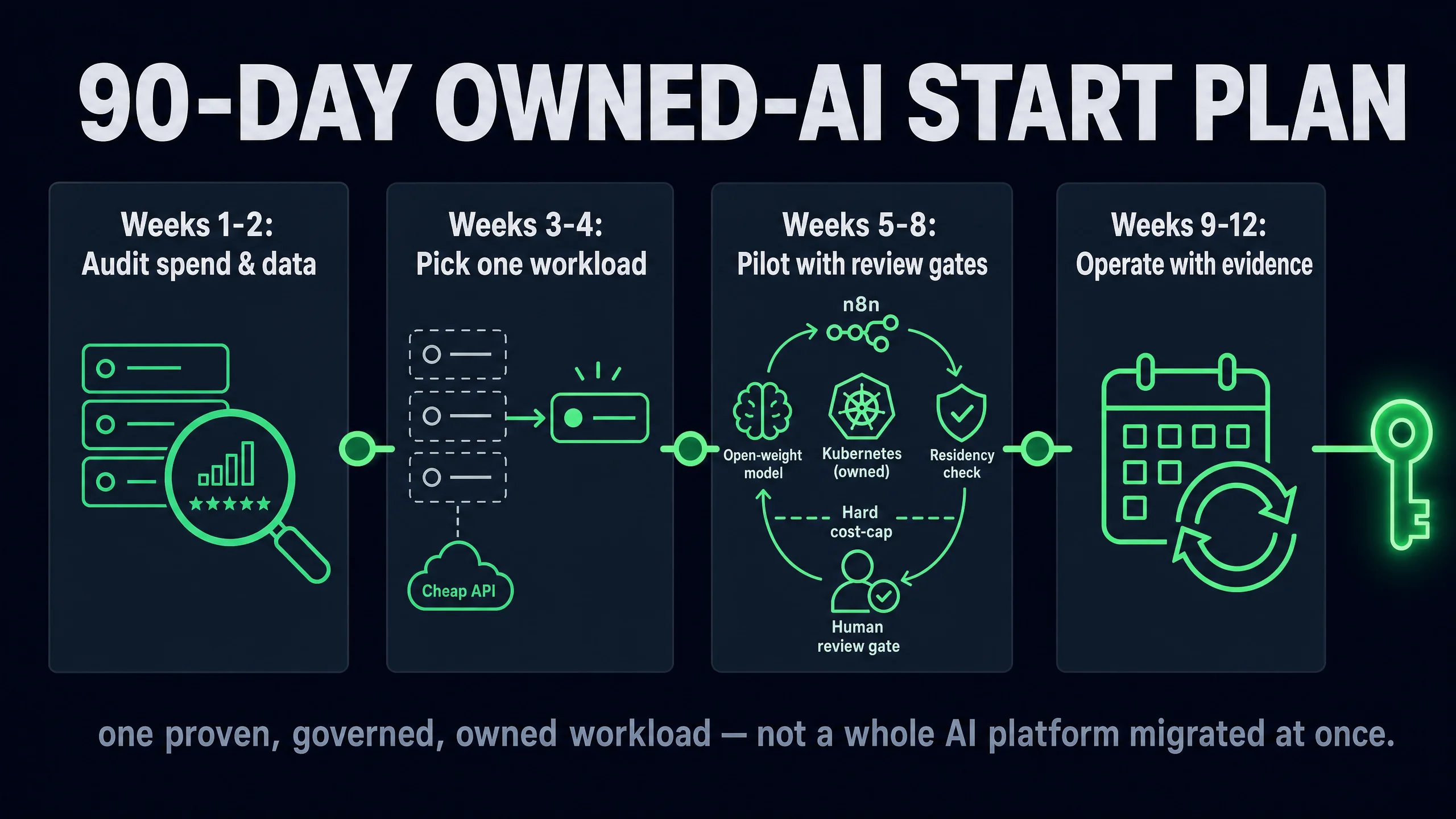
A bounded 90-day starting plan makes this concrete. Weeks 1–2: audit. Map AI spend and data flows, score workloads by sensitivity and volume, name data classes and review roles. Weeks 3–4: pick a workload. Select one sensitive, high-volume, recurring workload as the first self-hosting candidate — not the whole AI strategy at once. Weeks 5–8: pilot. Deploy an open-weight model on DACH Kubernetes, orchestrate through n8n, with hard cost caps, residency check, and human review. Weeks 9–12: operate. Build and verify cost, residency, and exit evidence in live operations, and check whether the path scales to a second workload.
The economics of open-weight AI have clearly turned in 2026. The question is no longer whether open weights are good enough, but whether your business owns an operating layer that turns a cheap model into a sovereign, audited capability. If not, that is the first workload Planfold moves with you.
Plan. Unfold. Stay Sovereign.