When a Foreign Government Gates Your AI Access: Sovereign AI Procurement as a Board-Level Risk for SMEs
When your production AI's availability depends on a foreign approval decision, that is a continuity and compliance risk — not a benchmark. This guide shows SMEs how sovereign AI procurement dissolves the dependency.
Contents
When your production AI's availability depends on a foreign approval decision, that is a continuity and compliance risk — not a benchmark. This guide shows SMEs how sovereign AI procurement dissolves the dependency.
Share this article
The breakfast headline: your model now needs a foreign approval
A 55-person owner-operated consultancy in the DACH region runs its document intake and a customer-support assistant on a single closed flagship model, reached through an API in a foreign jurisdiction. Prompts, evaluations, tooling, and the support surface are all tuned to that one model. Mid-quarter, the managing director Maren reads at breakfast that access to their production AI has become conditional on a foreign approval and licensing decision. The support queue and the document intake stutter the same day.
This scenario is explicitly illustrative — not a measured customer case and not a specific product announcement. It does, however, stand for a real, verified pattern: the United States operates an active export-control and approval regime over advanced computing hardware and associated technology. The specific, this-year headlines about model-level access gating at named labs are not independently primary-sourced and are labeled illustrative in this text. The underlying mechanism — a foreign jurisdiction deciding the availability of technology your production depends on — is verified, and it is the honest core of the topic.
For the SME, that is where the real question begins. It is not "which model is strongest?" but "who controls the availability of a capability our daily operations already depend on?". When the answer is "a foreign authority where we have no seat", that is no longer a procurement preference. It is a board-level risk decision.
What Sovereign AI Access Risk actually means
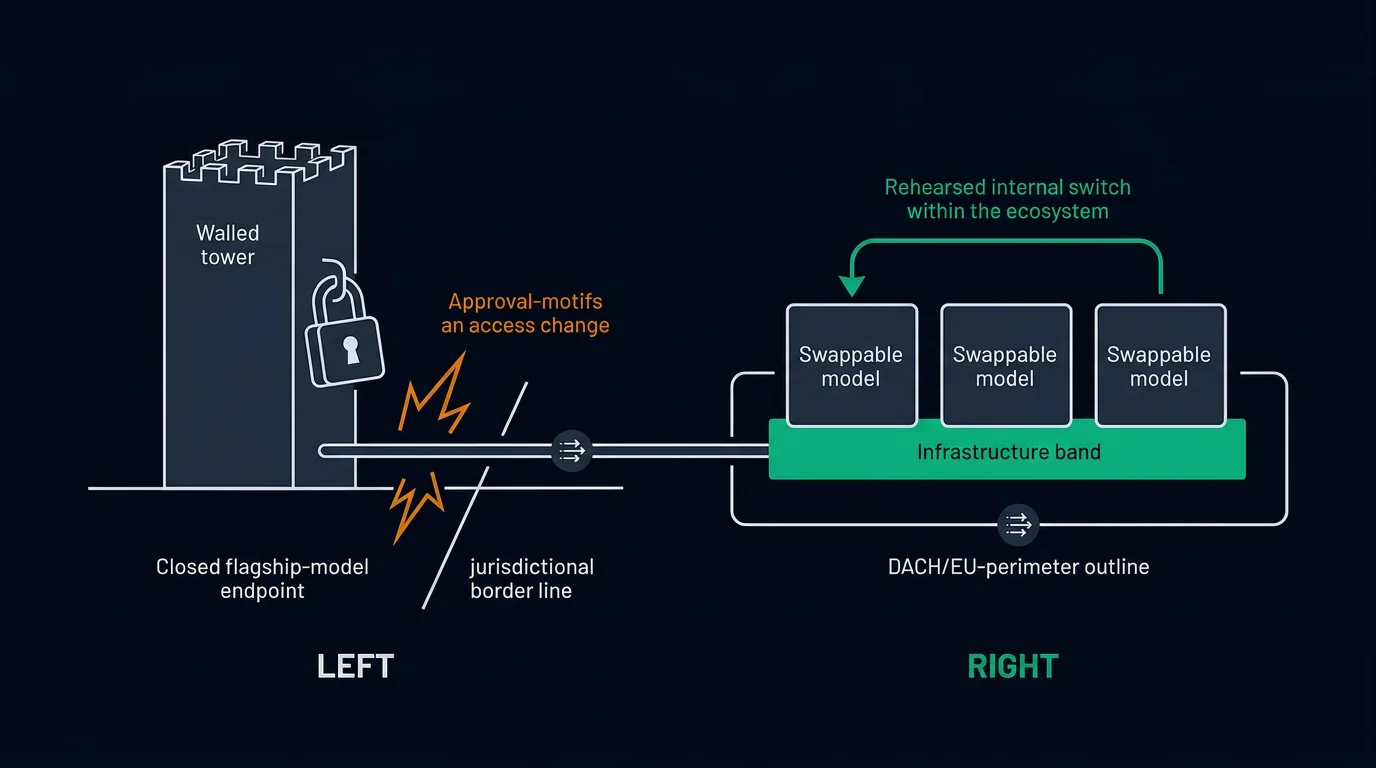
Sovereign AI Access Risk is not a benchmark shift or a product announcement. It is a production AI dependency whose availability can be changed by a decision outside your own jurisdiction — an export-control license, an approval list, an access-tier or jurisdictional change.
The verified mechanism behind this risk is tangible. The US Department of Commerce, through its Bureau of Industry and Security (BIS), maintains an export-control and approval regime over advanced computing items — the hardware and technology that frontier AI is built on. BIS guidance explicitly requires a license to export such items to entities headquartered in, or ultimately parented in, Country Group D:5 or Macau — even when the purchasing entity sits in a third country. In parallel, a government-run application process for "Approved IC Designers" has a timeline extended to 31 December 2026. Multiple active Section 232 investigations (semiconductors, critical minerals, robotics) confirm that export control is treated as an instrument of national security — and therefore subject to abrupt political change.
Honesty is mandatory here: the BIS regime governs advanced computing hardware and associated technology plus country and parent jurisdictions, not a published "company X may use model Y" roster. The board-level point survives intact: when your AI capability runs through a single foreign-controlled endpoint, its availability is shaped by an approval decision you have no part in. Whether that decision bites now or later is tactics — that it can steer is the structure an SME must prepare for.
Why SMEs feel this risk disproportionately
A large enterprise feels the same mechanism differently than a 55-person firm. An SME lacks three things at once: a seat at the license or approval table, a dedicated team that can pivot to a model swap in days, and a budget for the rework an unplanned change forces.
The dependency hardens on several layers at once. The workflow layer is walled in: prompts, tools, evaluations, and surfaces are optimized for one model — a swap forces a from-scratch re-validation, not a clean exchange. The data layer is exposed: routing customer documents and support transcripts to a foreign endpoint creates a cross-border data transfer under GDPR (Chapter V, Articles 44–49) and requires appropriate safeguards such as Standard Contractual Clauses plus a transfer impact assessment. An access change can strand data mid-flow. The supply-chain layer is regulated: the NIS2 Directive (EU) 2022/2555 requires essential and important entities to apply risk-management measures and incident reporting with explicit attention to supply-chain security and service continuity; the Member-State transposition deadline was 17 October 2024. A production AI whose availability is decided abroad is a supply-chain dependency NIS2 expects to see managed.
Then there is the EU AI Act. As a deployer, an SME faces transparency obligations (Article 50, from August 2026) and, for high-risk use cases, a duty of human oversight. A single-model dependency through a foreign endpoint makes evidence and oversight measurably harder — not because the regulation forbids the model, but because the evidence and oversight chain runs through a foreign jurisdiction. None of this is asserted here as "you will be fined amount X". The thesis is more robust: a foreign access decision compounds your compliance and continuity exposure and makes it less predictable.
Six warning signs: recognize your own exposure
Before an SME makes expensive architectural decisions, practical signals help that you can recognize in your own operation. Six warning signs indicate an existing Sovereign AI Access Risk exposure.
- Single-model dependency in production. Exactly one closed flagship model carries a production workload; there is no second, already-proven path.
- Foreign-only endpoint. All inference runs through one jurisdiction you do not control; there is no EU-resident path for sensitive data.
- No exit plan. It has never been rehearsed how the capability could keep running on a different model or different infrastructure.
- Data egress to a foreign jurisdiction. Neither where inference happens nor where request data flows is documented — and the data-processing agreement does not cover the actual data path.
- No multi-model abstraction. A model-agnostic inference or orchestration layer does not exist; the model is hard-wired to the workflow.
- Never-rehearsed model switch. "Switch" is a theoretical word, not a repeated, measured operation with evaluations and approvals.
Ignore these signals and you transfer the classic lock-in pattern onto the more sensitive model layer: the capability grows, the controllability shrinks. That uncontrolled dependency is exactly what sovereign procurement is meant to replace.
What changed for open-weights — and why that makes the answer possible
Until recently, the honest answer to "is an open model enough as a replacement?" was usually: for simple tasks yes, for demanding workloads probably not. That has verifiably shifted, and this shift is exactly what makes multi-model portability a realistic answer rather than wishful thinking.
The DeepSeek-V3 Technical Report (arXiv:2412.19437) documents a Mixture-of-Experts model with 671 billion parameters, of which 37 billion are active per token. The report's assessment: open weights reach performance comparable to leading closed models, at a training cost of 2.788 million H800 GPU-hours — and the model checkpoints are publicly released. On the serving side, DeepEP (github.com/deepseek-ai/DeepEP, MIT-licensed) provides an open inference communication library for MoE dispatch and combine with a dedicated decoding path; version v1.2.1 reaches up to 1.3x peak performance with up to 4x fewer SMs. The headline figure "60–85% faster generation" is not primary-sourced and is not asserted here as fact — the verifiable finding is that the open model and the open inference optimization are both public and efficient enough to make EU-resident self-hosting realistic.
These findings are not a call to chase benchmarks. They are the empirical basis for a sober statement: open-weights are now a credible, self-hostable alternative to the closed flagship. The NTIA (US National Telecommunications and Information Administration) treats open weights as an official policy category in its Open-Model-Weights Report and points to the NIST AI Risk Management Framework as a voluntary reference for AI risk management. In other words, "open-weights, self-hostable" is a recognized, evidenced procurement category — not a blog opinion.
Sovereign AI procurement: the three pillars of the answer
The recommendation is not "avoid AI" — it is own the control point. Sovereign AI procurement rests on three verified pillars that translate an external shock into an internal, rehearsed operation.
Multi-model portability. A model-agnostic inference and orchestration layer ensures that an access change at one model triggers a controlled reroute to an already-proven alternative — not a rebuild. That swap targets exist and are credible is backed by the open-weights findings (DeepSeek-V3, DeepEP). The abstraction layer turns the switch into a configuration change instead of a re-engineering project.
EU-resident open-weights for the regulated core. Only the sensitive, high-volume, recurring workload is self-hosted — inside the DACH or EU jurisdiction, so the data path never leaves the regulated perimeter. The evidence (public checkpoints, MIT-licensed inference kernels) shows the full sovereign inference stack — model and serving kernel — is available and efficient enough. For less sensitive or volatile-volume workloads, a cheap API remains legitimate; the goal is not to self-host everything, but to own the control point.
AI exit-readiness as a continuous state. Regular model-switch drills, owned evaluations, model-agnostic tooling, and human-review governance gates turn the switch into a repeated, measured operation — like a backup-restore test or a fire drill — rather than a one-time migration project. The governance posture aligns with the NIST AI RMF and the human-oversight duty of the EU AI Act.
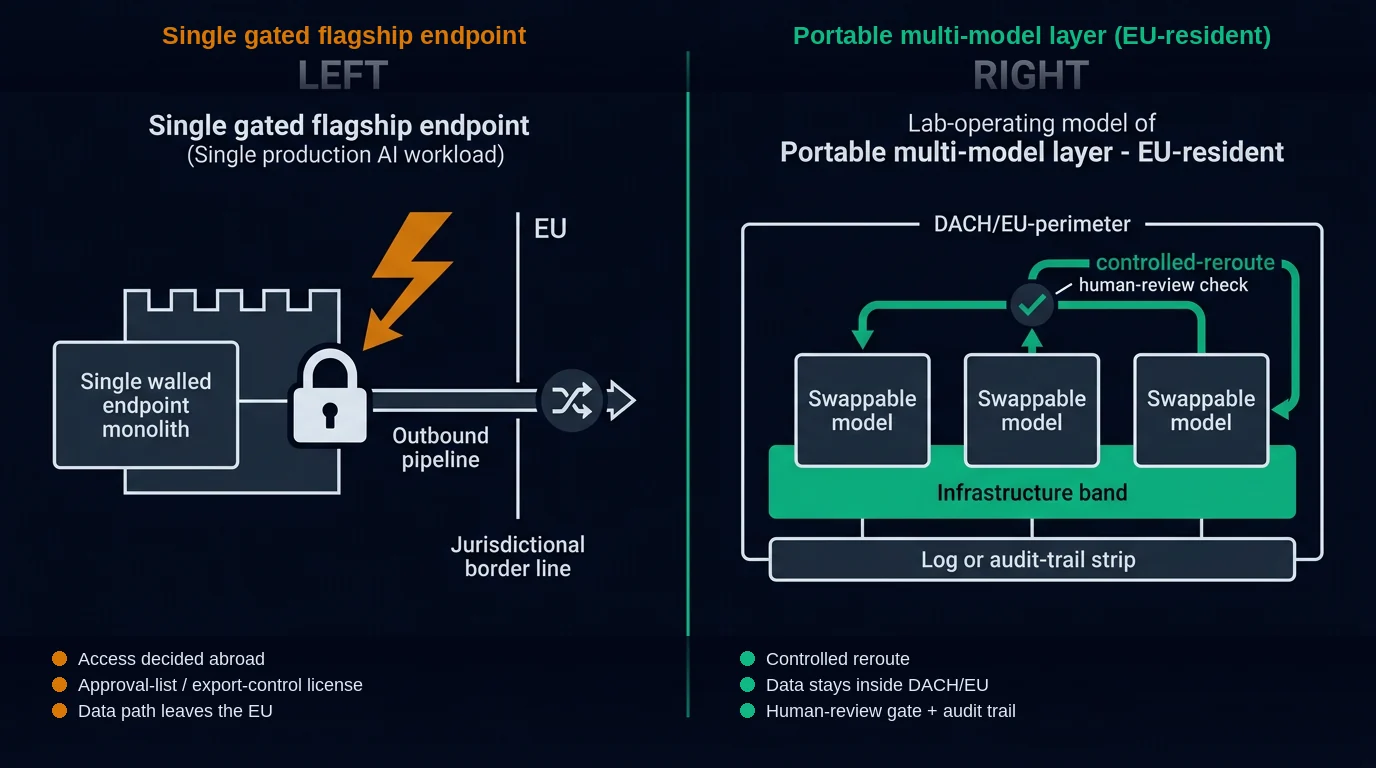
The following comparison summarizes the structural difference:
| Dimension | Single gated flagship endpoint | Portable multi-model layer (EU-resident) |
|---|---|---|
| Control over availability | foreign approval/license decision | internal, rehearsed reroute decision |
| Data path | leaves the EU (transfer impact assessment) | stays inside the DACH/EU perimeter |
| Reaction to access change | re-validation over weeks, data may strand | controlled reroute in hours, with audit trail |
| Compliance evidence | hard to evidence (foreign jurisdiction) | residency proof, logging, approvals |
| Warning time | low, no seat at the table | high, because exit is rehearsed |
AI exit-readiness as a rehearsed, repeated operation
The decisive difference between a one-off migration and genuine resilience is practice. "Exit" is not an emergency button you build and then forget; it is an operational property that fades when it is never rehearsed. A fire drill that has not run in years is no protection.
AI exit-readiness means concretely: a model-switch drill runs regularly — quarterly, say — against owned, versioned evaluations, so a real switch brings no qualitative surprise. Owned evaluations do not travel with the vendor; they are the company's own artifacts and prove that a fallback model meets the production standard. Model-agnostic tooling keeps prompts, tools, and data flows free of hard model assumptions. Human-review governance gates ensure a switch does not happen silently: a named responsible person approves, every change is logged with a reason, and an audit trail records which model version ran when and who corrected what.
This aligns with what already keeps a DACH compliance officer awake. The EU AI Act requires human oversight for high-risk cases; NIS2 expects documented risk management and incident response; the GDPR demands traceability of processing. An EU-resident open-weights layer with a rehearsed switch and a human-review gate is not an extra burden — it is the architecture that operationally fulfills these expectations, as "architecture for compliance readiness", not as a legal or certification promise.
An illustrative SME case: from shock to rehearsed reroute
An illustrative case shows how the dependency dissolves. The same 55-person DACH consultancy from the opening — with no dedicated platform team — decides to take the control point back. Roles involved: Maren, managing director and risk owner; Tobias, CTO of the one-person "platform" function; Sabine, IT-ops lead for the document and support tooling; Yilmaz, compliance officer and data-protection officer.
The sequence follows the Plan/Unfold/Resonate rhythm. In the Plan phase, the exposure is audited: which production workloads hang off the single foreign endpoint? What data flows there? Where is the highest sensitivity and volume? The output is a prioritized list — the document-intake and support workloads are the top candidates because they are sensitive, high-volume, and recurring.
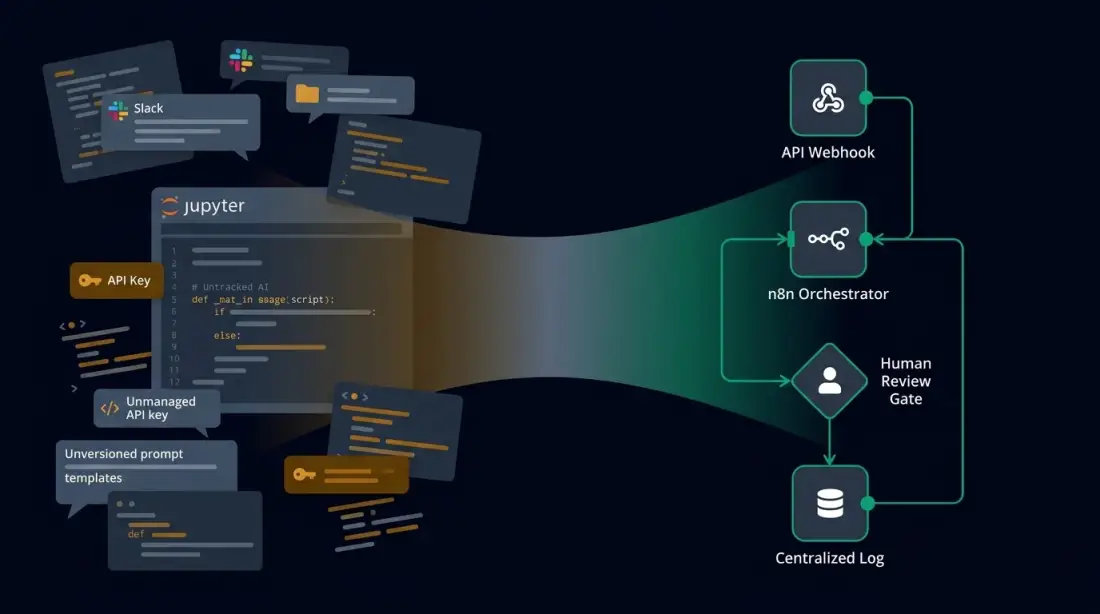
In the Unfold phase, a model-agnostic inference and orchestration layer is installed: EU-resident open-weights (DeepSeek-class, public checkpoints) for the regulated core, orchestrated through n8n with human-in-the-loop approvals. The remaining, less sensitive load still runs through the abstraction layer — but now swappably. A first model-switch drill is rehearsed: Tobias triggers the reroute, owned evaluations confirm quality, Yilmaz signs off at the human-review gate, and the audit trail logs the event.
In the Resonate phase, the shock is a controlled operation. If the foreign access condition does change, the SME reroutes the portable load in hours — not weeks — onto the already-rehearsed EU-resident path. Customer data does not strand, because it never left the DACH perimeter. The operation now has a residency proof, logging, and an exit key. The timings are illustrative ("hours not weeks"), not a measured SLA — the direction of improvement is well-supported, the exact number is operation-specific.
The Planfold perspective: own the control point
Planfold frames AI dependency as infrastructure plus governance, not model choice. The argument follows a clear operating schema: Plan means auditing AI workloads, data flows, sensitivity classes, and residency requirements, and scoring dependencies by risk and volume. Unfold means building a model-agnostic inference and orchestration layer with EU-resident open-weights for the regulated core — Kubernetes-based, orchestrated through n8n, with human-in-the-loop approvals and logged decisions. Resonate means operating with a rehearsed model switch, residency proof, audit trail, and exit key.
The claim is operational and sober: translating a foreign access decision into an internal, audited reroute requires a portable inference layer, EU-resident hosting, and operational discipline (drills, evaluations, human review). Planfold provides that layer — as a natural extension of existing Kubernetes operations, DACH hosting, and n8n-based automation with human approval. Planfold does not sell a model, does not provide legal advice, does not certify compliance, and does not perform security audits. Regulatory topics are handled as "architecture for compliance readiness". The relevant Planfold certifications remain CKA, CKAD, and LFCS; no broader capability or compliance certification is claimed.
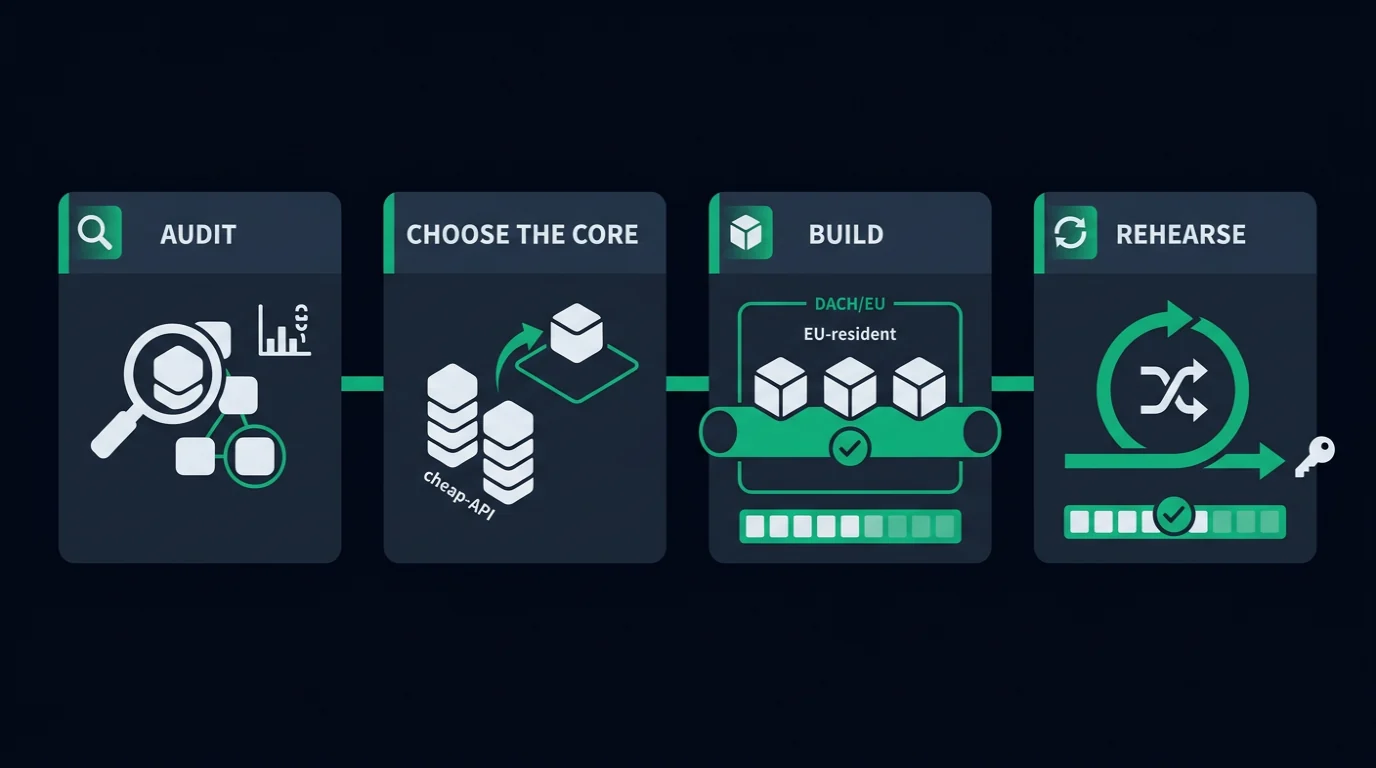
A bounded 90-day starter plan makes this concrete. Weeks 1–2: Audit. Map AI workloads and data flows, score dependencies by sensitivity and volume, name review roles. Weeks 3–4: Choose the core. Pick the sensitive, high-volume, recurring workload as the first candidate for EU-resident self-hosting. Weeks 5–8: Build. Deploy a model-agnostic inference layer with EU-resident open-weights, orchestrated through n8n, with hard cost ceilings, a residency check, and a human-review gate. Weeks 9–12: Rehearse. Run the first model-switch drill, build the audit trail in live operation, and check whether the path scales to a second workload.
Sovereign AI procurement is not a call to avoid AI. It is the answer to a simple question: if a foreign jurisdiction changes your model availability tomorrow, do you have a rehearsed, audited path — or an unrehearsed emergency? If the latter, that is the first workload Planfold lifts onto a controllable layer with you.
Plan. Unfold. Keep the control point.