Off the Migration Treadmill: How SMEs Stop Paying for Vendor-Forced Migrations
Forced migrations are not a one-off. This article shows how SMEs spot vendor lock-in and turn a forced migration into a repeatable redeployment on sovereign, portable infrastructure.

Contents
Forced migrations are not a one-off. This article shows how SMEs spot vendor lock-in and turn a forced migration into a repeatable redeployment on sovereign, portable infrastructure.
Share this article
The Deprecation Notice That Hits a 60-Person SME Without Warning
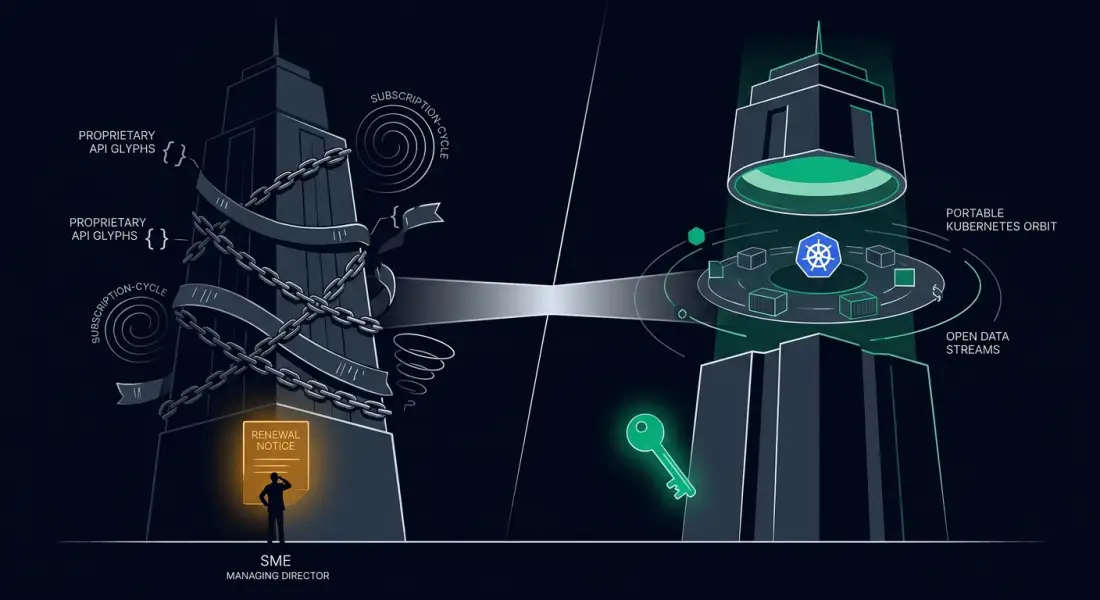
It is an ordinary Tuesday afternoon when the email arrives. Mr. Weber, managing director of a 60-person manufacturing SME, reads it first. The vendor of the ERP and CRM platform that runs production, customer data and analytics announces the retirement of the current architecture. Support ends in nine months. To keep receiving security updates and support, customers must move to the new platform. There is no budget line for the move, no project capacity, and no staffing reserve.
Ms. Lang, the IT lead, assesses the situation plainly: about 1.2 terabytes of production and customer data sit in formats the new platform will not accept one-to-one. Fourteen third-party system interfaces are bound to the old architecture. Mr. Demir, the controller, runs the numbers and finds that an emergency migration would exceed the annual budget for unplanned IT spend. Ms. Vogt, the application developer, knows that every rebuilt interface means weeks of work — and that nobody wrote the old contracts so that operational continuity is provable to customers.
This scene is not a catastrophe on a single day. It is the moment a recurring pattern becomes visible: the company has stood here before, and without different decisions it will stand here again. The question is not whether a vendor will eventually set the rhythm — but how your stack responds when it does.
What the Migration Treadmill Really Is
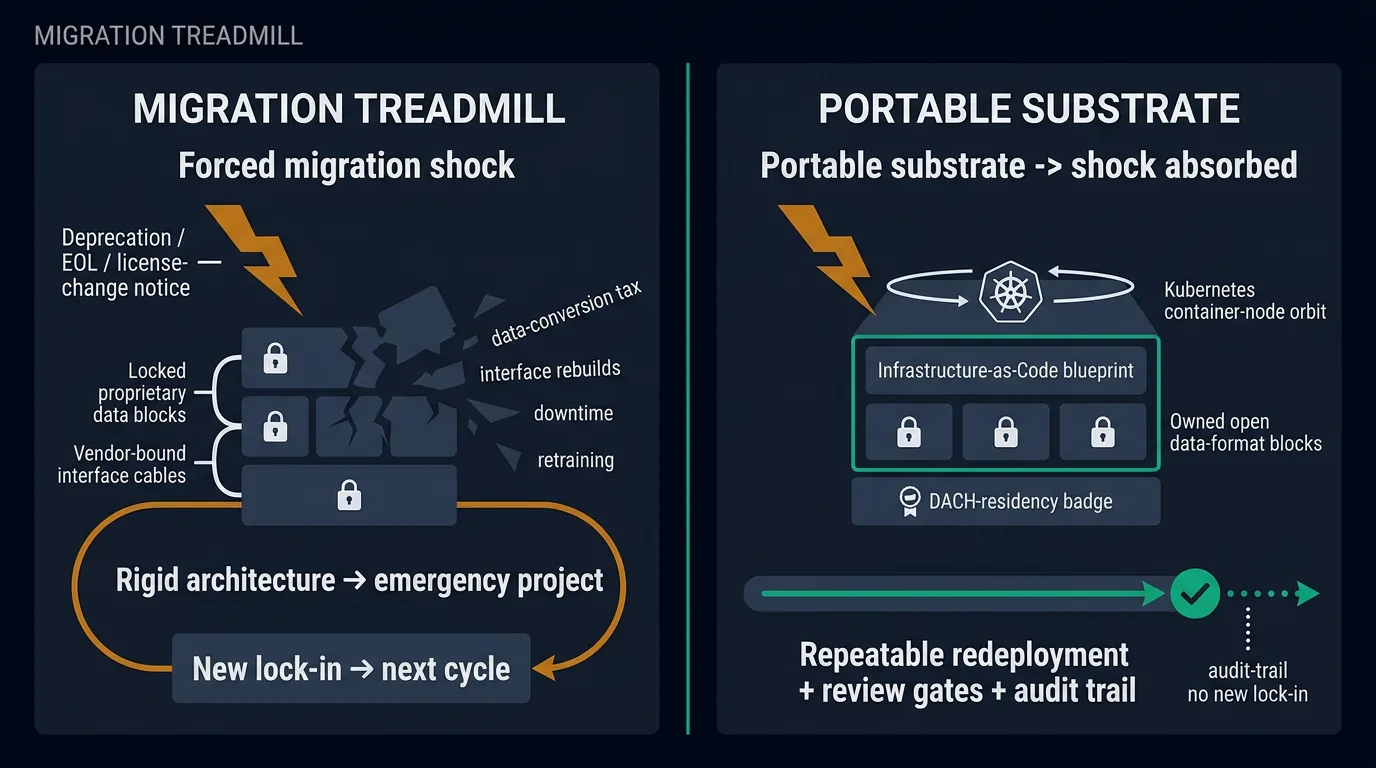
The migration treadmill is the recurring, vendor-driven cycle of deprecation, end-of-life (EOL), license changes, acquisition shutdowns and forced upgrades. It is different from a voluntary, planned exit where you choose the timing and the destination yourself. On the treadmill, the vendor sets the pace. You pay the rework cost — data conversion, retraining, interface rebuilds, downtime — and each forced migration leaves new lock-in that triggers the next cycle.
Three documented events in roughly twelve months show this is not a slip-up but a business-driven, predictable pattern:
- CentOS Linux 7 reached end of life on June 30, 2024. Red Hat defines EOL unambiguously: the product is discontinued, and users must migrate to a new solution to keep receiving updates and security patches. Running EOL software means exposure to unpatched vulnerabilities. A free, widely deployed operating system forced a migration within a fixed window — proof that lock-in is not about purchase price but about operational dependency.
- HashiCorp moved to the Business Source License on August 10, 2023. Products like Terraform, Vault and Consul shifted from a permissive open-source license to BSL, a source-available license with restrictions for competitors. The question became: accept BSL, switch, or leave? The community's answer was the OpenTofu fork under the Linux Foundation — proof the industry was forced to move.
- Redis moved to dual source-available licensing on March 20, 2024. From version 7.4 onward RSALv2/SSPLv1 replaced the BSD license; Redis itself stated that Redis is no longer open source under the OSI definition. Again, Valkey emerged as a Linux Foundation fork, backed by AWS, Google and Oracle.
Two of these three events forced whole communities to fork. This is not a hypothetical threat. It is a recurring, documented pattern.
If you look at these events one at a time, you plan for the last migration. If you see the pattern, you ask a different question: what makes my stack turn a forced migration into a redeployment instead of an emergency project?
Why Forced Migrations Hit SMEs Disproportionately
Large enterprises run migration and portability teams. A mid-sized company with 10 to 100 employees has no such reserve. When the vendor sets the pace, the IT function absorbs the full rework — usually in parallel with day-to-day operations.
The cost spreads across four line items that are rarely itemized:
- The data conversion tax: Every migration requires data to be exported from proprietary formats, reshaped and re-imported. Proprietary formats are the real lock-in — not the license price.
- Interface rebuilds: Every third-party connection bound to a specific API or architecture has to be rebuilt from scratch.
- Downtime and retraining: While the migration runs, operations stall; staff must adjust to new surfaces and processes.
- New dependency: Each forced migration installs the next layer of lock-in that prepares the following cycle.
To make this tangible, consider the illustrative scenario of the 60-person SME from the opening. Without a portable architecture, the nine-month deprecation notice becomes an emergency project with an estimated cost of 90,000 to 150,000 euros for data conversion, interface rebuilds, downtime and retraining — plus unpredictable timeline risk. These figures are an illustrative planning model, not a hard guarantee. The assumptions (staff-days, number of interfaces, data volume) are stated in the scenario so you can adapt them to your own situation.
The decisive point: these costs are not the problem of a single vendor. They are the consequence of an architecture that never built portability in as a property. Falling back to a fork alone — OpenTofu instead of Terraform, Valkey instead of Redis — treats the symptom. The fork exists precisely because the original vendor forced a move. Choosing a fork is itself a migration with its own tradeoffs in compatibility, support and long-term governance.
Four Warning Signs Your Company Is on the Treadmill
Most SMEs feel the treadmill long before they can name it. Four signals reveal that you are paying for a cycle, not a single migration:
1. "Our data lives in the vendor's format"
If an export only works through manual reshaping or expensive consultants, the data model is the lock-in. As long as your data is not in a format you control, you pay the conversion tax at every switch.
2. "The architecture rhythm comes from the vendor"
When security patches or compliance relevance are tied to paid major versions, you do not have a real upgrade decision. You have a forced decision dressed up as a planned investment. There is a difference between planned upgrades (budgeted, scheduled, reversible) and forced migrations (vendor-driven, deadline-bound, leave new lock-in).
3. "We have never practiced our exit"
The vacation test for infrastructure: could you redeploy your workloads to another environment today, without rewriting the application? If the answer is "no" or nobody can answer it, the exit exists only as an assumption — not as a capability.
4. "Nobody knows all the dependencies"
If nobody can sketch on a whiteboard which workloads are bound to which APIs, formats and runtimes, a forced switch is a blind flight. Invisible dependencies are only discovered when they break.
If two or more of these signals apply to you, you do not have a tooling problem. You have an architecture problem: your stack is built so that the vendor decides what a switch costs.
How Sovereign Infrastructure Absorbs the Migration Shock
The technical answer to the treadmill is not a single tool but a substrate that has portability built in: Kubernetes, Infrastructure as Code (IaC), owned data formats and DACH-side data residency. The goal is not to make migration free or instant. The goal is to turn a forced migration from an unpredictable project into a repeatable redeployment with predictable effort, review gates and an audit trail.
The four building blocks and why each one counts:
- Kubernetes portability: Workloads that run as containers with declarative manifests are not bound to a specific data center or vendor. A redeployment means rolling out the same manifest on a different environment — not rewriting the application.
- Infrastructure as Code: What is described as code is reproducible. Servers, networks and configurations can be rebuilt from a Git repository instead of an administrator's memory. IaC makes the infrastructure itself versionable and replaceable.
- Owned data formats: Owning the export and schema control disowns the data model from the vendor. The data conversion tax no longer recurs at every switch because the data lives in a format the company understands and controls.
- DACH data residency: Hosting in the DACH region with documented ownership makes data flows provable for customer contracts and reduces regulatory friction during a switch.
Cloud-native is not an experimental frontier for this. The CNCF annual report for 2024 records hundreds of hosted projects and a broad, mature contributor base, and the CNCF annual survey shows that a substantial share of respondents use cloud-native techniques for nearly all development and deployment. That is the foundation on which a portable redeployment is practically realistic for an SME — not the claim that Kubernetes is only for large enterprises.
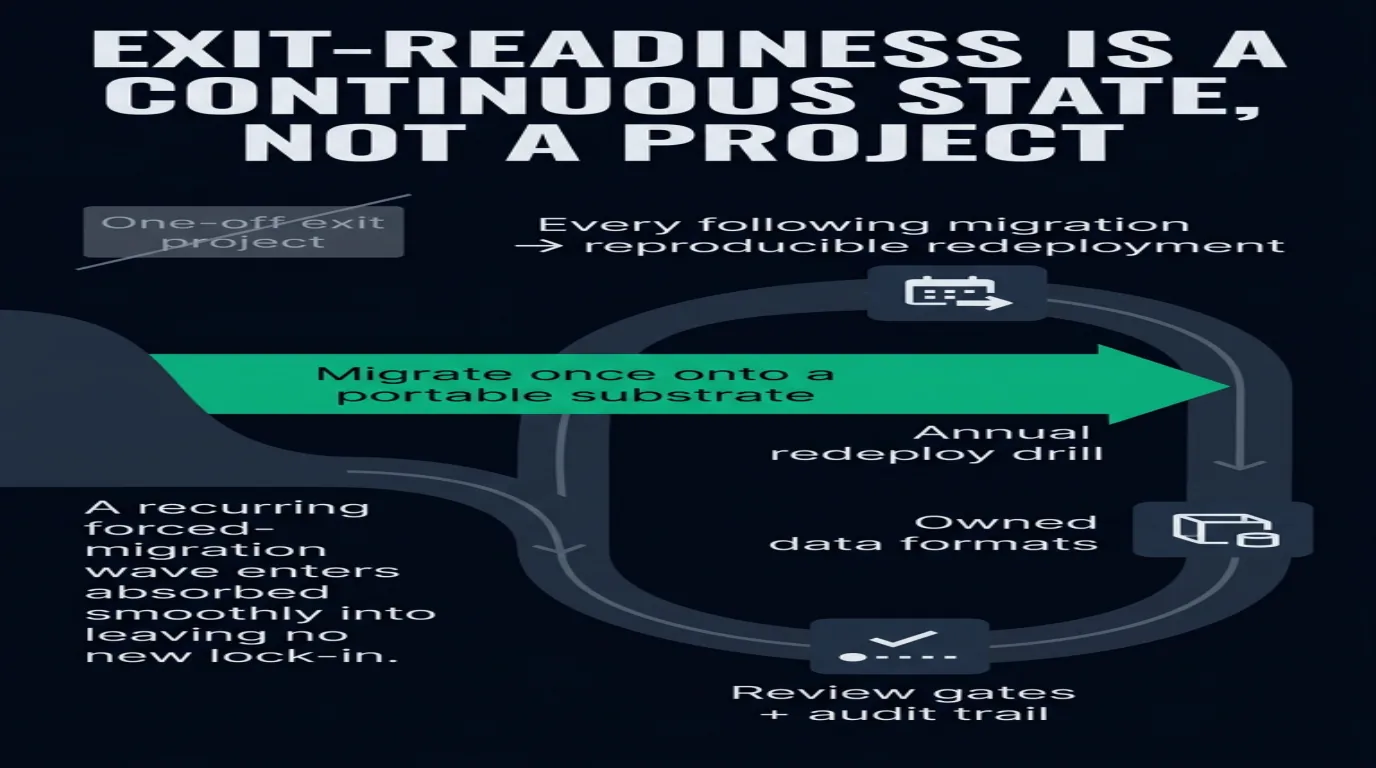
This architecture closes the first objection right away: "Isn't moving to Kubernetes itself a big migration?" Yes — but it is a one-time investment in a portable model, not a recurring forced project. The point is to migrate once onto a portable substrate, not forever. After that, every further forced migration becomes a reproducible redeployment.
Exit-Readiness as a Continuous State, Not a One-Off Project
Many SMEs treat exit as a project you start in an emergency. That is exactly the assumption that keeps the treadmill running. Exit-readiness is only a real capability when it becomes a measurable, recurring operational property — not a hope in the contingency plan.
Three practices make the difference between "we could theoretically exit" and "we proved the exit this quarter":
- Redeploy drill: At least once a year, a workload is actually rolled out to an alternative environment. Skip the drill and you discover the gaps only under pressure.
- Data format ownership: There is a documented schema and a practiced export that works without the vendor.
- Review gates and audit trail: Every redeployment passes through defined approvals and is logged. That makes portability auditable — for internal governance and for customer contracts that demand operational continuity.
For the 60-person SME from the opening this means: instead of the nine-month emergency migration, Ms. Lang reviews a portability score quarterly — which workloads are redeployable today? Mr. Demir holds a documented export path for the core data. Mr. Weber approves the annual redeployment drill as a budget item, not as a reaction to a deprecation notice. Ms. Vogt keeps the interfaces as code, not as isolated solutions. A forced migration becomes an effort with a known risk profile — and leaves no new layer of lock-in that triggers the next cycle.
The Planfold Lens: Sovereignty Instead of Ever-New Migrations
Planfold frames the migration treadmill as a recurring operational risk and capital drain — and sovereignty as the cost-control mechanism that turns a catastrophic forced migration into a routine redeployment. Our methodology follows three technically defined phases:
Plan means auditing the technical debt and architecture. We map which data sits in proprietary formats, which workloads are already portable and which dependencies would break on a switch. The result is not a theoretical landscape but a prioritized list of concrete exposures.
Unfold means building systems and delivering infrastructure: a vendor-neutral Kubernetes and IaC substrate, owned data formats, DACH-side hosting standards. The implementation follows recognized standards; our Kubernetes teams are CKA- and CKAD-certified, complemented by LFCS. That is a Planfold service, not a headcount you have to hire.
Resonate means stable operations with observability, recurring redeployment drills and measurable exit-readiness. A system that runs is not finished — it needs an owner who continuously secures its portability.
The honest boundary: sovereign infrastructure does not eliminate every dependency — it reduces it systematically. Lock-in is mitigated, not magically removed, and choosing a fork remains its own migration decision. But when the next vendor sets the rhythm, your answer is a tested redeployment — not an unbudgeted emergency project.