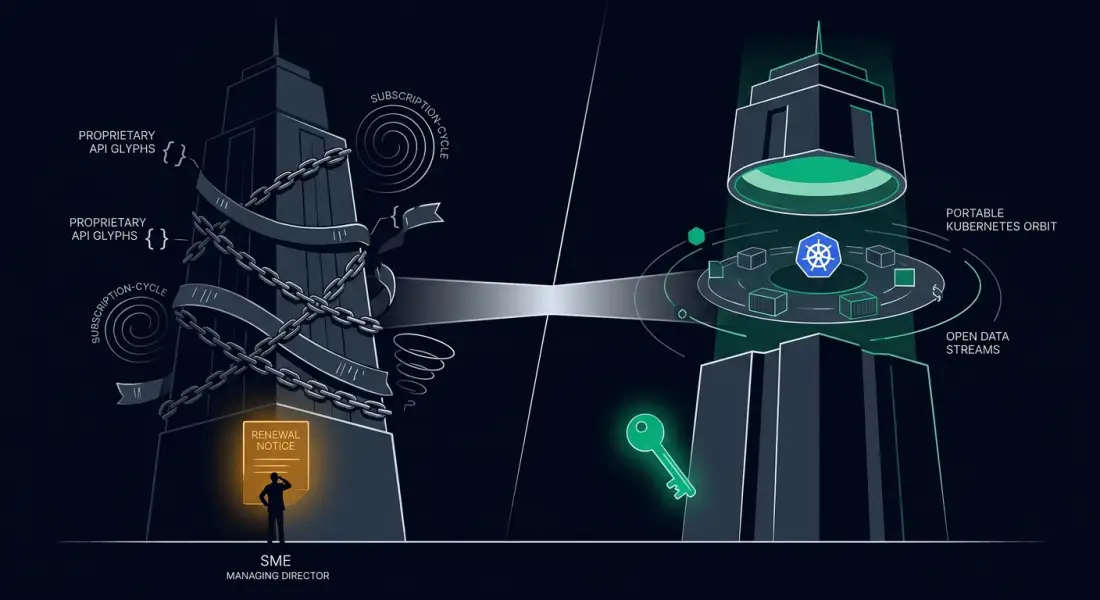
The 2026 Subscription Inflation: How SMEs Exit the Legacy SaaS Price Spiral
On July 1, 2026, per-seat office-suite pricing rises again — and Broadcom/VMware add a 20% late-renewal penalty on top. Here is how SMEs turn the hike into the trigger for a sovereign exit path.

Contents
On July 1, 2026, per-seat office-suite pricing rises again — and Broadcom/VMware add a 20% late-renewal penalty on top. Here is how SMEs turn the hike into the trigger for a sovereign exit path.
Share this article
The invoice that climbs every year
Markus, head of finance and controlling at a 48-employee production SME, opens the announced price increase for the office suite on a Wednesday in June 2026. The effective date: July 1, 2026. Next to it sits an email from a Microsoft partner with the subject line "Lock in current rates by June 30" — renew now and keep the old rate for one more year. 48 knowledge-worker seats, an established identity and document landscape, several years of shared file history. A week later, Andrea, the managing director, asks Markus what the increase "really" means. Markus answers honestly: "This year, not a mid-five-figure amount — but the line goes up every year from here, and every switch gets more expensive, not cheaper."
This moment is not an exception. It is the normal renewal event of a DACH SME in early summer 2026. Microsoft published the new commercial price list for Microsoft 365 and Office 365 on February 16, 2026, giving roughly seven months of lead time. The obvious response — negotiate, consolidate seats, hopefully lock in the old rate — is correct in the short term and deficit in the long term. The 2026 hike is not an isolated vendor move; it is part of a converging licensing-reset wave that hits two independent cost lines: the office suite per seat and the virtualization/infrastructure license per host. Anyone who simply waits out the wave pays it again every year — and loses bargaining power in the process, because data, identity, and workflows sit deeper in the incumbent with every passing year.
This article translates that renewal event into three steps: an honest, SME-scaled reckoning; a pragmatic lock-in self-check; and a phased exit path (Plan → Unfold → Resonate) that turns the price hike into the occasion to pilot a single workload under sovereign control — instead of renewing in panic on June 30 and swallowing the next increase a year later.
Why 2026 is structurally different
If you look at individual vendor increases in isolation, you miss the pattern. In 2026 the office-suite hike is not an island; it is part of a licensing-model change arriving simultaneously at Oracle, Broadcom/VMware, and Microsoft. Block64 named this convergence "the 2026 Licensing Reset" in March 2026 — and for SMEs the structural significance is heavier than any single price list.
The hike is a wave, not an incident
Three vendors are moving in the same direction at the same time: away from flat and perpetual licenses, toward per-employee or per-seat subscriptions with narrower negotiation room. Oracle has moved Java SE from a named-user/processor model to an employee-based subscription — cost now tracks headcount, not Java usage. Broadcom/VMware has discontinued perpetual licenses entirely and consolidated the portfolio into VMware Cloud Foundation (VCF) subscription bundles, with mandatory three-year terms. In parallel, Microsoft raises commercial list prices on M365/O365 suites and several adjacent products effective July 1, 2026. Read these three items as one and the structural point becomes clear: the old negotiation play — "bargain harder at renewal" — is running out of room.
Per-Seat, Per-Employee, Per-Renewal: the new licensing model
The table below shows the verified Microsoft commercial price-list deltas for suites with Teams, effective July 1, 2026 — quoted from the primary vendor source. EUR figures are illustrative conversions at ~0.92 EUR/USD and carry the "Illustrative" label, because DACH list pricing, EA discounts, and FX vary.
| SKU | Old (USD) | New (USD) | Change | Illustrative EUR/seat/month Δ |
|---|---|---|---|---|
| Office 365 E3 (with Teams) | $23.00 | $26.00 | +13% | ~+€2.76 |
| Office 365 E5 (with Teams) | $38.00 | $41.00 | +8% | ~+€2.76 |
| Microsoft 365 E3 (with Teams) | $36.00 | $39.00 | +8% | ~+€2.76 |
| Microsoft 365 Business Basic | $6.00 | $7.00 | +16% | ~+€0.92 |
| Microsoft 365 Business Standard | $12.50 | $14.00 | +12% | ~+€1.38 |
| Microsoft 365 Apps (standalone) | $12.00 | $14.00 | +17% | ~+€1.84 |
| Windows E3 | $6.63 | $7.63 | +15% | ~+€0.92 |
| Entra Plan 1 | $6.00 | $7.00 | +16% | ~+€0.92 |
| EMS E3 | $10.60 | $12.00 | +13% | ~+€1.29 |
[Illustrative conversion at ~0.92 EUR/USD; DACH list pricing, EA discounts, and FX vary. Standalone Microsoft Teams and Copilot are explicitly excluded from this increase. Suites without Teams increase at different rates — name the exact variant when in doubt.]
Two readings matter. First: the percentages sound small, but they are per seat and recurring — and they stack with the second cost line, the VMware reset, into a structural amount. Second: for existing customers the increase does not apply automatically on July 1; it applies at their next renewal. Microsoft confirms this explicitly in the official FAQ.
The June 30 trap: time pressure as a sales instrument
The "Lock in current rates by June 30, 2026" window is a procurement instrument for resellers and customers whose renewal falls within the next twelve months — not a free freeze for everyone. AppDirect documented the mechanism for partners at the end of May 2026. The honest framing for Andrea and Markus is: anyone renewing in the next twelve months can preserve old pricing for one year by binding early; anyone mid-term sees the hike at their next renewal. The trap is not the window itself but the time pressure that prevents a strategic alternative (a piloted exit) from being thought through at all. That June 30 pressure is exactly the newsjacking trigger for this article.
What the hike actually costs your SME
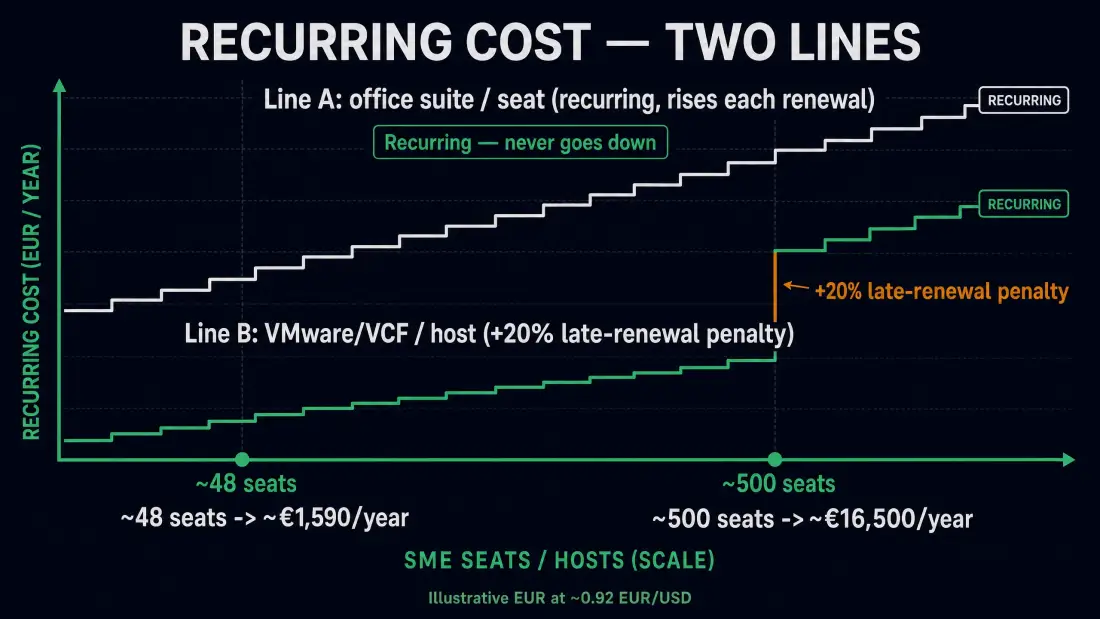
The percentage table is not the bill. The bill is the sum of three effects that look manageable in isolation and together erase the negotiation room: a recurring cost line that never goes down; a lock-in multiplier that makes each renewal harder to refuse; and a missing internal owner who absorbs the increase by default.
The €/year line that never goes down
At 48 Office 365 E3 seats (with Teams), the verified +$3/seat/month delta produces an annual increase of 48 × $3 × 12 = $1,728/year ≈ [Illustrative] €1,590/year — and not once, but at every renewal, trending upward. Scaled to a 500-seat scenario, that becomes 500 × $3 × 12 = $18,000/year ≈ [Illustrative] €16,500/year, recurring. Frontline seats add to this: Microsoft 365 F3 rises +25% ($8 → $10), F1 even +33%. In a production firm with shift staff these are not edge cases. The EUR figure is intentionally labeled illustrative, because DACH list pricing, EA discounts, and FX vary — but the mechanic (per seat, recurring, annually rising) is verified.
This single cost line is not the whole story. In parallel, the VMware/VCF reset hits the same firm on a second, independent line: per host or core instead of per seat, with mandatory three-year terms and — the structural lever — a 20% retroactive late-renewal penalty if a renewal misses its anniversary date. Acronis and Trilio documented this mechanic independently in 2026. A single missed renewal term on six hosts can exceed the entire year's office-suite hike. Read the two lines together and it becomes clear why 2026 is structurally different from an ordinary price increase.
The lock-in multiplier
The price hike is not the price of the software — it is the price of leaving. Shared documents, permission groups, mail history, the 3–4 workflow integrations (quote creation, approval, archive), and the identity layer all live in the incumbent. With every year the data gravity grows; with every new integration the coupling grows. The next increase is therefore not easier to refuse but harder — because the switching-cost stack has grown in the meantime. This is not a side effect of the business model; it is its mechanism: the recurring bill is priced against the wall that stands around data ownership, not against the value of the software.
The missing internal owner
Andrea asks Markus who in the company owns the exit. The honest answer: no one. Daniela, IT administrator on a part-time contract, runs identity, mail, file storage, and the few integrations — she has no capacity to own a migration roadmap on top. Herr Yildiz as head of sales needs working collaboration and CRM connectivity, not a pilot project. In an SME without a platform team the bill wins by default, because there is no internal owner who can even think an alternative. That vacuum is exactly what makes the converging 2026 wave so effective: it does not need to convince everyone, it just needs to wait until no one objects.
The lock-in self-check: how deep are you really in
Before you move a workload, you need to map honestly how tightly you sit. Three signals say more than any contract analysis: data gravity, identity/workflow coupling, and the hidden switching-cost stack.
Data gravity
How many years of shared file history live in the incumbent? How many shared documents, permission groups, and versioned files are actively referenced in workflows? At this 48-employee production SME, it is several years of history in a single shared drive. Data gravity is not measured in GB but in active references: a five-year-old quote that still serves as a template today is heavier than 500 GB of archive that no one opens. The first lever is not migration but triage: which data is alive, which is cold.
Identity and workflows
Identity is the most invisible coupling. When the incumbent's identity provider is effectively the company's SSO — mail, CRM, file storage, the 3–4 workflow integrations all authenticating against it — an office-suite migration is in truth an identity migration. At this company the quote-creation flow runs over an n8n-style pipeline with approval and archive steps; these integrations are not disposable. An honest lock-in map lists not only "which tools" but "which workflows hang on which identity" — and which of them could move without an identity migration.
The hidden switching-cost stack
The switching-cost stack is the sum of things no one thinks about until it is too late: external shares bound to incumbent accounts; macros and formulas optimized for a specific client version; collective training memory; support processes; backup and compliance evidence that leans on vendor history. This stack grows silently and is visible in no budget line. Map it before the decision and you act; discover it on migration day and you react.
The sovereign exit path
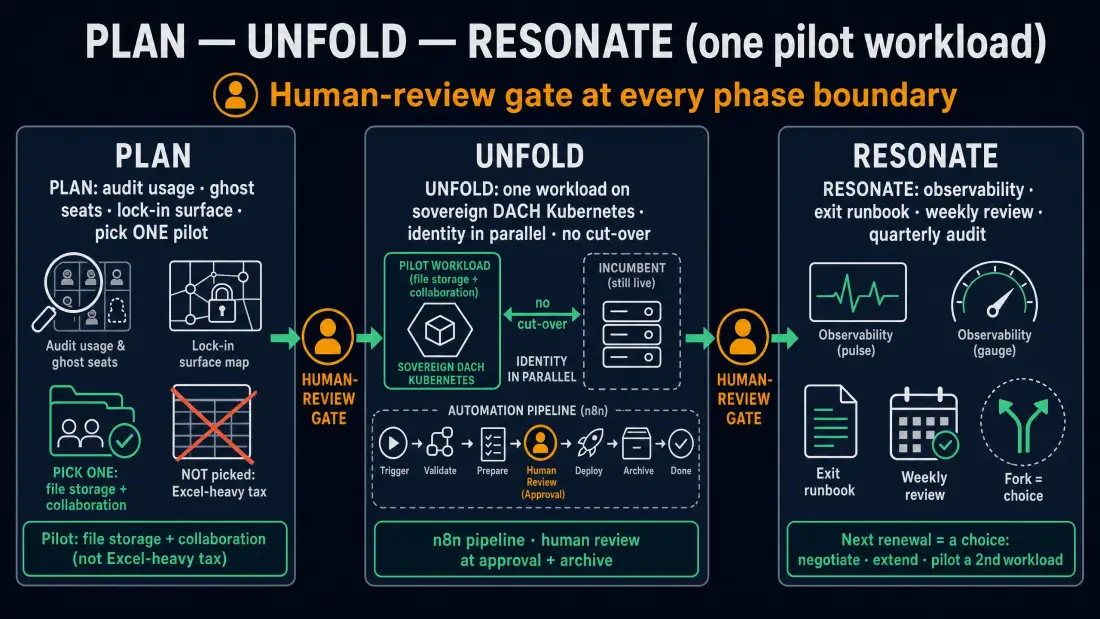
In 2026 sovereignty is not a slogan but an architecture decision that the price hike makes financially urgent. The pragmatic answer is not a big-bang exit but a phased path with human-review gates at every critical step.
Plan — audit real usage and lock-in surface
In a one- to two-week Plan phase, Daniela and Planfold map real usage together: ghost seats, underused SKUs, frontline-vs-knowledge-worker distribution, and — the decisive point — the lock-in surface per workload. The output is not an abstract risk list but a prioritized pilot workload with the lowest switching cost and the highest leverage. File storage and collaboration are typically better candidates than Excel-heavy tax or production systems — the lock-in there is deeper and the fault tolerance lower. The audit also separates the two cost lines (office suite per seat vs. VMware/VCF per host) so the decision is not blurred together.
Unfold — pilot one workload
Unfold pilots a single workload on a mature, self-hosted or open-source alternative behind a sovereign, DACH-hosted Kubernetes platform. Concretely that can be Nextcloud (file storage and collaboration) with Collabora or ONLYOFFICE for document editing. Mature, commercially operable alternatives exist in 2026: Nextcloud Workspace by IONOS has been available as a DSGVO-compliant, Germany-hosted product since November 2025; openDesk (ZenDiS) bundles Nextcloud, Collabora, OpenProject, XWiki, Element, and Jitsi into a sovereign workplace suite; Collabora, ONLYOFFICE, CryptPad, and eXo are commercially established, not experimental. The identity migration runs carefully and in parallel to the live incumbent — no big-bang, no cut-over. At every approval and archive step of the workflow migration a human-review gate sits in the loop, controlled by an n8n pipeline.
Resonate — operate with observability and a runbook
Resonate operates the pilot workload with observability, patching, and a documented exit runbook. Weekly review with Andrea and Daniela; quarterly sovereignty audit. The goal is not to switch off the incumbent overnight but to turn the next renewal into a choice: negotiate, extend, or pilot a second workload — from a position of ownership, not dependency. That ownership effect is the durable gain; cost reduction is a side effect that pays off later depending on seat count and workload.
An SME scenario with numbers
[Illustrative scenario — composite pattern for a DACH Mittelstand firm, not a verified single case. EUR figures are illustrative conversions of the verified USD list-price deltas at ~0.92 EUR/USD; DACH list pricing, EA discounts, and FX vary.]
Before: more expensive every year
The 48-employee production SME runs ~48 knowledge-worker seats on an Office 365 E3 suite (with Teams) and 6 hypervisor-bound hosts under a legacy VMware model. The 2026 wave hits both lines: +$3/seat/month on the office side ([Illustrative] €1,590/year, recurring) and a structural VMware reset with 20% late-renewal-penalty risk. Add 3–4 workflow integrations with several years of shared file history. Daniela runs all of it part-time; there is no platform team and no internal owner for the exit.
After: one workload under your control
After a two-week Plan phase, the company pilots file storage and collaboration on Nextcloud behind a DACH-hosted Kubernetes platform; Collabora handles document editing. Identity migrates in parallel; the incumbent keeps running for now. n8n drives the workflow migration with human review at approval and archive steps. A weekly review with Andrea and Daniela tracks the pilot workload against a documented exit runbook. The result is not an ideological big-bang but a conscious dependency: at the next renewal Andrea can negotiate, extend the pilot, or keep the incumbent for the workloads where it still makes economic sense — from a position of ownership.
An honest boundary must be stated plainly: a City of Zurich study (Competence Center for Digitalization + Bern University of Applied Sciences, presented in May 2026) found openDesk in that context to be not yet a full Microsoft 365 replacement and more than twice as expensive there as comparable M365 packages. The Schleswig-Holstein migration also ran from older on-premise Office, not modern M365. The conclusion is not "open source is always cheaper" — it is: a single workload under your own control stops the recurring spiral for exactly that workload and delivers sovereignty plus operational ownership as durable gains. Cost parity per seat is context-dependent and currently sometimes worse. Communicate that honestly and you avoid the next lock-in.
How Planfold turns the exit into the first delivery asset
At Planfold we treat the exit not as an emergency procedure but as the first, tangible delivery asset. Our method follows three technically defined phases that connect to the scenario above.
Sovereignty line: DACH hosting and Kubernetes
The pilot workload runs on a sovereign, DACH-hosted Kubernetes platform — open, portable, operated under CKA/CKAD/LFCS-certified engineering (these three certifications are the only ones we use for this claim). Server location alone is not enough: under US ownership the US CLOUD Act applies regardless of physical server location. Sovereignty comes from control over the vendor jurisdiction and the operations layer, not from geography alone. The Kubernetes platform abstracts the hypervisor and turns the second cost line (VMware/VCF) into a negotiation question, not an existential one.
Automation: controlled migration with human review
Every workflow migration runs through an n8n-controlled pipeline with human-review gates at every approval and archive step. Automation at Planfold does not mean "without a human" but "with a controlled human" — the review point is documented, the audit trail traceable. That difference is exactly what makes a migration responsible in an SME without a platform team: Daniela signs off on data migration and identity takeover, not a script.
Operations: observability and a documented exit runbook
Resonate means stable operations with observability and a documented exit runbook. The exit runbook is not for emergencies but for the next negotiation: when Andrea sits at the next renewal she has a documented alternative in hand, not an empty threat. Quarterly sovereignty audits keep the evidence current.
Your next step before June 30
June 30, 2026, is not a deadline where you lose everything without a reset. It is the rare moment when strategic alternatives become thinkable at all, because otherwise time pressure produces only the renewal. Three decisions should be made before renewal.
The three decisions before renewal
Pick one workload and pilot it
The concrete starting point is a two-week audit: real usage, ghost seats, lock-in surface per workload, and the selection of a single pilot workload with the lowest switching cost. The audit is not a commitment to migrate — it is the precondition for being able to think an alternative at all. Let June 30 pass without starting the audit in parallel and you push the increase out by twelve months and lose the window in which ownership is even negotiable.
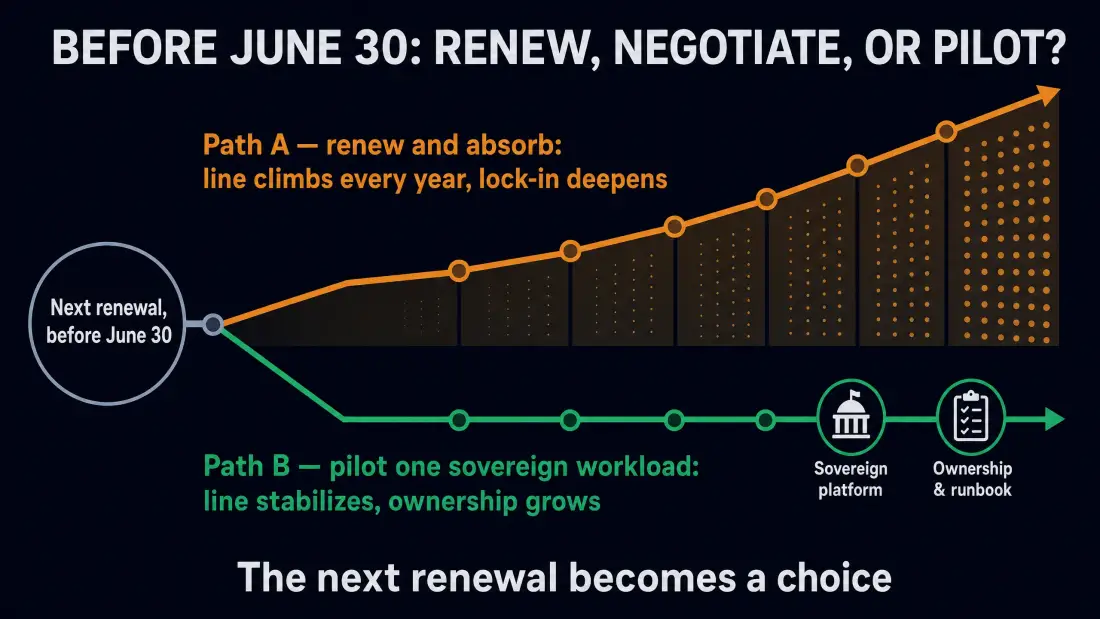
Treat the 2026 price increase as an occasion, not a fate. Start with a sovereignty audit: Planfold maps your real usage, the lock-in surface, and a first workload that you bring under your own control on a sovereign, DACH-hosted platform — before the next renewal comes due.
Plan. Unfold. Resonate.