Cloud Bill Shock: Why Your Monthly Invoice Keeps Climbing
Your cloud bill did not explode because cloud is inherently bad. It exploded because nobody designed your stack around ownership, visibility, and operational control.

Contents
Your cloud bill did not explode because cloud is inherently bad. It exploded because nobody designed your stack around ownership, visibility, and operational control.
Share this article
The Invoice That Ends the Illusion
The finance lead opens the monthly invoice and immediately sends a screenshot into the management chat.
"Can someone explain why cloud spend is up another 27%?"
Nobody can answer the question cleanly.
Engineering says usage increased. Operations says the new analytics platform was necessary. Marketing says the customer data tooling was approved months ago. The external partner who set up the latest automation stack says the higher bill is normal once a company starts to scale.
That is usually the moment a business realizes it does not actually have a cloud strategy. It has a purchasing history.
Cloud bill shock rarely appears as one dramatic mistake. It shows up as dozens of reasonable decisions made in isolation. One more managed database because it was faster. One more SaaS platform because procurement was easy. One more premium support tier because the team did not want to risk downtime. One more environment that nobody dared to shut down.
Each decision looked small. Together they created a stack that became expensive to run, difficult to understand, and hard to leave.
This is the real problem: rising cloud spend is usually not a pricing problem first. It is an architecture, ownership, and operating-model problem. If nobody owns the full system, the invoice becomes the first place where the damage is visible.
Why the Problem Looks Harmless at First
Cloud spending almost always starts as a story about convenience.
You want the team to move faster, so you buy a managed service instead of operating one yourself. You want less friction, so you add SaaS tools with built-in integrations. You want reliability, so you accept premium pricing in exchange for someone else carrying the operational burden.
On day one, this feels rational. In many cases, it is rational.
The problem is that convenience compounds faster than governance. Most companies do not add one cloud cost layer. They add many:
- infrastructure spend in AWS, Azure, or Google Cloud
- seat-based SaaS subscriptions across departments
- automation tooling priced per run, user, or workflow volume
- observability, backup, and security add-ons
- contractor or agency dependency to keep the whole system understandable
At first, the cost curve hides inside growth. Revenue is climbing. Headcount is increasing. New systems are being introduced. Nobody wants to be the person blocking speed over a few hundred extra euros a month.
Then the stack crosses a threshold.
What began as helpful outsourcing turns into operational dependence. The company is no longer paying only for software. It is paying for architectural drift, duplicated capabilities, fragmented data, and decisions nobody revisits.
That is why cloud bill shock feels sudden even when it has been building for a year.
Where the Money Actually Goes
When leaders say, "Our cloud costs are too high," they often mean something broader: the entire digital machine costs more than expected and delivers less control than promised.
The visible invoice is only part of the cost model. The hidden part sits in duplicated tools, unused capacity, operational friction, and weak ownership boundaries.
| Symptom | Root Cause | Business Impact |
|---|---|---|
| Monthly invoice keeps rising | No architecture review as tools and workloads accumulate | Budget uncertainty, reactive cuts instead of deliberate planning |
| Teams buy overlapping tools | Department-level optimization with no system-level ownership | Duplicate spend, inconsistent workflows, fragmented data |
| Nobody knows what can be removed | Weak inventory, unclear dependencies, poor documentation | Paying for fear, not value |
| Premium managed services everywhere | Convenience chosen by default without lifecycle review | High recurring costs, low leverage |
| External partner remains essential | Knowledge and access live outside the business | Exit risk, slow decisions, vendor dependency |
| Cloud migration promised flexibility | Applications were moved without redesign for portability | New monthly bill, same old lock-in |
There are usually five big cost buckets hiding behind the headline number.
1. Duplicate capability
Three teams use three different tools to solve variants of the same problem: project management, reporting, file storage, automation, internal knowledge, customer messaging. The spend looks reasonable when examined per team. It becomes irrational when examined as a system.
2. Idle or forgotten infrastructure
Old environments survive because nobody wants to break something. Staging databases keep running long after the project ended. Snapshots accumulate. Logs are retained for far longer than anyone actually needs.
3. Managed-service layering
You are not just paying for compute. You are paying for managed databases, managed networking, managed observability, managed secrets, managed CI, managed backups, and often a separate SaaS around each one. Every layer reduces local effort. Every layer adds recurring spend.
4. Pricing power you handed away
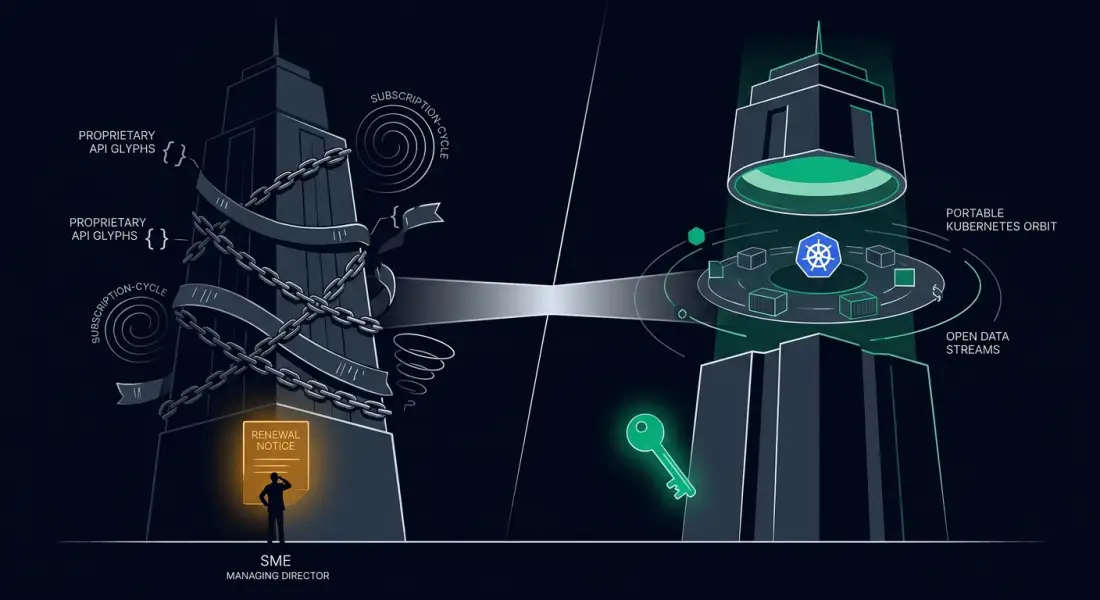
Once your workflows, permissions, integrations, and data flows depend on a platform, the vendor gains leverage. Seat prices rise. Usage thresholds shift. Features move into higher tiers. Leaving becomes expensive, so staying looks easier.
5. Operational drag
The team spends time explaining invoices, investigating usage spikes, tracing old dependencies, and asking who owns what. That is not cloud spend on paper, but it is absolutely cost in practice.
The bill is not just expensive. It is expensive in a way that weakens decision-making.
A Realistic Scenario: The 65-Person Company With No Clear Map
Consider a 65-person professional services company. Nothing exotic. They use Microsoft 365 for collaboration, AWS for customer-facing systems, a managed database, two analytics products, a CRM, a customer support suite, and a handful of automation workflows built over time by a mix of internal staff and outside contractors.
Twelve months earlier, the total monthly digital operating bill was manageable. Now it is 38% higher.
Nobody panics at first because each increase had a story behind it:
- a new client portal needed better infrastructure
- the sales team upgraded the CRM tier
- support added a premium package for advanced routing
- observability costs increased because more logs were retained
- automation runs grew as more processes were connected
Then the company tries to cut costs and runs into a wall.
They discover a reporting workload still running on oversized instances long after a one-off project ended. They find two automation products doing similar work because one department preferred a no-code SaaS tool and another used a contractor-built stack. They learn that the external analytics vendor stores historical exports in a way that makes migration awkward and time-consuming. They realize the AWS bill includes data transfer patterns no one has reviewed in months.
The biggest surprise is not technical. It is organizational.
The people closest to the spend only understand their own slice of it. Finance sees invoices. Department heads see tool value. Engineering sees implementation details. Nobody sees the whole machine.
That is what cloud bill shock really looks like in a mid-sized company: not one bad platform, but a collection of local optimizations with no central architecture discipline.
Why Architecture Determines Cost More Than Pricing
Leaders often negotiate harder when bills climb. Negotiation can help, but it usually addresses symptoms. Architecture determines whether your costs stay understandable or become structurally unstable.
The Pricing Trap
Most cloud and SaaS vendors use pricing models that expand quietly with growth.
Seat-based pricing grows with headcount. Usage-based pricing grows with customer activity. Managed platforms charge for convenience at every layer. Premium support gets attached because nobody wants to own risk internally. By the time the monthly bill becomes a board-level topic, the underlying dependencies are already embedded.
This is why cloud cost reviews fail when they focus only on discounts. A 10% reduction on the wrong architecture still leaves you with the wrong architecture.
The Ownership Trap
The harder problem is ownership.
Who owns the integration map? Who knows which workloads are business-critical? Who can explain why a system exists, what data it holds, and what would happen if you turned it off? Who has the credentials, access policies, and deployment knowledge needed to move it somewhere else?
If those answers live partly with vendors, partly with former employees, and partly in undocumented habits, then cost is no longer just an accounting issue. It is a sovereignty issue.
That is when the invoice becomes dangerous. You are paying every month for a system you do not fully control.
The practical consequence is predictable:
- tools stay because removal feels risky
- vendors stay because migration feels impossible
- costs rise because nobody can challenge the full stack with confidence
Architecture matters because it decides whether your business has an exit key or just a recurring bill.
The Technical Deep-Dive: How Cost Compounds Inside the Stack
If you look closely, cloud bill shock usually comes from interaction effects between layers, not from one single expensive service.
What a Cost-Controlled Stack Looks Like
This is the difference between an unmanaged cloud estate and a cost-aware one.
Unmanaged Cost Sprawl
├── Compute sized for peak load all month
├── Managed database tiers chosen once and never reviewed
├── Cross-region traffic and egress charges nobody tracks
├── Observability collecting everything forever
├── SaaS automation priced per run with duplicated workflows
├── Backup snapshots retained without policy discipline
└── External experts required to explain the environment

Cost-Controlled Architecture
├── Workloads mapped by business criticality
├── Environments sized and scheduled deliberately
├── Data transfer reviewed as a first-class cost factor
├── Log retention tied to operational and compliance needs
├── Automation centralized where possible
├── Shared services chosen intentionally, not by habit
└── Access, documentation, and ownership kept inside the business
Cost control is not a single tool. It is a set of engineering choices.
Compute: Many teams provision for worst-case traffic and forget to revisit the decision. Rightsizing, environment scheduling, and workload classification matter more than one-off savings campaigns.
Storage and backups: Object storage looks cheap until retention, replication, snapshots, and old exports pile up. Backup discipline is architecture discipline.
Data transfer: Egress, inter-service traffic, and cross-region communication are easy to ignore because they do not feel like "real infrastructure." They still hit the invoice every month.
Managed services: Managed databases, managed queues, and managed observability can be excellent choices. The mistake is treating every operational burden as something to outsource forever, even after the workload is stable and well understood.
Automation layers: Workflow tools are often cheap until they become critical. Then pricing scales with activity while reliability expectations rise. If the workflows are now part of core operations, they need the same ownership discipline as application code.
Observability and security tooling: Logging everything, retaining everything, and piping data into multiple systems can create huge cost overhead without improving operational clarity. Visibility is valuable. Undirected visibility is expensive noise.
This is why business leaders need technical clarity. You cannot govern the bill if you do not understand the stack layers that generate it.
The Better Alternative: Convenience With an Exit Key
The answer is not to rebuild everything on your own servers next month. The answer is to design for controlled dependence.
That means asking a different set of questions:
- Which systems create real competitive value?
- Which ones are commodities that can stay managed?
- Which workloads need portability because the cost or dependency risk is too high?
- Which tools only exist because no one ever consolidated them?
- Which parts of the stack should stay care-free, but with clear ownership and documentation?
This is the distinction many teams miss. A care-free package is useful. Somebody should handle updates, security, backups, and routine operations. But convenience is only healthy if you preserve the title deed to the system and keep the exit key.
That changes the architecture conversation completely.
You no longer ask, "Can we outsource this?"
You ask, "If we outsource this, do we still keep visibility, portability, and operational leverage?"
Some systems will stay on managed platforms. That is fine. Some will be consolidated into fewer services. Some should be repatriated or rebuilt in a more portable way. The point is not ideology. The point is deliberate control.
How to Evaluate What Stays, What Goes, and What Must Be Reclaimed
Once you stop treating the bill as a mysterious number, you can evaluate each workload and platform more rationally.
| Decision | Best Fit | Warning Sign | Typical Goal |
|---|---|---|---|
| Keep | Commodity service with clear value and healthy pricing | Team wants to replace it only for ideological reasons | Preserve speed where lock-in risk is low |
| Replace | Tool duplicates another capability or has poor cost-to-value ratio | Multiple teams paying for similar outcomes | Reduce overlap and simplify operations |
| Repatriate | Stable workload with predictable usage and high recurring managed cost | Vendor premium exceeds the value of outsourcing | Lower recurring cost while keeping control |
| Rebuild | Core workflow or data path trapped inside a restrictive vendor model | Migration friction blocks strategic decisions | Regain portability, ownership, and future leverage |
This is not a one-week spreadsheet exercise. It is a decision framework that mixes finance, operations, and engineering.
The most important thing is sequencing.
If you try to optimize every cost line at once, you create chaos. If you do nothing, the stack keeps drifting. The pragmatic route is staged evaluation.
Phase 1: Build the map
Inventory every meaningful system, subscription, managed service, and workflow. Record owner, purpose, dependency, monthly cost, and business criticality. Most companies are surprised by how incomplete this map is.
Phase 2: Cut obvious overlap
Consolidate duplicate tools. Remove unused environments. Review premium tiers and retention policies. These changes rarely solve the whole problem, but they create immediate breathing room.
Phase 3: Redesign the risky parts
Identify the platforms where lock-in and cost drift are structurally linked. This is where architecture work matters: data ownership, integration control, deployment portability, and internal documentation.
Phase 4: Move to a managed model that preserves ownership
The goal is not a heroic internal ops team doing everything manually. The goal is a managed setup where the business still owns the knowledge, access, and future options.
That is how cost control turns into strategic leverage instead of short-term austerity.
What Leaders Should Do Next
If your cloud and SaaS bill keeps climbing, do not start with panic cuts.
Start with clarity.
Ask for a full system view, not just a cost export. Ask which parts of the stack are core, which are duplicated, which are idle, and which are too risky to leave undocumented. Ask whether your current setup gives you operational freedom or just operational comfort.
Most businesses do not need the cheapest stack. They need a stack they can understand, govern, and change without fear.
That is the real difference between a digital liability and a digital asset.
If you want, we can review your current setup and show you where cost growth is coming from, which dependencies create lock-in, and where a more sovereign architecture would reduce both spend and risk.
Want a clearer picture before the next invoice arrives? Get in touch and we will help you map the stack, identify the expensive dependencies, and define a path toward convenience without losing control.