Runbook-Driven Operations for SMEs: Documenting Knowledge Instead of Keeping It
When critical operational procedures live only in one person's head, every incident becomes a gamble. Here is how SMEs build operational clarity with runbooks — before they automate.
Contents
When critical operational procedures live only in one person's head, every incident becomes a gamble. Here is how SMEs build operational clarity with runbooks — before they automate.
Share this article
The Sunday Evening When Nobody Knew What to Do
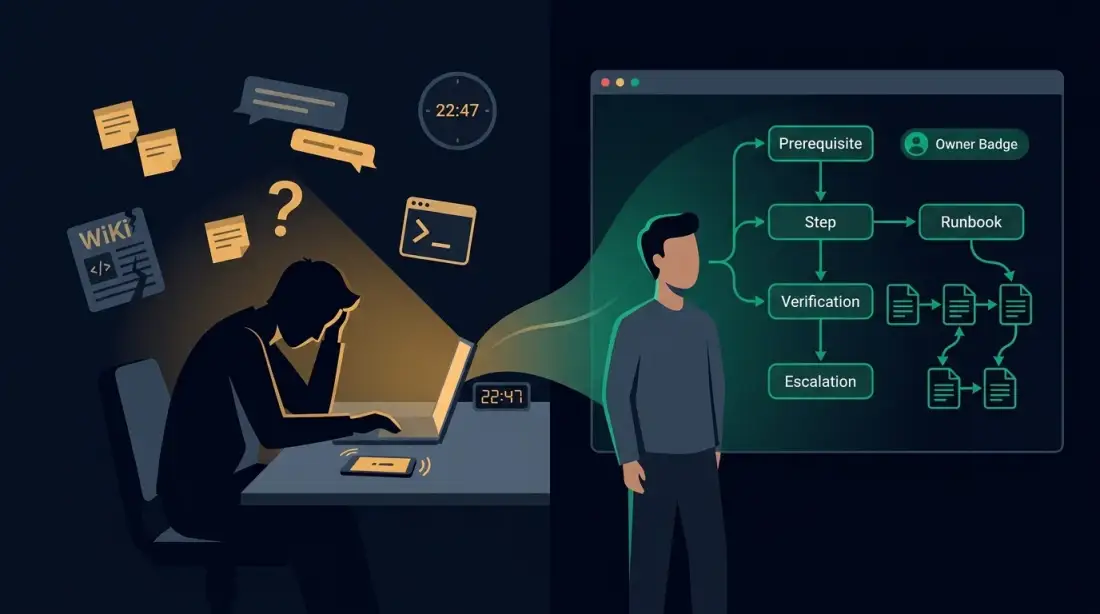
It is 22:47 on a Sunday in November. Sarah, an operations specialist at a 22-employee media services provider, receives a PagerDuty alert: the nightly backup for 34 customer websites has failed. The backup software reports a consistency error for the customer with a custom CDN setup. Sarah knows the routine tasks — she performs them daily. But she has never seen this specific error before.
She opens the internal wiki folder. A 40-page manual on backup infrastructure sits there, created by Klaus, the technical lead, two years ago. It describes the architecture at an abstract level. Nothing in it helps Sarah decide whether she can safely restart the backup for the CDN customer in isolation, or whether that would invalidate the existing recovery points for the other 33 customers.
Sarah calls Klaus. He is at the cinema and unreachable. She tries Jonas, the intern who started three weeks ago. Jonas has no idea. At 01:15, Sarah finally finds a Slack thread from March where Klaus discussed a similar situation. The message thread is 47 entries long, peppered with half-formed exception rules and a link to a shell script on a server Sarah did not know existed.
Three hours later, the backup is running again. The customer data was unprotected for four hours. Nobody slept. Nobody documented which steps actually led to the resolution.
In the introduction to its SRE book, Google reports roughly threefold improvement in repair time using prepared playbooks compared with improvising. This is an observation from Google's operations, not a general SME benchmark. Test the effect in your business with an unfamiliar operator and a documented comparison.
When Procedures Live in Heads Instead of Systems
The failure does not begin on the night of the incident. It begins on Monday morning, when Klaus drinks his coffee and monitors backups without ever writing anything down. Knowledge of exception rules, escalation thresholds, and manual corrections grows organically through his experience, not in a document that someone else could read.
The Three Forms of Operational Memory
In most SMEs with 10–100 employees, operational procedures exist in three precarious forms:
-
Personal knowledge: Klaus knows which customer has a custom CDN, which recovery procedure applies in that case, and under what conditions a manual intervention is permitted. This knowledge leaves the company when Klaus gets sick, takes vacation, or leaves.
-
Chat archaeology: Slack threads, email chains, and private notes contain fragments of the truth. But they are not searchable, not versioned, and not written for people who did not follow the original discussion. A Slack thread from March is not documentation for Sarah in November — it is an excavation project.
-
Static manuals: The 40-page wiki manual is theoretically correct and practically useless. It describes an ideal world, not the real one. It contains no decision trees, no escalation paths, and no verification checks. It is a monument, not a tool.
Why Chat Histories Are Not Documentation
A chat thread documents what was once said. It does not document what is valid. It does not document prerequisites, failures, or alternative paths. When Sarah finds a thread from March in November, she cannot know whether the solution it contains still applies, whether it is relevant to her specific case, or whether Klaus has since established a better procedure that is mentioned nowhere.
The PagerDuty Incident Response Documentation, an openly accessible reference for incident management, puts it this way: runbooks must be actionable, accessible, accurate, authoritative, and adaptable — the so-called "Five A's." A Slack thread satisfies none of these. It is not actionable (it is discursive), not accurate (it contains speculation and detours), not authoritative (no one has confirmed it as a valid procedure), and not adaptable (it is frozen in time).
The Hidden Cost of Knowledge That Is Not Shared
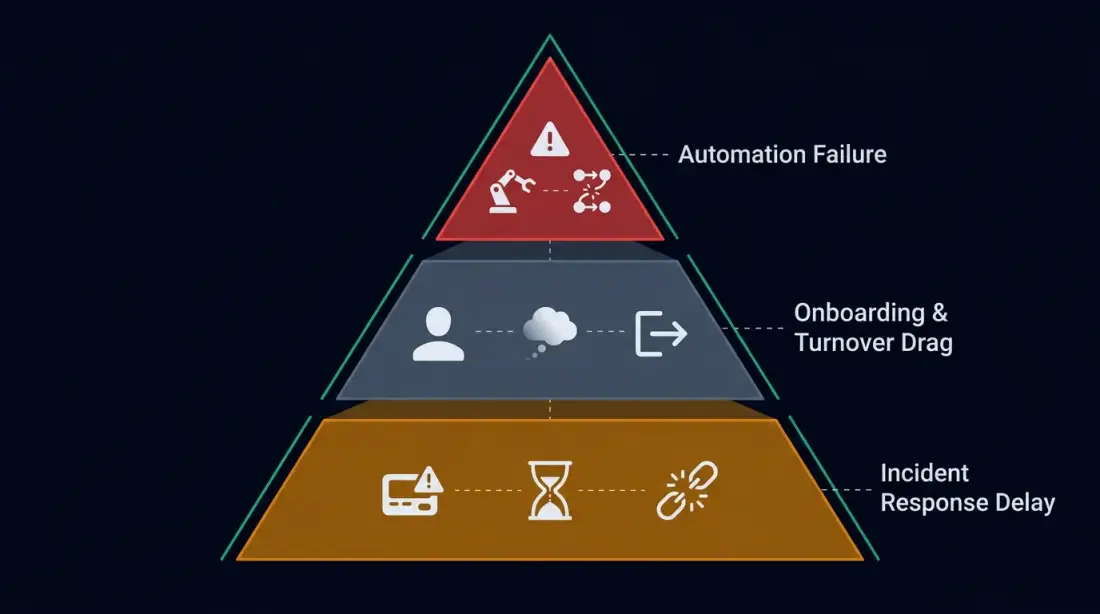
The costs of invisible procedures do not show up on a single invoice. They are distributed across three operational areas, each of which can endanger the growth and stability of an SME.
Incident Response Time
Atlassian, a leading provider of collaboration and incident management tools, emphasizes in its Incident Management KPIs documentation that Time to Detect (TTD) and Time to Recovery (TTR) are the decisive indicators of incident response process maturity. Without measurement of when an incident begins, is detected, and ends, teams learn little and repeat the same blind spots.
For this media services provider, this means: every incident where the fix is known only to Klaus costs the team an estimated four to five hours in context search and escalation (illustrative scenario). At two to three such incidents per quarter, that adds up to 32–60 hours per year — time spent not on improvements, but on repetitions.
Onboarding Drag and Turnover Risk
Jonas, the intern, is supposed to take over customer onboarding. But he has no written instructions. Every onboarding step must be explained to him verbally by Klaus or Sarah. After three months, Jonas understands the routine but not the exceptions. When he leaves the company, the media services provider does not just lose an employee — the team loses a half-finished process that no one fully documented.
Dependency on key individuals is not merely a personnel issue. It is a structural business continuity risk. According to NIST Special Publication 800-34 Rev. 1, the US standard for IT contingency planning, a documented plan is only as good as its most recent validation. Tests, exercises, and regular maintenance of recovery plans are essential. A plan that is not tested is an illusion — and an employee who is not replaceable is a single point of failure.
Automation That Fails Before It Begins
Management decides to automate the recurring SSL certificate renewal. The developer asks: "Which certificates expire when? What happens if the automation fails? Who is authorized to intervene manually, and under what conditions?" No one can answer these questions precisely because the process has always been adjusted on the fly. The automation project stalls — or worse: it encodes a misunderstood process that breaks in production.
This is the automation trap: automation assumes a process is understood. A process that exists only in people's heads is not understood — it is merely habitual. And habit cannot be encoded.
What a Runbook Really Is — and What It Is Not
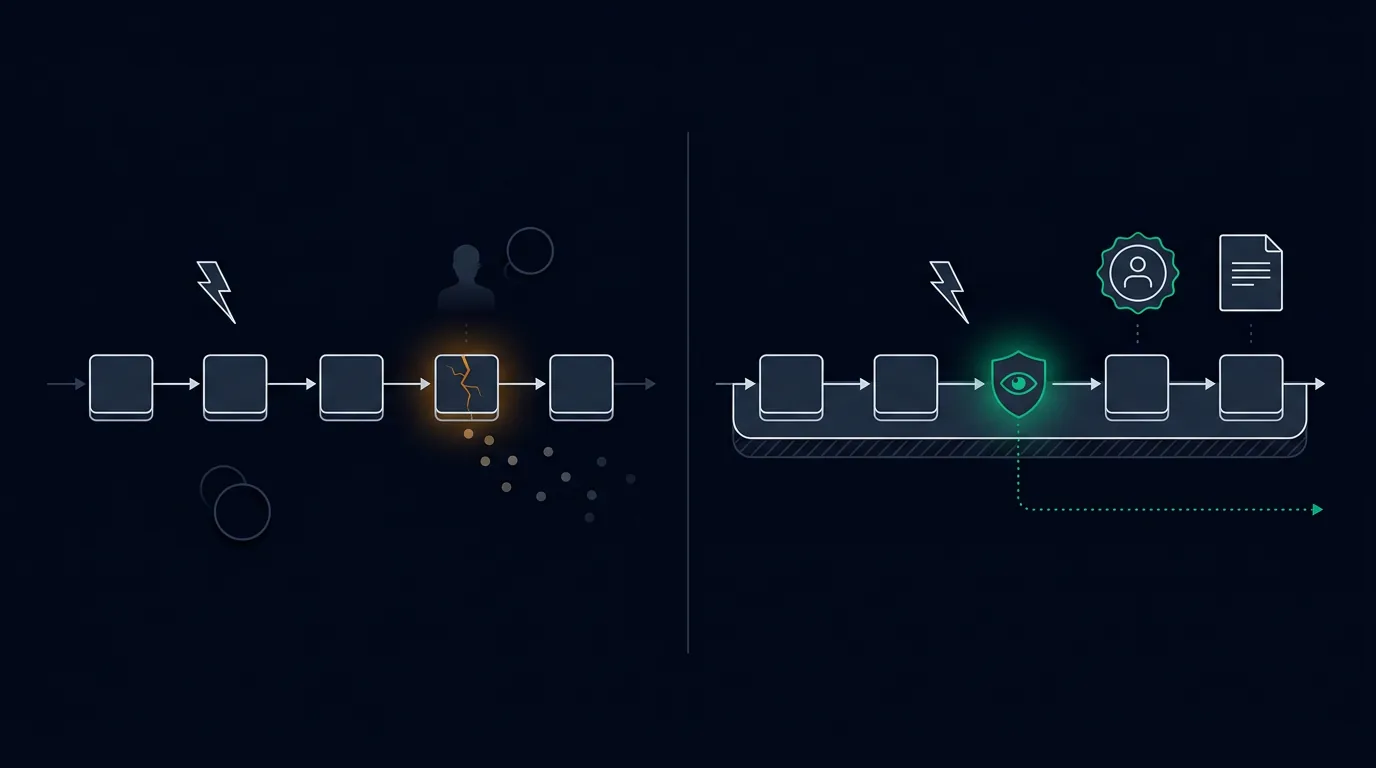
A runbook is not a manual. A manual explains how a system works. A runbook tells you what to do when something does not work — who does it, how it is verified, and when it is escalated.
Not a Manual, But a Decision Chain
The Google SRE Workbook defines playbooks (Google's equivalent to runbooks) as written, step-by-step instructions for handling incidents. The crucial difference from conventional documentation lies in structure: a runbook is a decision tree, not a prose essay.
A good runbook for this media services provider's backup scenario would not look like this:
"For backup issues, check the logs and restart if necessary."
It would look like this:
1. Check prerequisite: Are all 34 customer websites included in the backup set? → Yes: proceed to step 2. → No: note the missing customers and skip to step 5.
2. Identify error type: Is this a CDN customer? → Yes: use the specific recovery path for CDN setups (see Appendix B). → No: use the standard recovery path.
3. Verify after execution: Check backup log for consistency. Verify recovery points for the last 7 days.
4. Escalate: If recovery does not succeed within 30 minutes → escalate to Klaus (Technical Lead) via PagerDuty, high priority.
Prerequisites, Steps, Verification Checks, Escalation Path
Every runbook step contains four elements:
- Prerequisite: What must be true before this step is executed? (e.g., "Admin access to the backup portal is available.")
- Step: The concrete action. (e.g., "Isolate the CDN customer job and restart it using
--force-consistency-check.") - Verification check: How does the executor know the step succeeded? (e.g., "Check the backup log: all 34 jobs must show
Consistency check passed.") - Escalation path: What happens if the step fails or verification is negative? (e.g., "Escalate to Klaus within 30 minutes; until then, notify the customer of delayed backup.")
This structure turns a document into a tool. It makes the difference between a person improvising and a team acting traceably.
The Difference Between a Static Document and a Living Workflow
A static document is written and forgotten. A living runbook has an owner, a review date, and a change history. PagerDuty's documentation explicitly emphasizes: runbooks degrade without maintenance and ownership. Post-mortem action items must include runbook updates. Runbooks that are never updated based on incident learnings drift toward uselessness.
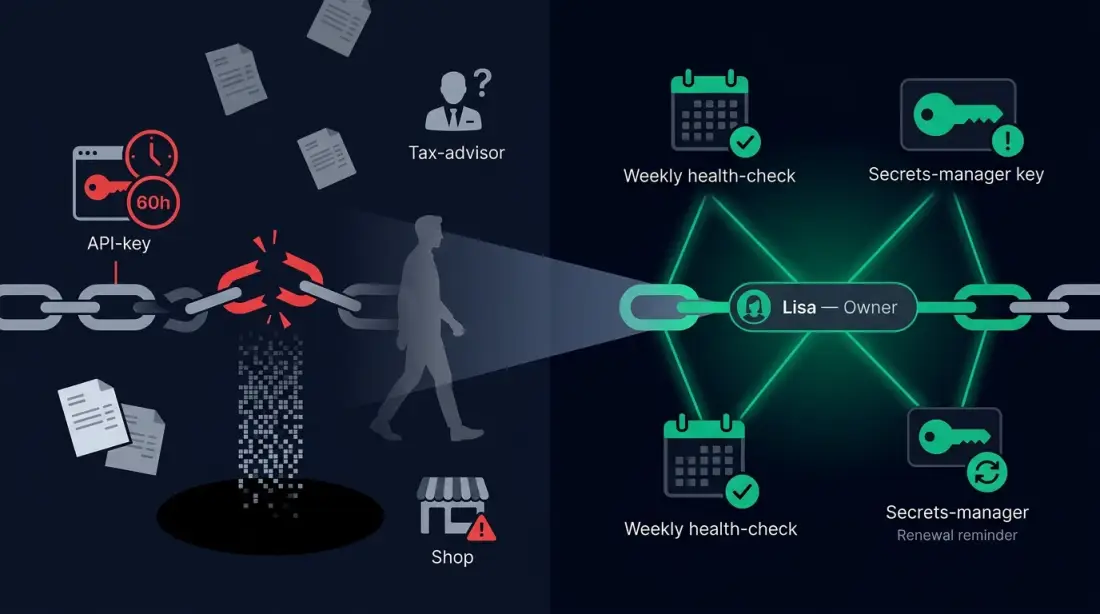
For SMEs, this means a runbook is not a one-time creation. It is a living artifact that is reviewed and adapted after every significant incident. The owner — not the author — is the person who ensures it stays current. At this media services provider, Sarah might be the owner of the backup runbook, even if Klaus was the original author.
From Head-Dependent Operations to Documented Procedures
The media services provider scenario is illustrative: 22 employees, 120 customer websites, daily backups, weekly certificate checks, five to ten customer onboardings per month, two to three incidents per quarter where the fix is known only to Klaus. The numbers are exemplary, but the structure is typical for the Mittelstand.
Before: A Procedure Only Maria Knows
Imagine Klaus suddenly falls ill for two weeks. A customer with a custom CDN reports a partial outage. Sarah tries to perform the recovery as she learned it verbally from Klaus. She misses an intermediate step that is necessary for CDN setups. The recovery appears successful, but CDN caching continues serving stale content. The customer notices the error only the next day. Escalation runs through three hierarchy levels because no one knows who is responsible for this customer type outside business hours.
The impact is not merely technical. It is trust-based. A customer who sees stale content for 24 hours begins to wonder whether their provider has control over its own infrastructure.
After: A Runbook Anyone Can Execute
After introducing runbooks, the same incident looks like this:
Sarah opens the backup runbook. She identifies in 90 seconds that the customer has a CDN setup. The decision tree leads her to the specific recovery path. She executes the steps, verifies the result using the defined check, and documents the execution in the audit trail. Total time from alert to verification is under 20 minutes. The customer notices nothing.
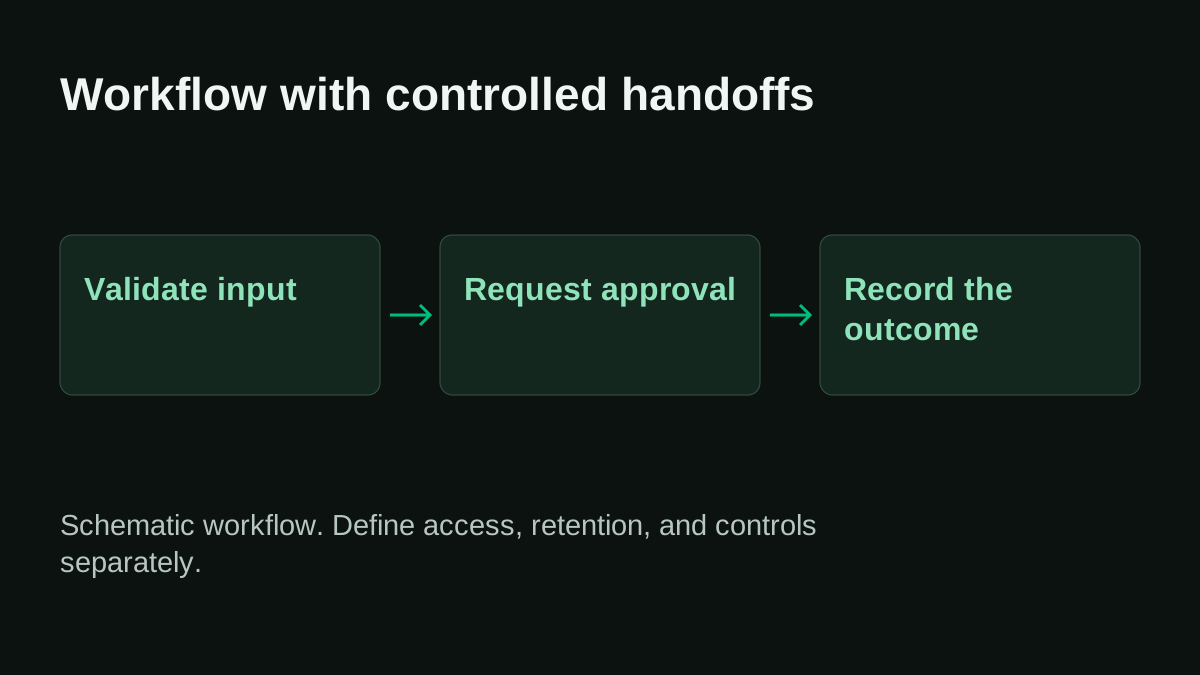
The three human review gates that Planfold recommends for runbook-driven operations are maintained throughout:
- Step-level verification: Every runbook step contains a defined checkpoint that the executor must confirm before proceeding.
- Exception approval: Deviations from the standard path require explicit approval from the technical lead or an authorized deputy.
- Audit trail: Every incident execution writes a timestamped entry with executor, steps, results, and escalation decisions.
How Planfold Translates Operational Knowledge into Operational Clarity
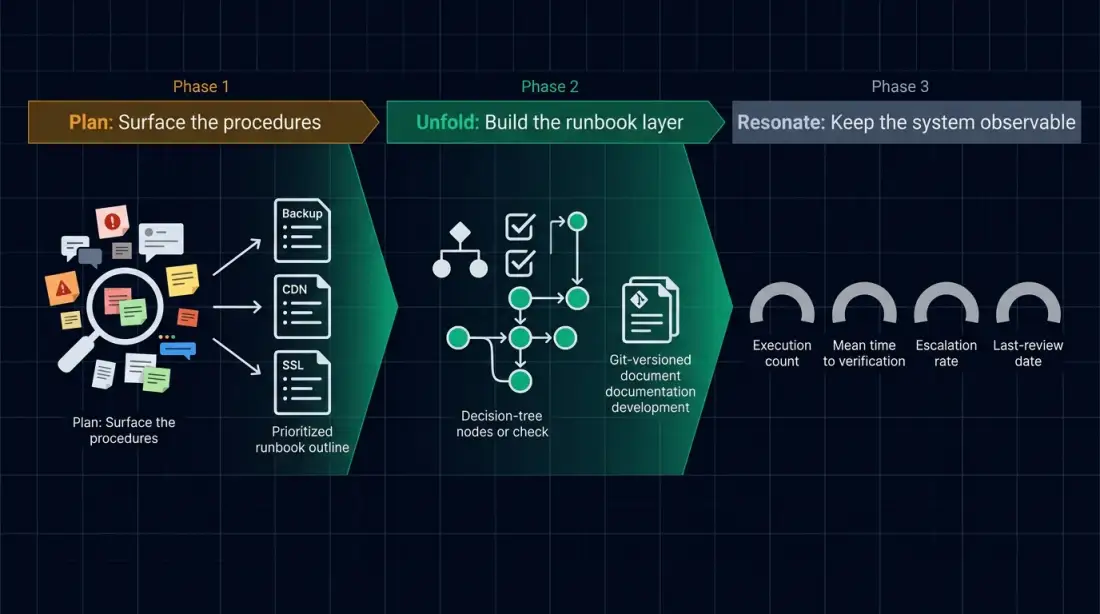
Planfold treats runbook-driven operations as the foundation of operational maturity. The methodology follows three phases that are technically defined — not as marketing labels, but as executable work steps.
Plan: Surface the Procedures
In the Plan phase, existing head-dependent procedures are made visible. This does not mean writing a 200-page manual. It means starting with the costliest incidents and documenting for each: What is the trigger? What steps lead to resolution? What exceptions exist? Who decides when the standard path does not apply?
For this media services provider, this would mean: the three most common incident types (backup failures, CDN outages, SSL certificate issues) are each mapped in a runbook with decision tree, verification checks, and escalation paths. No more. No less.
Unfold: Build the Runbook Layer
In the Unfold phase, documented procedures are transferred into operational systems. This can mean versioning runbooks in a central, searchable repository — for instance in Git, where every change is traceable. It can mean supporting verification checks with monitoring systems that automatically alert when a checkpoint is not met. And it can mean automating partial steps through n8n-based workflows, while the runbook continues to define the decision chain and human approvals.
The difference is crucial: the runbook remains the authoritative document. Automation is a tool that executes it — not a replacement that renders it obsolete.
Resonate: Keep the System Observable
In the Resonate phase, operational clarity is measured and maintained. This means: How often was a runbook executed last quarter? How long did execution take? Which steps regularly led to escalations? Which runbooks have not been updated since the last review?
These metrics are not academic. They show which runbooks are alive and which are aging. A runbook that has not been changed in twelve months is either perfect — or forgotten. The data distinguishes the two cases.
A Practical Start — One Procedure Anyone Can Execute
Runbooks sound like a big project. They are not. They are a small discipline that accumulates. The right starting point is crucial — and it is smaller than many fears.
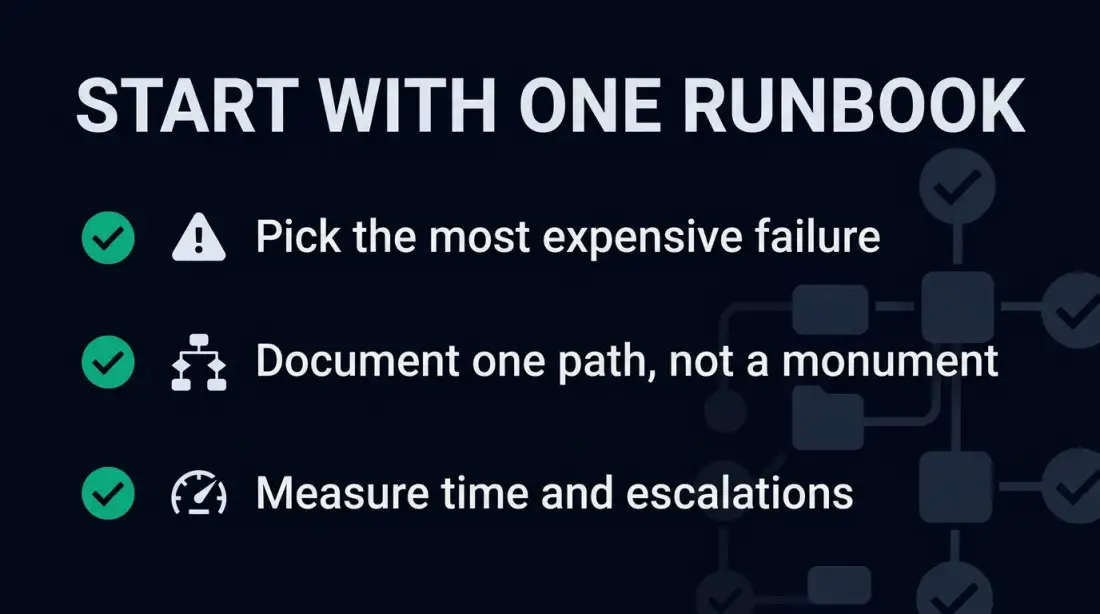
Pick the Most Expensive Failure
Do not start with the biggest system. Start with the most expensive failure. That is the incident that caused the most night hours, escalations, or customer trust damage in the last twelve months. Document this one path — not all paths, not the entire system, just this one.
For this media services provider, that would be the backup failure with CDN customers. A runbook with eight to twelve steps, three decision nodes, two verification checks, and a defined escalation path. This can be written in an afternoon and tested in a week.
Document a Path, Not a Monument
The biggest mistake in runbook adoption is trying to document everything at once. A 40-page manual that nobody reads is worse than no manual — because it creates the illusion of documentation while reality remains chaotic.
A good runbook is short enough to be read during an incident while the pager is beeping. It contains no architecture descriptions, no historical backgrounds, no general advice. It contains: prerequisite, step, checkpoint, escalation. Period.
Measure What Changes
After introducing the first runbook, measure two numbers: the average time from alert to verification for this incident type — and the number of escalations where the expert had to intervene. If the runbook works, the first number drops and the second drops too. If both numbers stay the same, the runbook is not precise enough or the verification checks are ambiguous.
NIST SP 800-34 Rev. 1 emphasizes: a documented plan is only as good as its most recent validation. Tests and exercises are not optional — they are the only method to prove that a runbook works in a real emergency. Conduct at least one targeted drill per quarter where one person simulates the incident and another executes the runbook. The results feed directly into the update cycle.
The transition from head-dependent operations to runbook-driven processes is not a technology project. It is an operational decision. The question is not whether your company is large enough for runbooks. The question is whether your company is small enough to survive the absence of a single person — without customers noticing.
Plan. Unfold. Resonate.