Workflow Automation in Retrospect: What SMEs Learn from Failed Rollouts
SME automation rollouts fail predictably — pilot purgatory, brittle integrations, ungoverned shadow automation, and over-automation. This retrospective names the failure patterns and a disciplined, owner-led rollout.
Contents
SME automation rollouts fail predictably — pilot purgatory, brittle integrations, ungoverned shadow automation, and over-automation. This retrospective names the failure patterns and a disciplined, owner-led rollout.
Share this article
The opening scene: a workflow that worked in the demo and went silent in production
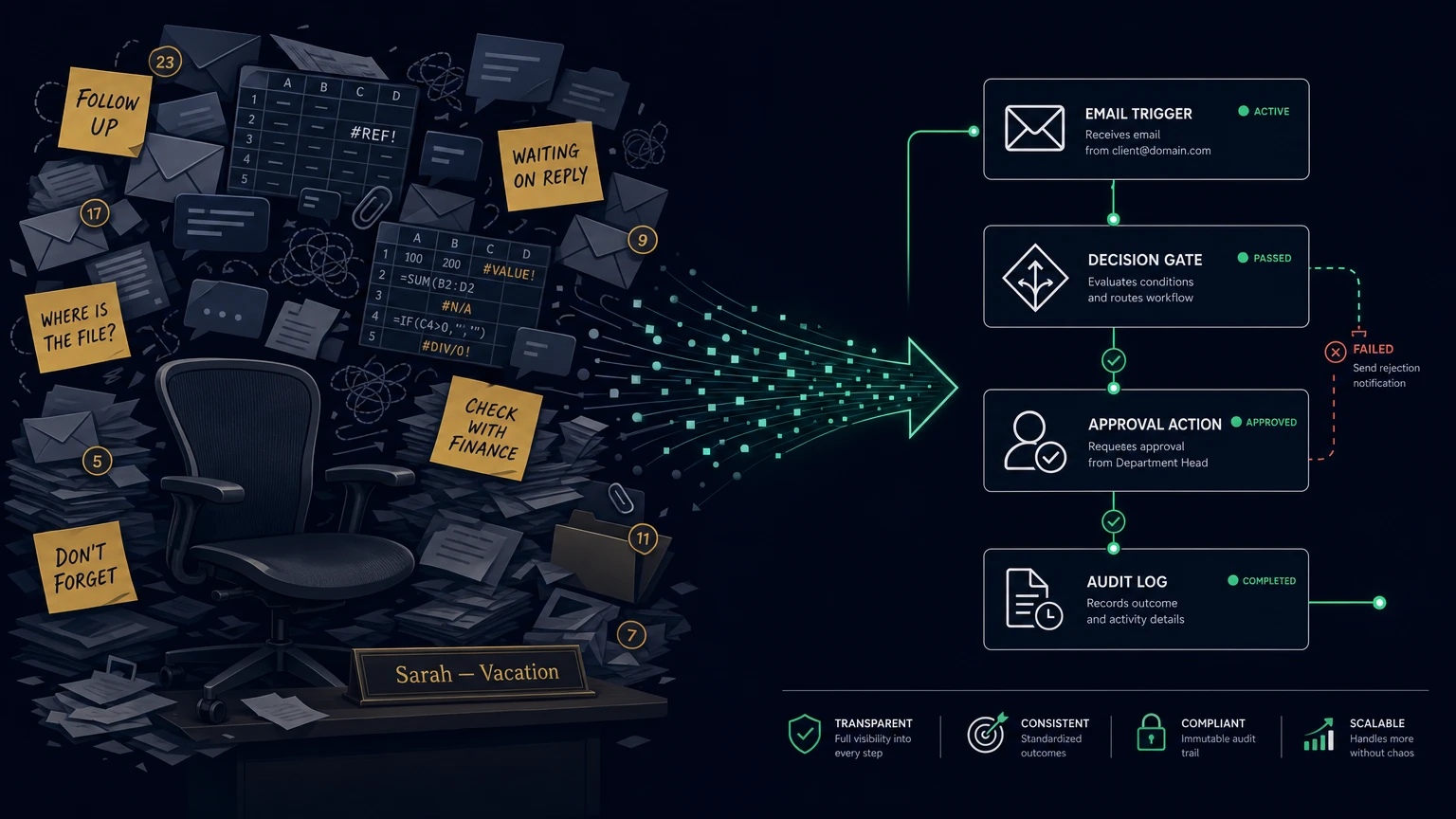
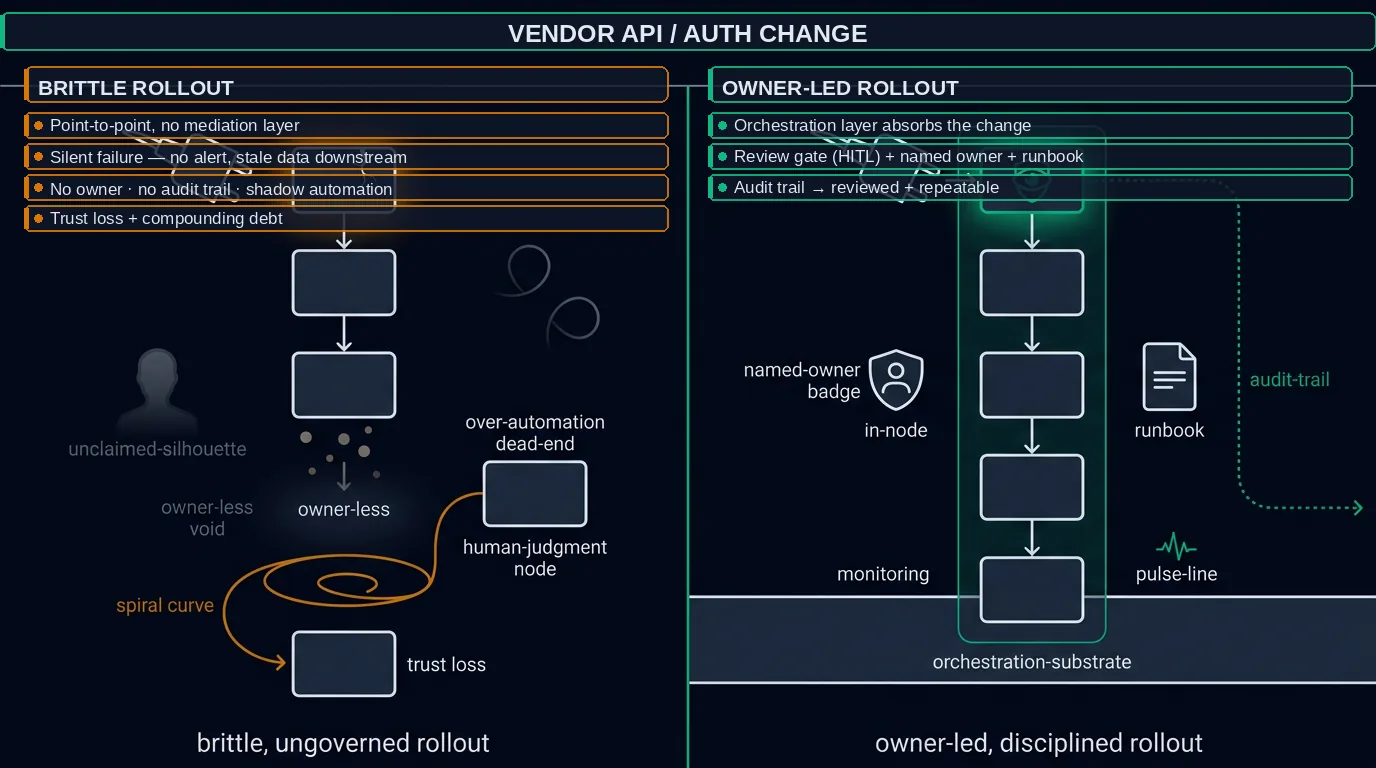
It is an ordinary Thursday morning when the sales-onboarding workflow goes silent. The company is a 45-person B2B services provider in the DACH region that began automating recurring processes six months ago — new-customer onboarding, invoice verification, and customer triage. In the demo, the onboarding workflow ran flawlessly. Now, after a minor API change from the CRM vendor, it breaks quietly: it throws no error, it simply pushes stale fields into downstream systems. No one gets an alert.
Bauer, the operations manager, only notices when a customer complains about a missing welcome flow. Köhler, the IT lead, traces the cause after half a day of searching — an auth endpoint had changed, and the workflow was glued point-to-point to the old interface. It is not the only workflow with the problem: in the same period, two shadow automations sprang up from individual departments, owned by no one, with no log, and whose outputs no one accepts.
This scenario is an illustrative example, not a documented Planfold customer case. It stands in for a pattern that repeats across companies and tools. The question is not whether some workflow will eventually break. The question is how your rollout responds when it does — and whether anyone even notices that it is broken.
Why automation rollouts fail: the pattern, not the tool
The obvious reaction to a scene like this is: wrong tool, wrong vendor, we should switch. The retrospective shows something different. The recurring failure of automation rollouts is rarely a tooling problem. It is a problem with the operating model around the tool — and that problem is documented industry-wide.
The numbers are unambiguous. IDC reports that 88 percent of AI and automation proofs of concept never reach production (IDC finding, cited via the Lenovo CIO Playbook 2025). That is the scale of what has become known as pilot purgatory: promising experiments that never make the leap into production because no one built the substrate of governance, ownership, and stable integration a workflow needs to run durably. BCG's research on the AI Value Gap from September 2025 reinforces the same diagnosis: 60 percent of companies generate no material AI value ("laggards"), 35 percent have success in isolated pockets ("scalers"), and only 5 percent have embedded AI structurally across the organization ("future-built"). By these findings, the gap is a governance and operating-model gap, not a tooling gap — and that is exactly the thesis of this retrospective.
A structured reference model helps order the diagnosis. The n8n AI Maturity framework describes five maturity levels, assessed across the dimensions of usage, sophistication, governance, and infrastructure. Two observations shape this article: pilot purgatory sits at the experimental level (L1), and the critical architectural shift is a dedicated orchestration layer with mandatory human-in-the-loop (HITL) review from the integration level (L2) onward. The framework is AI-flavored; the lesson applies to workflow automation broadly — including classic, non-AI integrations. The tool does not make a rollout reliable. The operating model around it does.
The five recurring failure patterns: a diagnosis
Anyone who has seen enough failed rollouts recognizes the same five patterns. They appear individually, but they reinforce one another.
1. Pilot purgatory — the experiment that never reaches production
A process is built as a proof of concept, works in the demo, and never enters production. The IDC finding of 88 percent of POCs failing is the hard metric for exactly this pattern. The cause is not the technology but the absence of ownership, integration discipline, and a plan for how the workflow will be sustained in operations once it is live.
2. Brittle point-to-point integrations
Workflows glued directly from one system to the next, with no mediation layer, break on the first change to an API, a field name, or an auth model. This is a documented operational reality, not a claim about a specific failure rate. The problem: there is no owner who knows the dependency, and no test that signals the break early. Instead, the workflow keeps running silently, pushing stale or wrong data downstream.
3. Ungoverned shadow automation
Employees automate because things need to move fast — in personal accounts, with their own credentials, with no shared log. The n8n framework calls this stage Shadow AI: the organization bears the entire risk (data exposure, silent failures, no audit trail) while capturing none of the strategic benefit, because no one knows it exists. The automation runs, but no one owns it.
4. Over-automation and missing review gates
A process that needed human judgment is fully automated. Quality gaps appear, and the company is forced to reintroduce human oversight — after trust is already damaged. The textbook case is a named real-world retrospective: Klarna's AI customer service delivered measurable scale and savings in the Q1 2025 report — customer-service transaction costs fell 40 percent versus Q1 2023, with maintained customer-satisfaction levels, and the system handled a volume on the order of roughly 853 full-time agents (source: Klarna quarterly report, cited via the n8n framework). The later walk-back — Klarna reintroduced human oversight for complex cases after reports of generic answers — is documented in later Klarna communications and industry coverage (carried by the n8n framework, not by the Q1 report text itself). The lesson is not that automation does not work. It worked, with measurable savings. The lesson is: scaling without a quality and review plan for the complexity the system cannot handle forces a reactive reintroduction of human oversight after quality gaps have already appeared. The n8n framework makes HITL review standard from the integration level (L2) for any decision with meaningful business impact.
5. Missing ownership model
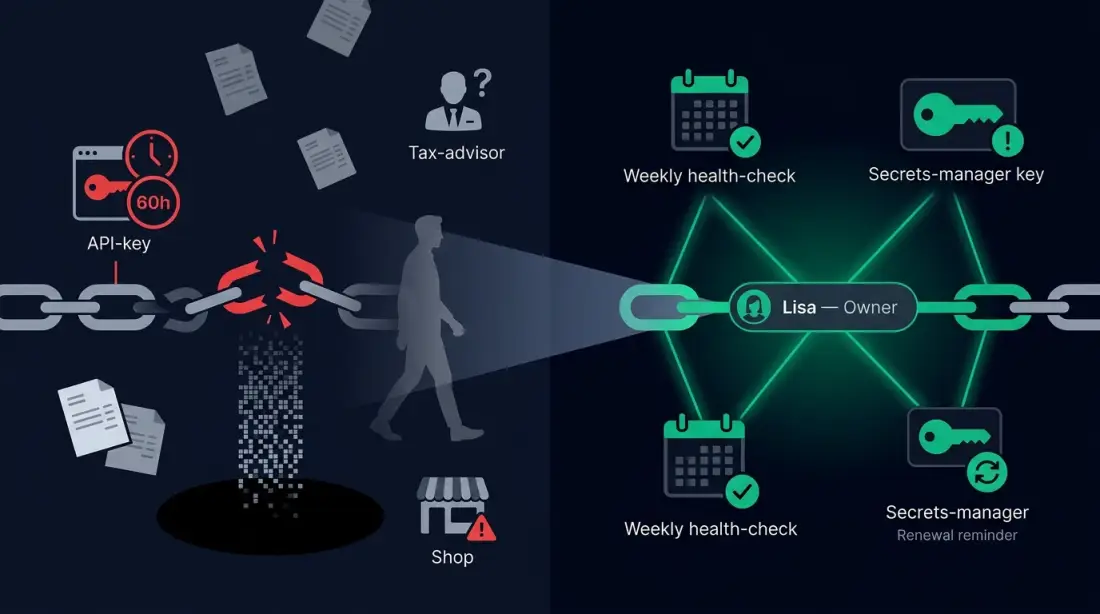
Workflows go live with no one owning their data formats, their integration, or their audit trail. When something breaks, it is unclear who decides, who maintains the rollout, and who approves a change. Without ownership, automation becomes a burdensome asset no one maintains.
The cost of failure: business impact
The five patterns translate into concrete operational costs — and these costs are cumulative, not additive. Every failed rollout leaves technical debt and eroded trust that makes the next rollout harder.
The most tangible costs are the immediate rework costs. In the illustrative scenario of the 45-person B2B services provider, roughly half of the three automated workflows broke on API or auth changes over six months — about one silent failure per week, with no budget line and no named owner. These figures are an exemplary planning model for illustration, not a hard guarantee; the assumptions are disclosed so you can adapt them to your own situation. The signal lies not in the euro amount but in the pattern: rework that no one budgeted lands on top of day-to-day operations.
More expensive than rework is the trust damage. The Klarna case shows the scale of exposure when automation is scaled before a plan exists for the complexity it cannot cover: measurable efficiency gains in breadth, but a reactive walk-back after customers received generic answers. For an SME without a large enterprise's reserves, the trust loss among customers weighs heavier, because there is less room to absorb reputational damage.
The most durable effect is compounding technical debt. Every workflow that was glued point-to-point and went live without an audit trail will be harder to change next time — not because the tool got worse, but because no one knows which dependencies exist. A botched rollout thus becomes a recurring cost block that raises the threshold for the next automation initiative.
Warning signs: diagnostic signals for a failing rollout
Most SMEs sense a failing rollout long before they name it. Four signals indicate that the problem is not a single workflow but the operating model.
"Workflows break without an alarm"
When a workflow silently pushes stale data and is only caught by a customer complaint, operational visibility is missing. Retrying is not a review process: a brittle integration that retries silently can still deliver wrong data downstream. What is missing is monitoring, alerting, an owner, and a defined escalation.
"No one owns the audit trail"
When no one can say when a workflow last ran, who approved a change, and which version is active in production, the automation exists only as an assumption. A workflow without a version, run log, and approval history can neither be reviewed nor changed in a controlled way.
"Demos never reach production"
When new POCs appear every quarter but few make the leap into production, you are in the middle of pilot purgatory. The IDC marker of 88 percent is not an enterprise-only diagnosis — SMEs are more exposed, not less, because they have fewer people to absorb the rework when a pilot never ships.
"Processes run without human review where judgment was needed"
When customer- or financial-facing decisions are fully automated without an approval gate, the review gates that the n8n framework makes standard from the integration level are missing. Over-automation rarely shows up in the normal case — it shows up in the cases the automation cannot classify.
If you recognize two or more of these signals, you do not have a tooling problem. You have an operating-model problem: your rollout is built so that failures stay invisible and ownership is undefined.
How disciplined rollouts absorb the shock
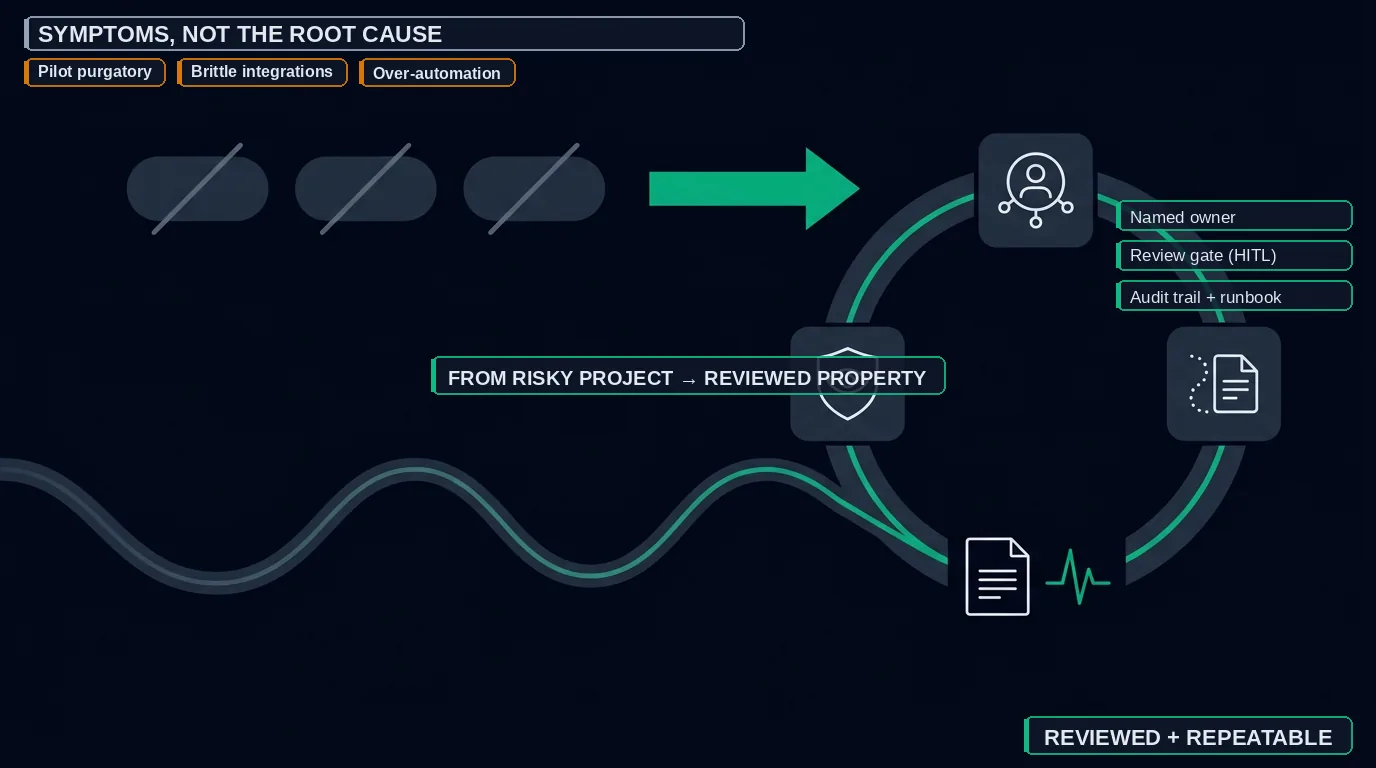
The technical answer to the five patterns is not a better tool but a different operating model — one that builds automation as a reviewed, owner-led property instead of a one-off project. Four building blocks carry it, and each counts individually.
Start with one process. The disciplined rollout begins with exactly one process that has high, well-understood value. That reduces the variables before you have to prove orchestration and review gates in operations. Starting with five processes at once spreads the effort so thin that none of them is truly owned.
Own the data formats and integration layer. Instead of gluing point-to-point from system to system, you build a dedicated orchestration layer and control the data formats yourself. That is the architectural shift the n8n framework marks as critical: the integration layer is where a vendor change is absorbed instead of cascading into the workflow. Owning the schema disowns the data model from the vendor.
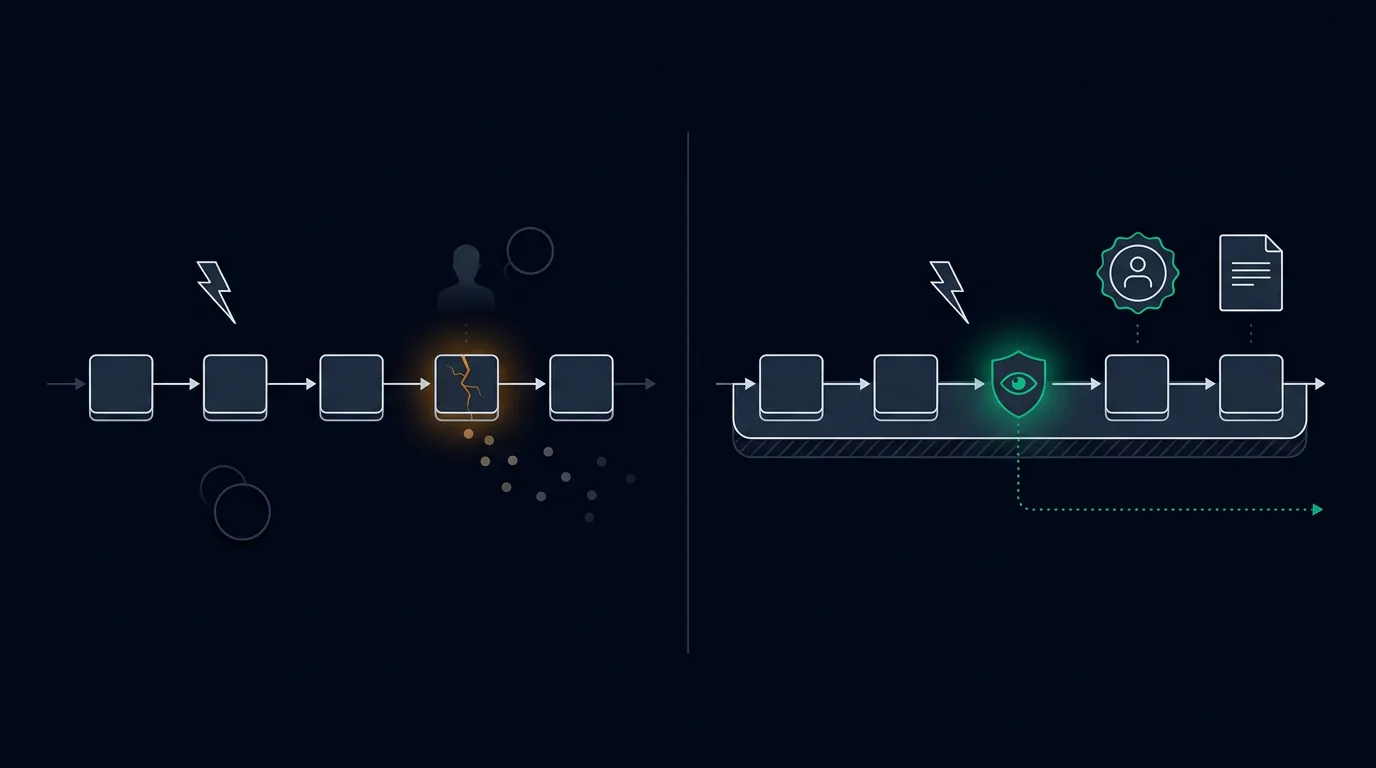
Review gates and an audit trail from day one. Every decision with customer or financial impact runs through a HITL approval gate. Workflow definitions, versions, and change history live in code; run logs, error paths, and approvals are recorded per execution. That turns a silent failure point into a reviewed process that someone can change in a controlled way rather than re-glue in secret.
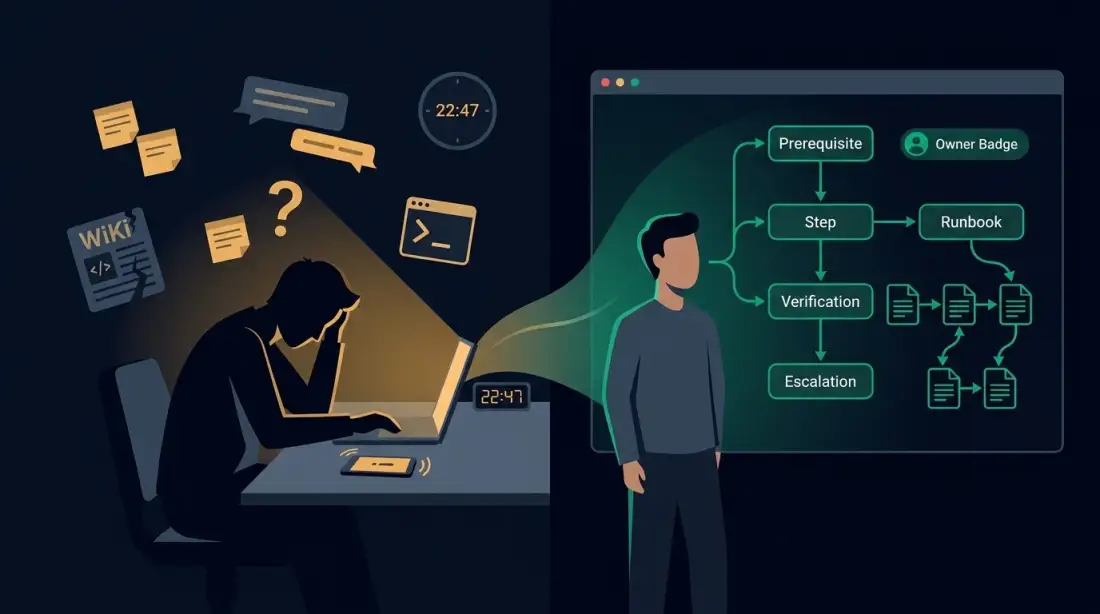
Operational clarity as a property. Observability, runbooks, and named owners are not a launch checkbox but a permanent property. A workflow that runs is not finished. It needs a person who continuously secures its health and a runbook that describes what happens when a vendor changes an API.
Operational clarity as a permanent state
Many SMEs treat an automation rollout as a project you complete. That assumption is exactly what keeps the failure patterns alive. Operational clarity is only a real capability when it becomes a measured, recurring property — not a pillar on the kickoff slide.
Three practices make the difference between "we could automate in theory" and "we proved a reviewed rollout this quarter." First: every workflow has a named owner and a defined review checkpoint for any decision with customer or financial impact. Second: a weekly failure review catches silent failures and feeds the findings back into the runbooks. Third: when a vendor changes an API, there is a known, rehearsed path — not an ad-hoc repair under pressure.
This discipline is lighter than an enterprise governance program and heavier than set-and-forget. For the 45-person B2B services provider from the opening, that means concretely: Bauer records per workflow which approvals are needed for customer- or financial-facing decisions; Köhler runs the orchestration layer as code with version and run logs; a short weekly review sorts out silent failures before a customer complains. A risky rollout thus becomes a reviewed, repeatable property — and the next rollout does not start from zero again.
The Planfold view: automation as a reviewed state, not a lottery
Planfold frames failed automation rollouts as a recurring operational risk and capital drain — and disciplined ownership as the cost-control mechanism that turns risky automation into a reviewed, repeatable property. Our methodology follows three technically defined phases.
Plan means auditing processes, technical debt, integration fragility, and ownership gaps. We map which workflows are already owned, which break point-to-point, and which shadow automation runs ungoverned. The result is a prioritized list of concrete exposures, not a theoretical landscape.
Unfold means building systems and integrating them: an owner-led orchestration layer on self-hosted n8n, your own data formats, review gates, and an audit trail from the first workflow onward. Implementation follows recognized standards; our teams are CKA- and CKAD-certified, supplemented by LFCS. Fixed-price automation engagements start at €1,500. That is a Planfold service, not headcount you have to hire.
Resonate means stable operations with observability, runbooks, and named owners. A workflow that runs is not finished — it needs a person who controls its health and a runbook that describes the path for the next vendor change.
The honest boundary: discipline does not eliminate every dependency, and no automation runs without maintenance. Planfold does not guarantee specific savings, ROI, uptime, or fixed rollout timelines — concrete outcomes depend on the process, the team, and operational diligence. But when the next vendor changes an API, your answer is a reviewed, owned workflow — not a silent failure that a customer complaint uncovers.