The Unfolding Method: From Digital Chaos to Automated Leverage
Automation creates leverage only when the workflow is understood first. The Unfolding Method helps teams map their digital chaos, build one reliable workflow, and improve it through feedback.

Contents
Automation creates leverage only when the workflow is understood first. The Unfolding Method helps teams map their digital chaos, build one reliable workflow, and improve it through feedback.
Share this article
The moment automation becomes a business question
The question usually appears in a normal operating moment. A lead lands in the shared inbox, product context lives in Notion, the CRM has partial history, Slack has the latest decision, billing sits somewhere else, and someone says: "Can we automate this?"
Often, yes. But not safely if the real workflow is still invisible. Automation amplifies the current system. If state, owners, sources, exceptions, and review points are unclear, the team does not get leverage. It gets a faster version of the same coordination problem.
That is the core idea behind the Unfolding Method: plan the work, unfold the smallest reliable workflow, then let feedback improve the system. It is a lean path from scattered tools to a Digital Headquarters: one owned operating layer where work, knowledge, decisions, and automation can be inspected.
The European Commission's 2025 Digital Decade reporting shows business digitalization is still a live gap, especially around AI, cloud, and data analytics adoption. Eurostat's 2025 digitalisation publication reports that 73 percent of EU SMEs reached at least basic digital intensity in 2024, still below the 2030 target of more than 90 percent. That is adoption data, not workflow maturity. The practical gap is not "do we have tools?" It is "do those tools form a system?"
Why "just automate it" creates more chaos
The fastest automation is often the most fragile one. A trigger fires, a SaaS connection moves data, an AI step writes a summary, and the demo looks useful. Then the edge cases arrive. Which record is authoritative? Who owns the exception? What happens when a required field is missing? Whose credential runs the workflow? Where does a human approve customer-visible output?
The failure mode is not laziness. It is operational debt. McKinsey's long-running transformation research is useful here as a caution: sustained change depends on operating practices, roles, capabilities, and communication, not technology rollout alone. The exact survey figures are broad and older, so they should not be used as a benchmark for a startup or Planfold client. The lesson still holds: tooling is not the same as durable operating change.
For lean teams, the trap is local speed. One person can build a Zap, script, or n8n flow that saves time this week. But if nobody else understands the logic, credentials, monitoring, rollback, or source boundaries, the team has created a hidden platform dependency.
| Symptom | What happens in practice | Risk |
|---|---|---|
| Informal business rule | Only one person knows when a deal is ready for handoff | The workflow automates incomplete logic |
| Conflicting source of truth | CRM, spreadsheet, and docs disagree | Bad data moves faster |
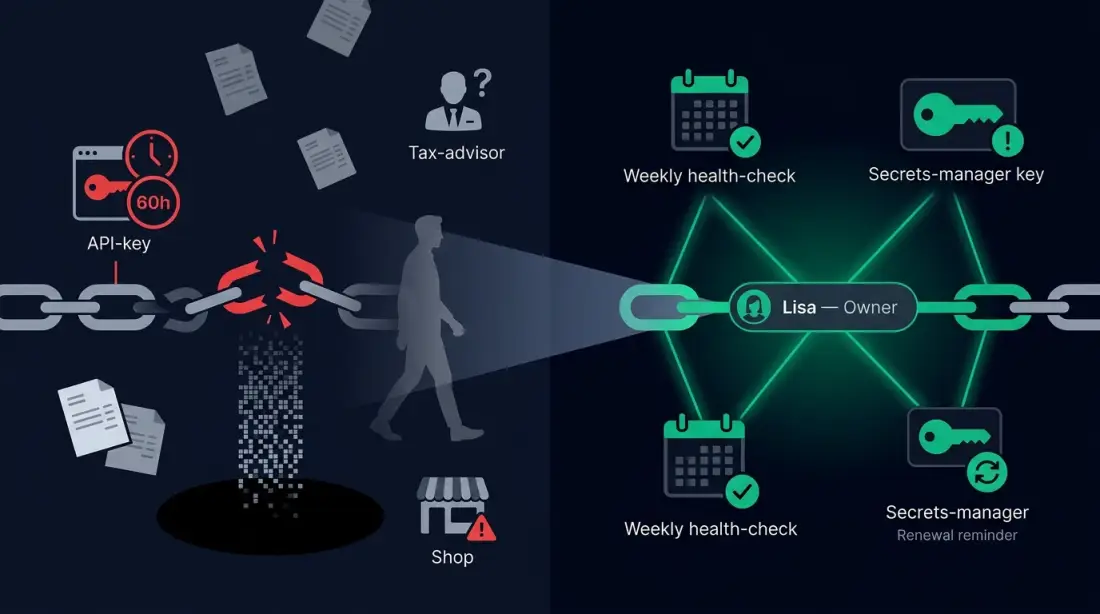
| Personal credentials | The automation runs through a former employee's account | Continuity and security become fragile |
| Customer-discovered errors | There is no alerting or fallback path | Trust erodes where automation should help |
| Raw AI context | Old and approved sources are mixed together | Output looks confident but is not reliable |
An illustrative example: From inbox to controlled inquiry flow
Let us look at a concrete scenario — illustrative, but familiar from real operations. A building-technology firm with about twelve employees. Roughly forty project inquiries arrive by email each week. Thomas, the founder and managing partner, qualifies them ad hoc between meetings. Lisa, the project coordinator, maintains customer data in a shared spreadsheet — except three incompatible versions now exist across different machines.
When Thomas is away for three days, unqualified inquiries pile up. There is no alert when an email sits untouched for more than 48 hours. Invoicing copies information manually from the spreadsheet into a separate tool. Nobody can say with confidence which data source holds the truth. This is not a competence problem. It is grown complexity without a deliberate operating model — and exactly where the Unfolding Method begins.
Phase 1: Plan - Make the real workflow visible
Planning does not mean writing an enterprise transformation deck. It means choosing one real workflow and making it clear enough to operate. Start with a lead, support ticket, onboarding step, quote, invoice follow-up, or recurring report. Trace it from intake to done.
The map should capture state, owner, data source, decision rule, exception path, review point, and feedback. A tool inventory tells you what apps exist. A workflow map tells you how work actually moves.
Map the work, not the software
A SaaS team might have HubSpot or Pipedrive, Linear or Jira, Slack, Notion, Stripe, support tooling, and a few automation snippets. The issue is not the number of tools by itself. The issue is the missing operating layer that records owner, status, exception path, decision history, and source boundaries.
This is also the right mindset for AI-assisted workflows. The NIST AI Risk Management Framework separates mapping, measuring, managing, and governing. Planfold is not making a compliance claim here. The useful operational point is simple: serious automation starts with intended use, context, stakeholders, and risks before a model or agent touches the workflow.
Choose one workflow by leverage, risk, and readiness
Score candidate workflows on frequency, manual time, error risk, customer impact, source clarity, data sensitivity, and reversibility. Use a simple 1-to-5 scale. High opportunity plus high readiness should move first. High opportunity plus low readiness is not ready for automation yet; it is a planning task.
Good first workflows are frequent enough to matter and bounded enough to validate: lead qualification, quote preparation, support triage, onboarding checklists, recurring reports, invoice follow-up, booking confirmation, or delivery handoff. Bad first workflows are undocumented, exception-heavy, high-liability, credential-fragile, or based on data nobody trusts.
Phase 2: Unfold - Build the smallest reliable workflow
Unfolding is the alternative to big-bang transformation. Instead of rebuilding the operating system of the company, build the smallest workflow that can be trusted in production. It needs source systems, permissions, handoff logic, error handling, a named owner, monitoring, documentation, and a rollback or exit path.
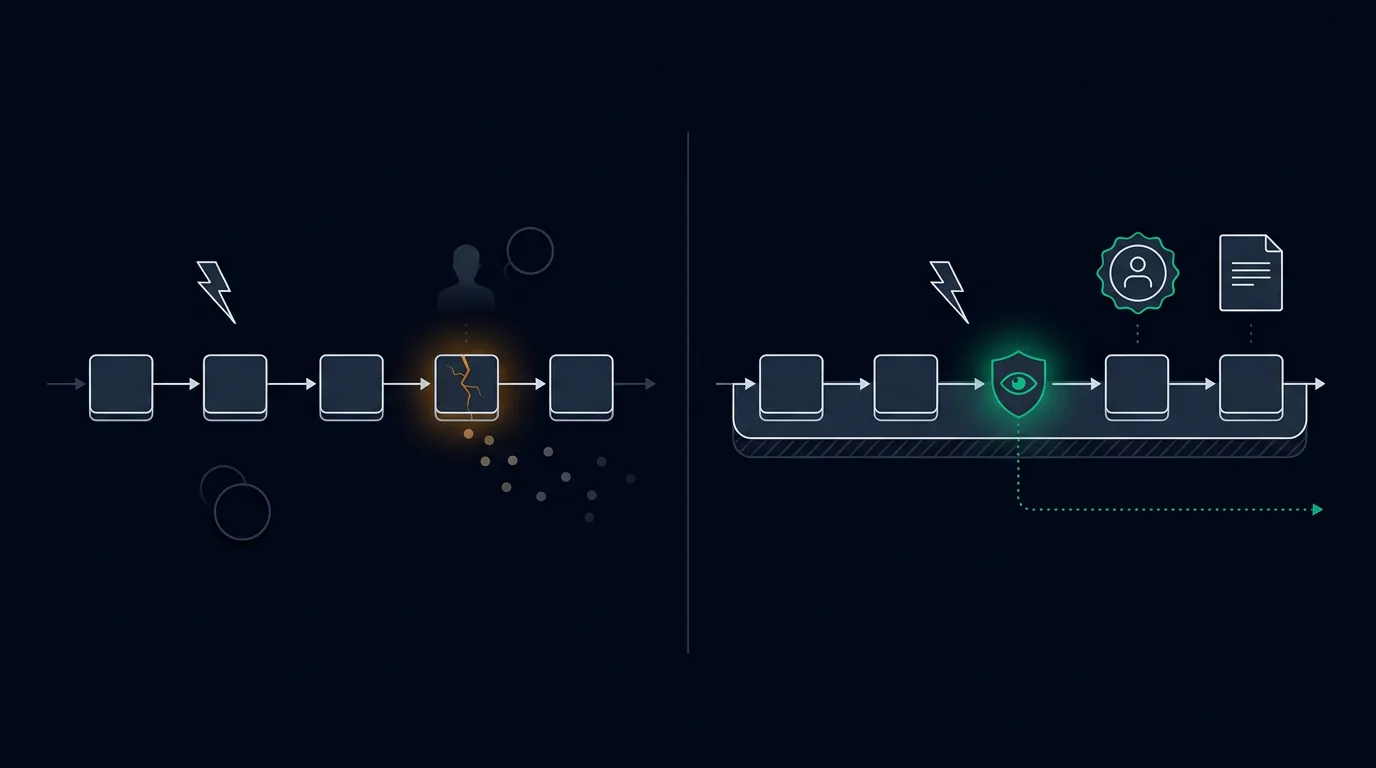
That makes the workflow a managed asset rather than a clever shortcut. A weak automation has a trigger, unclear ownership, personal credentials, customer-discovered errors, no documentation, and no rollback. An unfolded automation has documented triggers and sources, managed credentials, visible failure alerts, a manual fallback, and improvement notes.
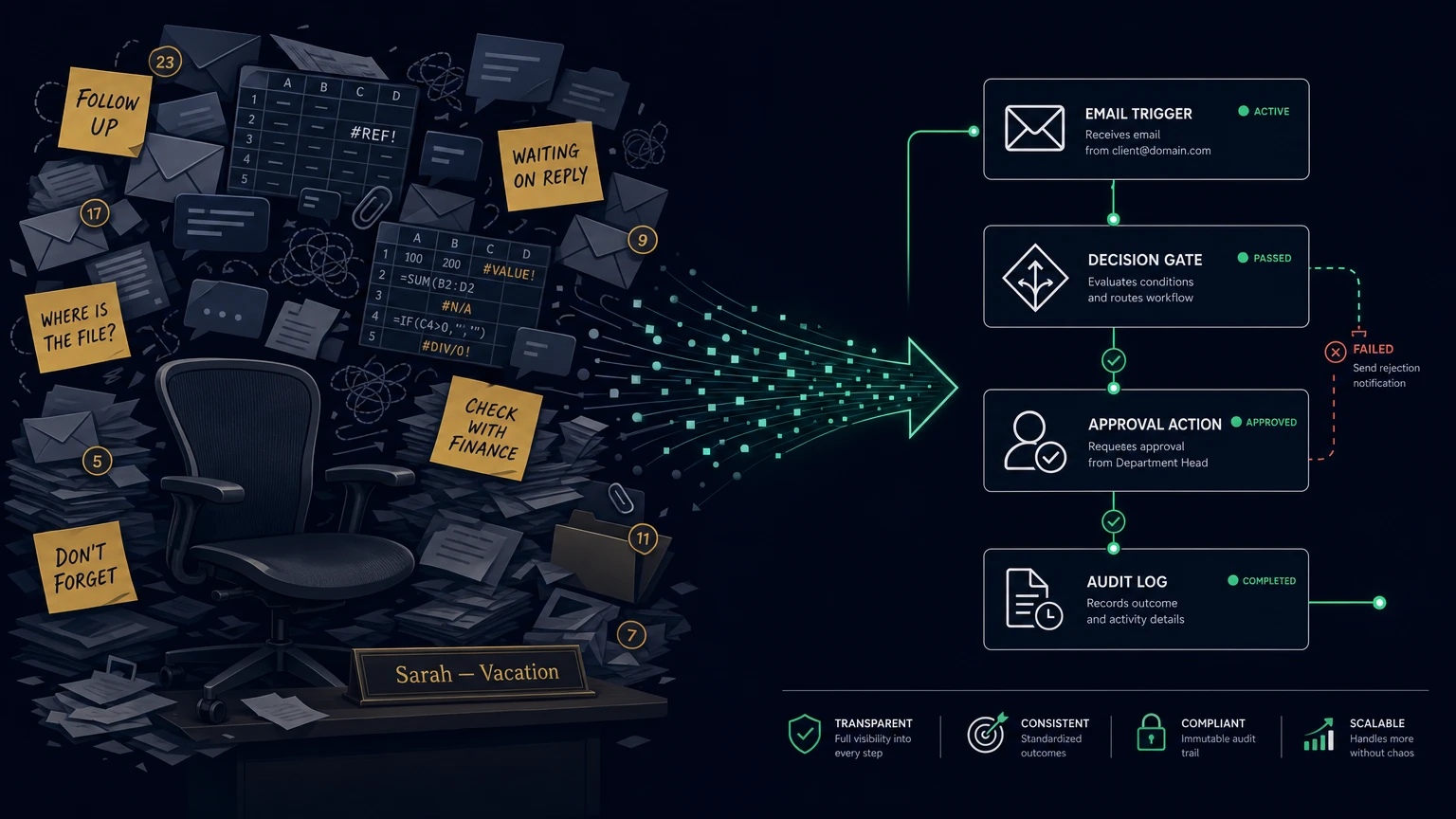
For this firm, this could mean: incoming inquiries are automatically tagged and logged, routed to a dashboard, paired with a structured qualification form, and on approval written into the CRM record. A monitoring alert fires if status does not advance within 48 hours. Thomas keeps the approval gate, Lisa maintains only one source, and both know who owns what.

Phase 3: Resonate - Let feedback improve the system
A workflow is not done when it runs once. It has to earn trust. Resonance is the feedback loop: where did users correct the output, what context was missing, which exception repeated, where did the owner intervene, and what should change before the workflow expands?
Measure correction points, not vanity automation counts
"We automated 80 percent of the process" is not useful unless the team defines what was excluded, how exceptions are handled, and how quality is checked. Better metrics are correction points: manual interventions per week, median time from intake to owner, missing-context rate, failed runs by root cause, and team trust.
For example, a quote-preparation workflow should be judged by fewer missing fields, faster owner assignment, and fewer correction loops before the proposal is sent. The number of API calls is not the business result.
At this firm, after four weeks the pattern is clear: misrouted inquiries drop because the routing rule learned from real patterns. Lisa no longer needs three spreadsheets because the CRM is accepted as the single source. Thomas shifts from daily inbox triage to weekly exception review. This is not a leap. This is a workflow earning trust.
Expand only after the workflow earns trust
Reliable automation grows through adjacent workflows. Once support triage works, add knowledge-base suggestions. Once quote preparation works, add invoice handoff. Once onboarding works, add renewal or follow-up reminders. That is how a Digital Headquarters forms: through repeated loops, not a platform rewrite.
What the technical operating model looks like
Under the surface, the method follows a clear operating pattern: intake, validation, context retrieval, automation decision, human approval where needed, action execution, logging, and feedback. The implementation can use n8n, backend services, SaaS APIs, databases, or AI steps. The architecture question is not "which tool is modern?" It is "where does responsibility remain visible?"
Intake can be a form, shared inbox, webhook, CRM event, or manual trigger. Validation checks required fields, duplicate records, permissions, confidence thresholds, and data sensitivity. Context retrieval pulls CRM records, project status, documentation, customer history, contract terms, or capacity information where those sources are approved and current.
The decision rule should be deterministic where possible. AI can classify, summarize, suggest, or draft, but customer-visible, financial, legal, or high-risk actions need clear human approval. Execution updates a tool, sends a message, creates a task, generates a document, or calls a backend action. Logging records what happened, when, through which service, and with which source. Feedback stores corrections, exceptions, and the next improvement.
The tradeoffs are concrete. No-code speed can hide logic. SaaS convenience can reduce portability. AI assistance can blur accountability. Centralization can improve visibility but frustrate teams if it becomes a bottleneck. A good Digital Headquarters makes those tradeoffs inspectable.
Warning signs your automation is not ready to scale
Scaling is the wrong move when the operating base is still weak. Watch for observable signals: no current workflow owner, no data-flow map, personal or undocumented credentials, errors discovered by customers or finance, no manual fallback, AI output without source boundaries or review rules, or a shadow spreadsheet that remains because the team does not trust the automation.
These signs are not a reason to stop. They are a reason to plan the next step correctly. The first win is often not another automation. It is making the current workflow explainable enough that automation can help without creating a hidden support burden.
NIST's governance materials emphasize documentation, transparency, roles, responsibility, and accountability for AI risk management. Again, this is not legal advice or a certification claim. It is a useful operating principle: if the workflow is important enough to automate, it is important enough to understand.

How Planfold applies the method
Planfold turns the Unfolding Method into a managed Digital Headquarters: roadmap, implementation, operations, documentation, monitoring, and improvement loop. The point is not to hand your team another system to babysit. The point is to remove operational drag while preserving an ownership map for future changes, audits, or exit.
Convenience comes first: less manual repetition, cleaner handoffs, faster response, fewer hidden dependencies. Sovereignty is the quality layer behind it: data flows, workflows, code, documentation, hosting decisions, and exit paths remain understandable. Plan. Unfold. Stay Sovereign.
If you want to start, do not begin with a tool list. Begin with one workflow that is frequent enough to matter and bounded enough to earn trust. The Planfold Roadmap turns that into a practical sequence: Plan, Unfold, Resonate.