Lead Generation for SMEs: Why the Contact Form Is Not Enough
A contact form is useful, but it is not a lead system. This article shows how SMEs can turn visitor intent, qualification, follow-up, and human review into a reliable conversion architecture.
Contents
A contact form is useful, but it is not a lead system. This article shows how SMEs can turn visitor intent, qualification, follow-up, and human review into a reliable conversion architecture.
Share this article
The Lead That Never Really Arrives
On Monday morning, a 34-employee machine service company finds a new inquiry in the inbox. The company has 34 employees, serves industrial customers across the DACH region, and receives regular website inquiries about maintenance, spare parts, and fast on-site support. The message says: "We need help with a machine. Please call." No machine group, no location, no urgency, no indication whether the request concerns spare parts, a failure, or a maintenance contract.
Lena, the managing director, forwards the email to Oskar in sales and customer support. Oskar asks for basic qualification details. Mira in operations waits for context before she can check availability. Jonas, the external web developer, can only confirm that the form works technically. It delivered the email. That is exactly the problem. The lead arrived, but not as an actionable operating record.
All numbers in this scenario are illustrative: 1,800 monthly website visits, 18 to 24 contact-form submissions, four core service pages, three main inquiry types, and six CRM fields that would be enough for first qualification. The exact number matters less than the pattern. When every visitor intent falls into the same generic form, the team has to reconstruct after submission what should have been clarified before submission.
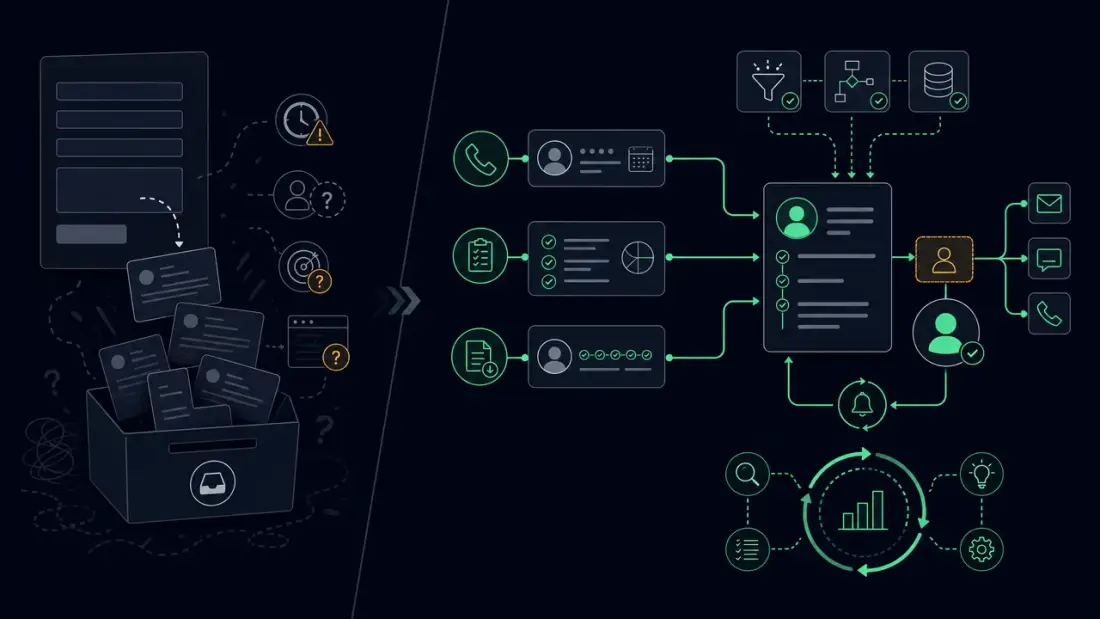
A contact form is not dead. It is just not enough. It is an entry point, not a lead generation system. The stronger question is: Which visitor intent deserves which next step, which three to six pieces of context does your team need for a useful response, and who owns the inquiry once it arrives?
Why the Contact Form Alone Is Not Enough
Many SMEs treat conversion as a contact page: if someone is interested, they will get in touch. That assumption only works for visitors who already have high buying intent, enough context, and enough trust. A referred buyer may want a callback immediately. A search visitor may first want to check whether the service fits. An operations manager may need a quick diagnostic. A founder may want to ask a first question without booking a meeting.
If all of these people receive the same path, friction appears. The strong lead has to explain too much. The uncertain lead gets no low-commitment next step. The technical lead cannot express urgency cleanly. Your team later sees one text field, but not the intent behind it.
The older Harvard Business Review article "The Short Life of Online Sales Leads" is not a current DACH benchmark and should not be treated as a modern formula. It remains useful as a directional warning: online inquiries lose value when response and ownership are slow or unclear. The form is only the beginning. The operating model after the form decides whether an inquiry can actually be handled.
The difference from a simple conversion-engine argument is depth. It is not enough to make a button larger. A serious lead system distinguishes intent, reduces form load, validates data server-side, stores source context, assigns an owner, triggers the right follow-up, and keeps human review visible for commercial commitments.
The Hidden Cost of Passive Lead Capture
Passive lead capture rarely appears as a clear line item. It costs decision speed, learning capacity, and trust in the process. At this machine service company, the cost appears in four patterns: Oskar asks for basic details again, Mira receives inquiries without priority, Lena cannot see which service pages create useful conversations, and Jonas can only inspect the form itself, not the full handoff.
Form quality is not cosmetic. Nielsen Norman Group's "Website Forms Usability" recommendations emphasize short forms, logical grouping, visible labels, clear optional fields, and specific error messages. For SMEs, that does not mean asking for everything. It means asking only for what the next step requires and moving deeper questions into the human conversation.
Technical performance also belongs to lead capture. Portent's analysis "Site Speed is (Still) Impacting Your Conversion Rate", based on large data samples, reports that speed is a relevant friction factor for B2B lead-generation pages. That is not a promise of revenue lift. It is evidence that slow or unstable pages create unnecessary barriers when intent is already present.
Google's Web Vitals define measurable signals for loading, interactivity, and visual stability. A lead system therefore starts before the form: with a page that loads quickly, stays stable, works on mobile, and tells the visitor which path fits their situation.
A Better Conversion Path Starts Before the Form
A better conversion path segments visitors by intent, not by your internal organization chart. High buying intent needs a callback or meeting path. Exploratory intent needs a short diagnostic. Technical uncertainty needs a clear question route. Educational interest can work through a lead magnet, but only when that lead magnet captures more than an email address.
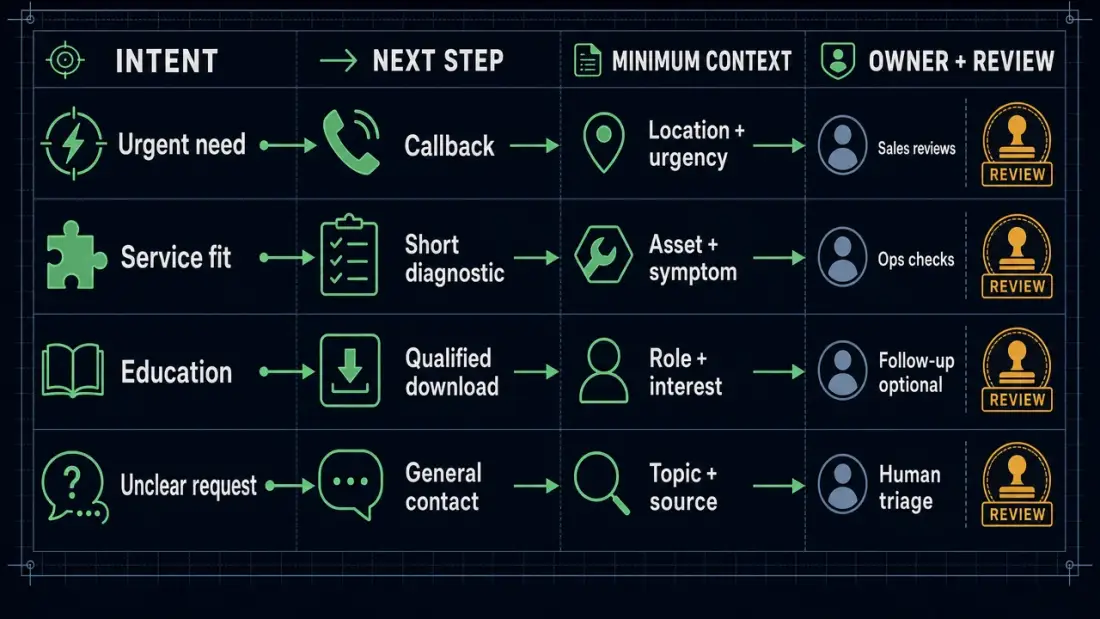
For this machine service company, the model could look like this: visitors on the emergency service page receive a callback path with location, machine type, urgency, and phone number. Visitors on a maintenance page receive a short service diagnostic with asset age, maintenance interval, and preferred time window. Visitors downloading a spare-parts checklist provide machine series, role, and consent boundary. Ambiguous requests still use the general contact form, but source and topic are captured in structured fields.
The practical rule is simple: the higher the intent, the shorter the path to a person. The lower or less clear the intent, the more useful a diagnostic intermediate step becomes. That protects both sides. Visitors are not forced into a long form, and your team receives enough context to avoid starting from zero.
From Web Form to Operating Workflow
The most important shift is conceptual: an inquiry is not an email event. It is the start of an operating workflow. Technically, that means the website should not only send a message. It should create a validated record that contains source, interest, urgency, consent, next action, and owner.
At Planfold, this pattern is backend-first. Lead data is validated server-side, enriched with context such as UTM parameters, referrer, and landing page, then handed into a controlled follow-up path. n8n can support the next layer as orchestration: acknowledgement, internal notification, CRM or task creation, reminders when nobody responds, and error handling when a step fails.
n8n's documentation on workflow executions and error handling matters because workflows should not merely run. They need visibility, filters, retries, and failure paths. At the same time, n8n is only the orchestration layer. It does not replace subject-matter decisions, consent boundaries, data classification, or human review.
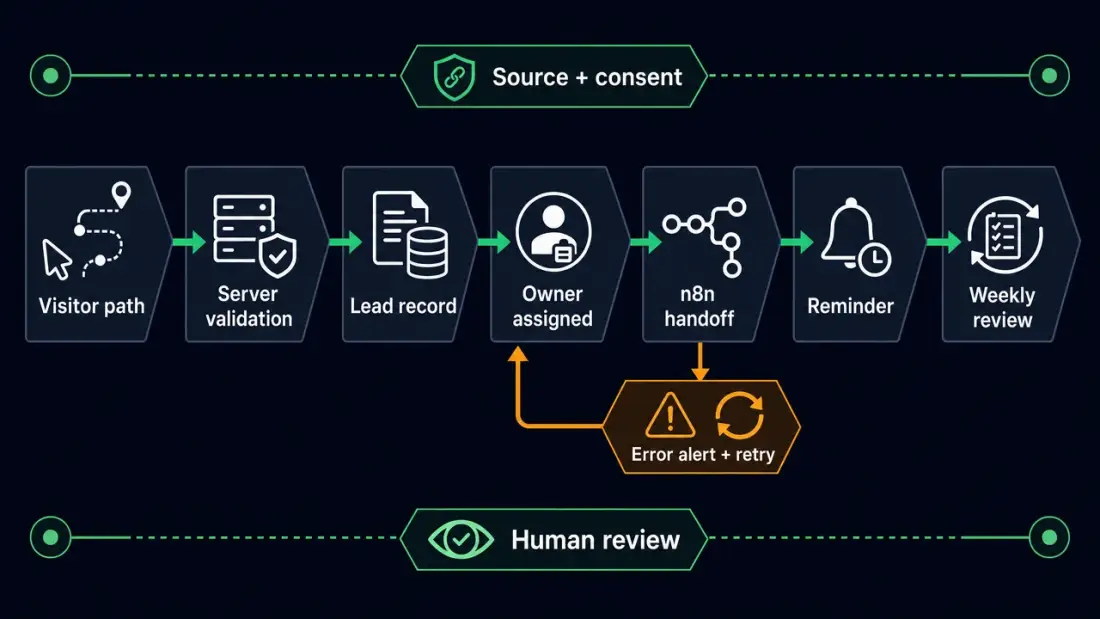
A robust SME starter model contains seven fields: lead source, service interest, urgency, company context, preferred contact path, owner, and next step. Add two status values: human review required yes/no, and follow-up deadline. More is often unnecessary at the beginning. Less often sends the team back into guesswork.
A Realistic SME Workflow
Back to this machine service company. Before the change, the company had a general form, inbox forwarding, and informal ownership. Oskar responded when he had time. Mira became involved once the request looked operational. Lena could see that inquiries existed, but not which path produced useful conversations.
After the change, the contact page and general form remain. Two intent-specific paths are added: a short service diagnostic for search visitors and a callback path for strong buying intent. Both produce the same base lead record, but with different required fields. The service diagnostic asks for machine type, symptom, location region, and preferred time window. The callback path asks only for phone number, urgency, location, and a short issue summary.
The human review gates are explicit. Automated emails only confirm receipt, expectation, and next step. Offers, technical commitments, pricing, and prioritization remain with Oskar or Lena. Urgent, ambiguous, or high-value inquiries route to manual review before any substantive reply. Mira only sees operational tasks once the lead has been classified as a service case.
Every Friday, Lena and Oskar review four questions: Which source created the best conversations? Which fields were frequently missing? Where did the follow-up deadline slip? Which automated message needed correction? These questions mark the difference between "we receive forms" and "we operate a lead process."
How Planfold Turns This Into a Digital Headquarters
Planfold does not treat lead generation as an isolated marketing tactic. It is part of the Digital Headquarters: your website explains the offer, captures intent, qualifies context, hands work into operations, and creates learning signals for the next improvement.
Plan means auditing the current visitor paths, forms, CTAs, source pages, validation, lead records, response times, and responsibilities. The output is not a slide deck. It is a map of where intent is lost and where rework is created.
Unfold means building the right conversion paths. That includes fast pages, intent-specific CTAs, concise forms, server-side validation, backend routing, source metadata, CRM or task handoff, and n8n workflows where automation makes operations more visible.
Resonate means operating the workflow. Lead quality, response time, missing fields, owner handoff, failed executions, and closed-loop learning are reviewed regularly. The website becomes a system that is easier to steer in daily work, not just a better-looking page.
The 30-Day Start Plan
You do not need a full relaunch to turn a contact form into a lead system. A good start takes 30 days and keeps the scope deliberately narrow.
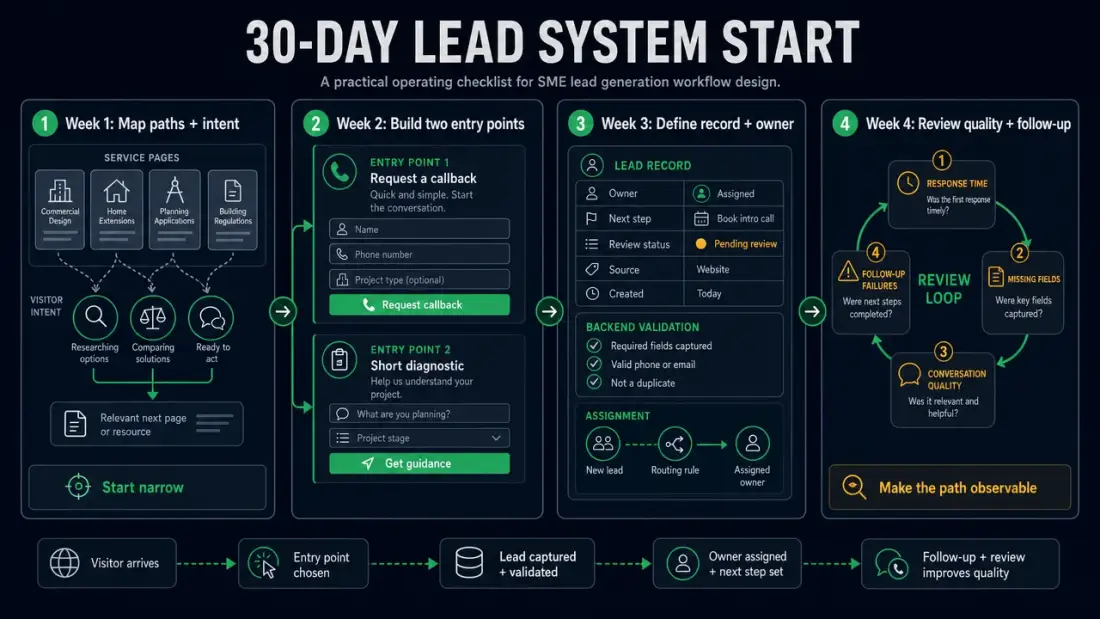
Week 1: Map the paths. List the main service pages, current forms, contact routes, and common inquiry types. Add who responds today and which information is usually missing. If you do not know the answer, that is already a signal.
Week 2: Build two better entry points. Choose one page with high buying intent and one page with an explanation-heavy offer. Define the right next step for each: callback, diagnostic, meeting, download, or general question. Keep fields short.
Week 3: Clarify the lead record and ownership. Define the minimum fields: source, interest, urgency, context, contact path, owner, next step, and review status. Decide which responses may be automated and where a person must review.
Week 4: Measure and refine. Review response time, missing data, conversation quality, owner changes, and follow-up failures. The goal is not perfect attribution. The goal is to stop operating blind.
If your website currently has only a general contact form, the next step is not another pop-up. The next step is a Presence review: which visitor intents actually exist, which two paths should be built first, and how an inquiry becomes a traceable operating workflow.
Plan. Unfold. Stay Sovereign.
Related Posts
Website Modernization for Traditional SMEs: From Digital Showcase to Trust-and-Fit Filter
AI Search Landing Page Architecture for SMEs: Turning Fewer Clicks into Better Qualified Leads