Visibility Through Architecture: Why Technical SEO Is the Foundation of Your Digital Presence
Technical faults can prevent Google from reliably fetching and processing your content. This article shows five common fault lines and a pragmatic improvement path.

Contents
Technical faults can prevent Google from reliably fetching and processing your content. This article shows five common fault lines and a pragmatic improvement path.
Share this article
The Invisible Ceiling: When Good Design Cannot Be Found
Sabine, managing director of a 45-employee metal construction company, invested EUR 25,000 in a website relaunch. The new design looks modern, the product images are sharp, the copy was written by an agency. Four weeks after go-live, Thomas, the external developer, reports that organic traffic has dropped by 40 percent. The old rankings are gone. Nobody knows why.
The opening scene is an illustrative relaunch example. A traffic decline alone establishes neither a technical fault nor its cause. First inspect redirects, indexing reports, and the affected queries. Demand, competition, and changes to content can also contribute.
Most SMEs understand SEO as a content discipline. They write blog posts, optimize keywords, acquire backlinks. In doing so, they overlook the fact that technical SEO is the invisible infrastructure on which all these measures must rest. When the architecture is flawed, even the best content is worthless — because no one ever sees it.
What Technical SEO Really Means — and What It Does Not
SEO Is Not Magic
Technical SEO creates the conditions for search engines to fetch pages and process their content. It does not guarantee indexing or rankings. An audit of the specific website must establish which technical issues actually matter.
The Three Pillars: Crawl, Understand, Evaluate
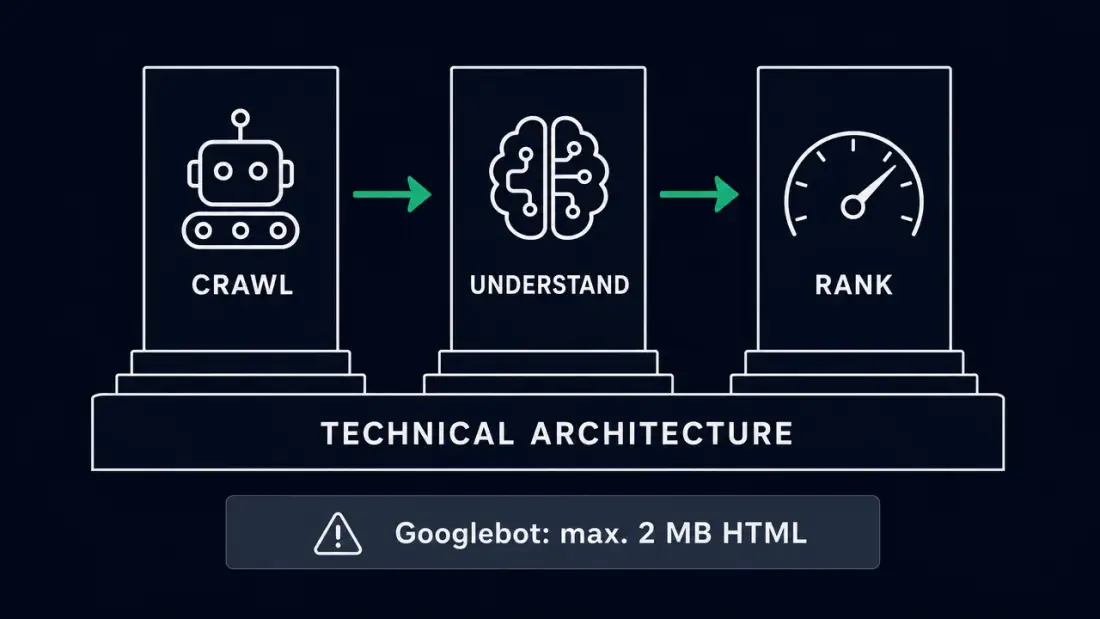
Three steps provide a simplified working model; rendering and indexing are distinct processing stages within it:
- Fetch: The crawler requests the URL and required resources. Access restrictions, server errors, and unreachable links can prevent retrieval.
- Process: The search engine processes HTML and, where supported, rendered JavaScript. Visible text, links, and appropriate structured data help it interpret the content.
- Select: The search engine decides what to index and display for a query. Technical accessibility alone is insufficient; relevance and quality remain essential.
Google documents a 2 MB HTML fetch limit, including the described headers, in its March 2026 crawler article. Referenced resources are fetched separately. Most sites will not approach this limit; very large inline scripts or embedded base64 images can make it relevant.
Five Architectural Fault Lines Blocking SME Websites
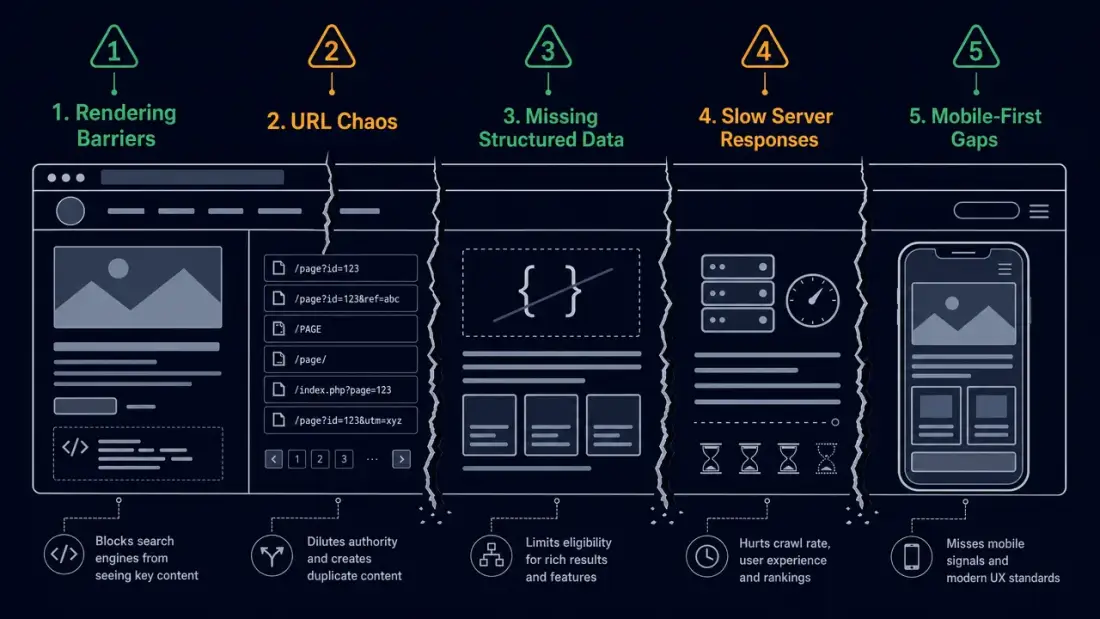
1. Rendering Barriers: When the Crawler Sees Empty Pages
Modern websites are often built with React, Vue, or Angular as single-page applications. The user's browser renders content client-side — text only appears after the JavaScript code has loaded. For a human visitor, this works. For a crawler analyzing the HTML source, the page often looks empty.
Google can render and process JavaScript, so client-side rendering does not automatically make a page invisible. Blocked resources, script failures, or content requiring interaction can still obstruct processing. SSR or SSG can provide important text and links in the initial HTML and reduce that dependency.
2. URL Chaos: Duplicates, Parameters, and Dead Endpoints
Choose a preferred URL for indexable content. The same content can appear at multiple addresses, such as parameter variants or different hosts. Redirects, internal links, sitemaps, and canonicals should support the same preferred address. Multiple URLs are not automatically a violation or evidence of ranking loss.
A canonical is a signal to search engines. It replaces neither checking which version Google actually selects nor appropriate relaunch redirects. Map old URLs to relevant successors and pay particular attention to destinations with existing visitors and external links.
3. Missing Structured Data: Why Google Cannot Understand Your Content
Appropriate structured data can make a page eligible for particular enhanced search appearances. Google explicitly does not guarantee those results. Use supported types that accurately describe visible content; not every Schema.org property produces a search feature.
A search engine can understand text and prices without markup. Structured data makes particular facts explicit. Whether images, prices, or other enhancements appear also depends on supported search features, content policies, and Google's selection.
4. Slow Server Responses: The Hidden Crawl-Budget Drain
Crawl budget concerns the volume and frequency of crawling. For small sites it is usually not a separate optimization priority. First check accessibility, internal links, the sitemap, and indexing reports. Slow or failing server responses still create a concrete problem for visitors and crawlers.
Core Web Vitals assess loading, responsiveness, and layout stability. Use field data where available and complement it with targeted lab measurements. A good Lighthouse score does not promise rankings; a poor result identifies something to investigate.
5. Mobile-First Gaps: When Responsive Design Only Half Works
Google announced the final move to smartphone Googlebot for 5 July 2024. Mobile content and resources need to remain accessible. Mobile-first indexing concerns processing the mobile version; it does not mean every rendering difference triggers a blanket ranking penalty.
Many businesses believe a responsive theme is sufficient. In reality, image sizes, interaction targets, font contrasts, and the loading hierarchy must be deliberately optimized for mobile use. What looks impressive on a 27-inch monitor can become a burden on a 6-inch display.
Why Content Alone Cannot Save Bad Architecture
The Content-Quality Myth
"Content is king" is one of the longest-lived myths in digital marketing. It is also one of the most expensive when it leads companies to keep investing in copy while the technical foundation crumbles. An excellent blog article that is not indexed because the page takes 12 seconds to first byte is not an asset. It is a hidden cost line.
In the illustrative metalworking example, Lisa first needs to inspect the affected URLs in Search Console. Are links missing from the processed HTML? Is noindex active? Are there redirect loops or server errors? Those observations justify technical corrections. A missing sitemap alone does not explain why an accessible, linked article remains unindexed.
The Paid-Ad Trap
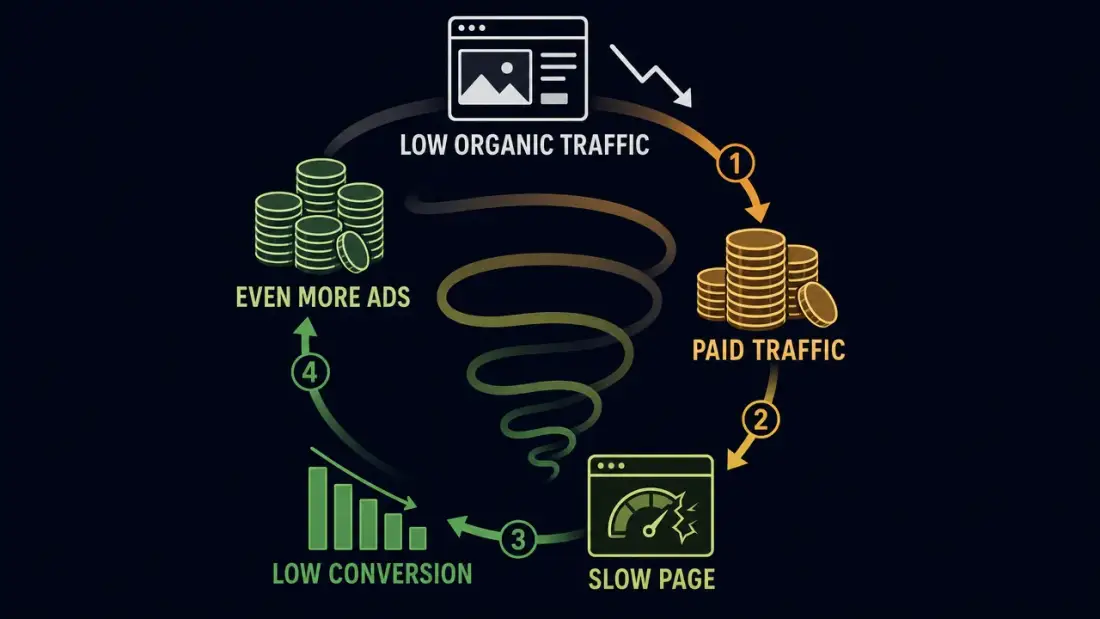
When organic visibility is missing, companies must acquire traffic through other channels. Google Ads, LinkedIn campaigns, display advertising — all short-term working channels that eat margins over the long term. According to Portent, websites that load in one second have three times the conversion rate of those that take five seconds. This means: a slow website not only burns organic potential but also makes paid traffic more expensive, because more visitors leave before converting.
Lost organic reach does not automatically have to be replaced with advertising. First establish which queries and pages are affected and what business value they had. Technical corrections, better content, or a different acquisition channel may be appropriate depending on the cause.
From Audit to Architecture: A Pragmatic Improvement Path
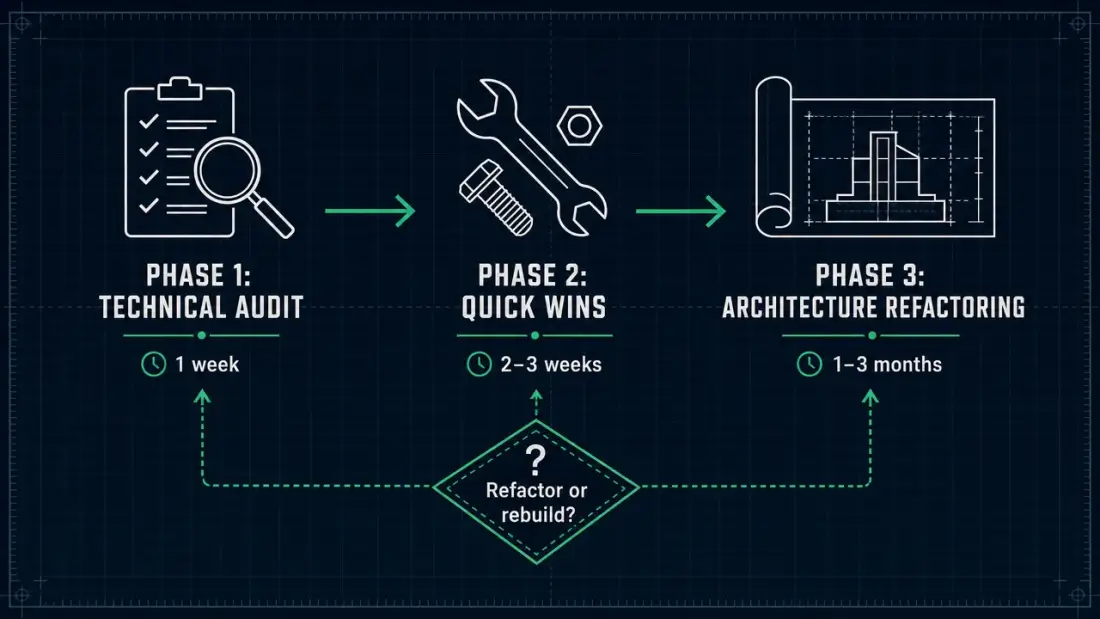
Technical SEO is not a one-time project but an ongoing architectural process. For SMEs without a dedicated SEO team, a three-phase approach is recommended that sets priorities and delivers measurable intermediate results.
Phase 1: Technical Audit (1 Week)
The goal is to capture the status quo and identify the biggest blockers. The audit covers:
- Crawlability check: robots.txt, XML sitemap, canonical tags, internal linking, redirect chains
- Indexation check: Google Search Console for indexation errors, manual actions, and crawl statistics
- Performance baseline: Core Web Vitals for mobile and desktop via PageSpeed Insights or Lighthouse
- Rendering test: Selected pages checked with the Search Console URL Inspection tool for server-side HTML output
The result is not a 100-page presentation but a prioritized list of five to ten concrete actions with estimable impact.
Phase 2: Quick Wins (2–3 Weeks)
Quick wins are measures with high impact and manageable effort:
- Correct faulty redirects and route 404 pages to meaningful targets
- Add JSON-LD structured data for products, services, FAQs, and organization
- Compress images and serve modern formats such as WebP or AVIF
- Switch critical pages to server-side rendering or static generation
- Implement hreflang tags for multilingual content
These measures do not require rebuilding the website. They demand targeted interventions in the existing architecture that an experienced developer can implement within days.
Phase 3: Architecture Refactoring (1–3 Months)
When the foundation is systematically weak, structured refactoring pays off:
- URL taxonomy: Consistent, descriptive URL structure with clear hierarchy and canonical discipline
- Internationalization: Complete hreflang setup for all language versions with automated validation
- Performance budget: Definition of maximum load times per page type and monitoring setup
- Crawl optimization: Internal linking structure designed so that important pages sit closer to the homepage and less relevant pages are deliberately excluded
At this point, the strategic question arises: is refactoring the existing platform worthwhile, or is a targeted rebuild on modern architecture more economical? The answer depends on the age of the system, the number of pages, and the technical debt. For a five-year-old CMS with 50 plugins, a rebuild is often the cheaper path.
The Planfold Perspective: Visibility as Foundation, Not Add-On
Why Performance and SEO Belong Together
At Planfold, we view digital presence as an architecture task. A website is not a digital brochure that gets optimized afterward. It is a technical system that must be built from day one so that search engines can understand it. This means:
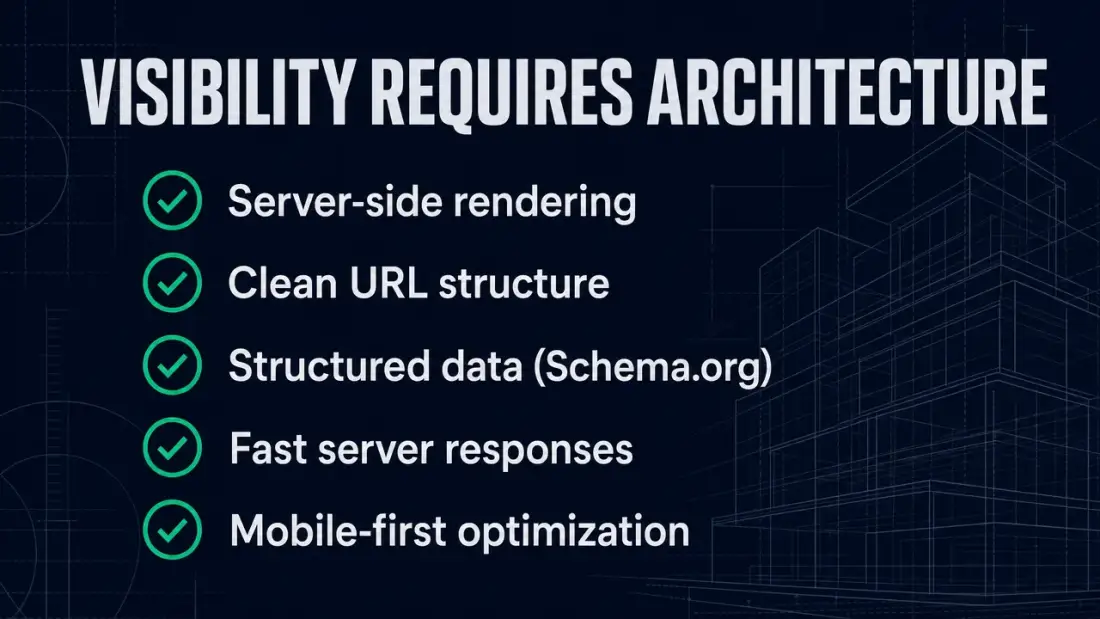
- Server-side rendering or static generation as standard, not as an option
- Semantic HTML that makes content structure and hierarchy recognizable without CSS or JavaScript
- Structured data using Schema.org that describes products, services, and organizations in machine-readable form
- Hreflang and canonical discipline that prevents multilingual content from competing against itself
- Core Web Vitals-first performance pursued as an architectural criterion from the first commit, not as a post-hoc optimization
The Planfold Standard delivers these foundations not as an add-on package, but as an integral part of every website. The question is not: "Do you also want SEO?" The question is: "Should your website be found — or not?"
The Next Step
Technical SEO is not a specialist project that the rest of the company walks past. It is a business decision with measurable return: every page that gets indexed is a potential channel for organic traffic. Every page that does not get indexed is a missed opportunity.
If you suspect your website suffers from architectural flaws, start with a technical audit. It reveals not only problems but prioritizes them by impact and effort. From this audit, a concrete roadmap can be derived — regardless of whether you work with your current developer, an agency, or a new partner.
Technical visibility is a pillar of the sovereign digital headquarters. It ensures that your knowledge, your products, and your services are discoverable where your customers search.
Plan. Unfold. Stay visible.