The AI Knowledge Gap: Why AI Fails When Your Business Knowledge Is Missing
AI projects rarely fail because the model is weak. They fail when processes, data ownership, and accountability are unclear. Here is how SMBs can close the AI knowledge gap.

Contents
AI projects rarely fail because the model is weak. They fail when processes, data ownership, and accountability are unclear. Here is how SMBs can close the AI knowledge gap.
Share this article
The real AI problem is not the model
Many AI projects begin with the wrong question: "Which model should we use?"
It sounds technical, modern, and decisive. For many small and mid-sized businesses, it is not the question that matters most. A better question is: What business knowledge does the AI need before it can do useful work?
That is where the AI knowledge gap appears.
It rarely looks like a dramatic failure. It looks like a vague answer, a wrong recommendation, an outdated process step, or an automated email that sounds fluent but does not match how your company actually works. The AI feels competent because the language is polished. Operationally, it still fails.
The issue is usually not that the model is too weak. The issue is that it is working without your actual context:
- Which process is authoritative?
- Which exceptions are allowed?
- Which data may move where?
- Who is accountable for quality?
- What happens when the AI is uncertain?
Without those answers, AI does not create reliable automation. It creates faster ambiguity.
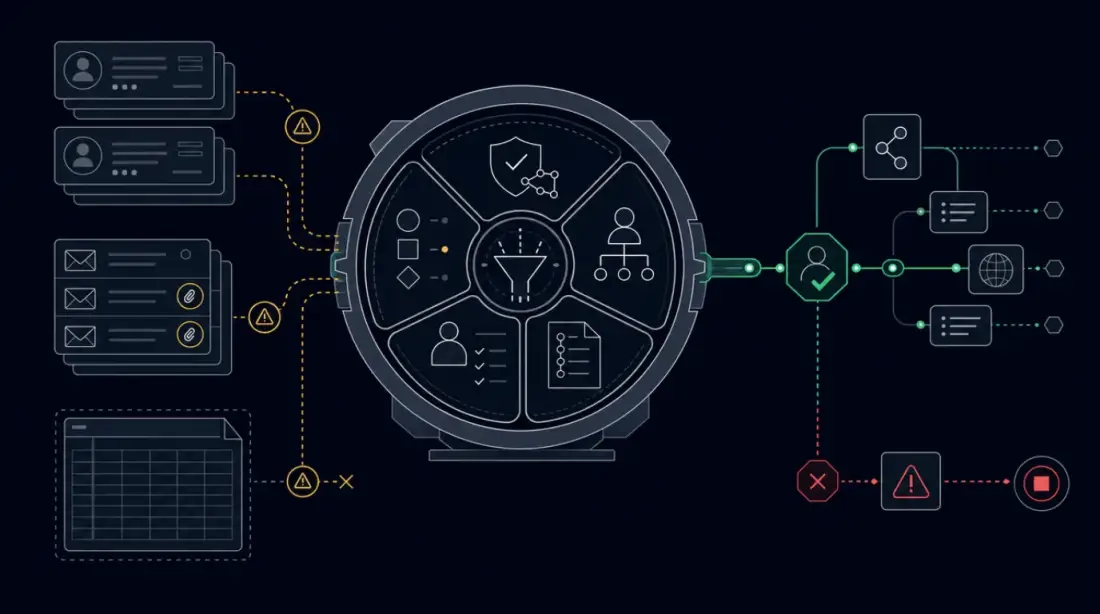
Planfold's answer is the source-based AI review: AI bound to your data, workflows, ownership boundaries, and review points. Not a generic chatbot. Not a demo. A digital machine that works with the knowledge your business actually owns.
What the AI knowledge gap really means
The AI knowledge gap is the distance between what an AI system can say fluently and what your company has actually decided, documented, and controlled.
A model can explain how a typical sales qualification process works. That does not mean it knows your process. It does not automatically know when you ask technical follow-up questions, which customer segments have priority, which pricing logic applies, or which contract clauses create risk in your market.
For SMBs, the gap usually grows for ordinary reasons:
- Process knowledge lives in people's heads, not in systems.
- Documentation exists but is outdated or scattered.
- SaaS tools hold partial data, not full context.
- Ownership has grown historically rather than intentionally.
- Decisions happen in email, chat, and meetings.
- Nobody owns data architecture as a business capability.
When people check everything manually, this disorder is expensive but survivable. Once AI starts automating on top of it, the risk scales. AI does not only scale good processes. It scales gaps too.
Five signs your business is not AI-ready yet
AI readiness does not mean every internal file is perfectly organized. It means the most important knowledge flows have enough structure, ownership, and control to become usable by automation.
These five signs show where work is needed first.
1. Everyone explains the core process differently
Ask sales, operations, and leadership how a lead moves from first contact to paid project. If you get three different versions, AI will not invent a fourth and better one. It will produce a plausible blend.
That becomes risky around proposal creation, customer scoring, invoice review, support triage, and any workflow where small differences matter. An AI system needs more than examples. It needs authoritative process logic.
2. Documentation is an archive, not an operating tool
Many companies have documentation. The problem is not absence. The problem is that nobody knows which document still applies.
A RAG system can search internal documents and answer with source context. But if the sources contradict each other, the answer only carries the contradiction forward. A knowledge base is not a magic filter. It needs curation, priority, and clear validity.
3. Data ownership is unclear
Who decides which customer data may enter an AI system? Who checks whether supplier data, contracts, or internal calculations are processed by an external service? Who can delete, export, or migrate that data?
If those questions are unresolved, AI is not just a productivity project. It becomes a sovereignty risk. That is why data sovereignty belongs at the start of an AI strategy, not at the end.
4. There is no escalation logic
AI must not behave as if it is always right. Good systems understand uncertainty. They can flag cases, show evidence, log decisions, and hand work to humans.
If an AI workflow has no stops, reviews, or accountable owners, it is not a digital machine. It is a black box with polite language.
5. Success is measured by demo impact
An impressive demo is not operational proof. The question is not: "Does the answer sound good?" The question is: "Did the AI complete a real task with our context correctly, transparently, and repeatably?"
That is the difference between AI theater and automation that actually reduces operational work.
Why generic AI is not enough for business knowledge
Generic AI is useful when the task is generic: drafts, summaries, wording variants, research support, first-pass structure.
Business work is rarely generic.
An operations lead does not need "a good answer." They need the right answer for the current customer, the valid process, the correct data source, and the internal approval path. A founder does not need AI theater. They need a workflow that saves time, reduces mistakes, and remains inspectable when something goes wrong.
This is why many AI initiatives stall after the pilot:
- The team tests a generic tool.
- Early results look useful.
- The tool is pointed at real processes.
- The AI hits unclear data, exceptions, and ownership gaps.
- Trust drops because nobody can explain why an answer was produced.
- The project is scaled back or remains a side experiment.
That is not a rejection of AI. It is an architecture problem.
AI needs a foundation of:
- curated business knowledge
- clean data flows
- clear ownership boundaries
- auditable workflows
- human review in the right places
Without that foundation, the result is AI slop: plenty of output, little operational reliability.
The role of an internal knowledge base
An internal knowledge base is not just a folder of PDFs. For AI, it is the controlled context behind answers, workflows, and decisions.
In practice, that means:
- Processes are converted into valid, versioned documents.
- Outdated information is removed or clearly marked.
- Subject matter knowledge is connected to owners.
- Access follows roles and data classes.
- Answers show sources, not just fluent text.
- Feedback from usage improves the knowledge base.
RAG, or Retrieval-Augmented Generation, is often a strong pattern for this. The language model does not freely invent the answer. It retrieves relevant information from a controlled knowledge base and uses that context to produce a response.
But RAG only solves part of the problem. It answers: "Where does the AI get context?" It does not automatically answer:
- Who maintains the context?
- Which data may be indexed?
- How are sources prioritized?
- When does a human need to review?
- How does an error become visible?
Those questions determine whether AI earns trust in daily work.
Planfold connects the knowledge base, workflow, and ownership model. Not merely an AI assistant, but a system that fits into your Digital Headquarters.
From scattered knowledge to controlled AI architecture
A useful AI project rarely starts with the model. It starts with a map.
Step 1: Identify critical knowledge flows
Which work depends heavily on internal context today?
Common candidates include:
- proposal qualification
- technical pre-checks for customer requests
- support triage
- invoice and document review
- internal process search
- employee onboarding
- supplier and contract management
Do not pick the loudest use case. Pick the one where better access to knowledge saves measurable time or prevents errors.
Step 2: Clarify sources and owners
Every use case needs clear answers:
- Which systems hold relevant data?
- Which documents are valid?
- Who may change content?
- Who owns the business logic?
- Which data is sensitive?
This may sound unglamorous. It is the part that turns AI into an actual business capability.
Step 3: Define data boundaries
Not every piece of knowledge belongs in every system. Customer data, contract information, internal calculations, and operational telemetry need different boundaries.
A sovereign AI system treats those boundaries as architecture, not as a privacy note added later. It records which data is processed, where it lives, who can access it, and how it can be exported or replaced.
Step 4: Build workflows with control points
AI should not answer in isolation. It should be part of a workflow:
- detect the input
- retrieve context
- create a recommendation
- show evidence
- flag uncertainty
- request approval
- execute the action
- log the result
That creates a digital machine that reduces workload without blurring responsibility.
Step 5: Measure quality
AI quality is not a matter of taste. It can be tested:
- answer accuracy on known cases
- share of answers with correct source grounding
- time saved per workflow
- escalation rate
- error rate before and after launch
- acceptance by process owners
This is what separates precision AI from mass-market AI.
What Planfold builds differently
Planfold does not treat AI as an isolated add-on. AI is part of your Digital Headquarters: processes, data, automation, hosting, security, and ownership work together.
That matters especially for SMBs without an internal platform team. You do not need another tool that somebody has to babysit forever. You need a care-free package with clear technical accountability and an exit key if requirements change.
In practical terms:
- source-based AI review: AI outputs are tied to real sources, rules, and review paths.
- Full-service implementation: Architecture, implementation, hosting, maintenance, and evolution are designed together.
- Ownership instead of dependency: Code, data flows, and system architecture remain understandable and portable.
- Auditable workflows: Decisions, sources, and handoffs are visible.
- Sovereign architecture: External services are selected deliberately, limited, and replaceable.
The goal is not to use AI loudly. The goal is to make work reliably better.
If you need a first pass on direction, the Planfold Roadmap helps sort automation and AI candidates. If you want to see how Planfold structures operational systems, the Proof section has concrete implementation stories.
The connection to the chatbot problem
In Beyond the Chatbot, we argued that AI is often applied at the wrong surface. Many companies start with a chatbot because it is visible. Visible does not mean valuable.
The AI knowledge gap explains why that mistake is so common.
A chatbot is easy to demo and hard to operate well. It immediately touches every gap in your business knowledge: outdated answers, exceptions, missing ownership, unclear data permissions, and undocumented process details.
The better path is usually less flashy and far more useful:
- First, organize knowledge.
- Then prioritize processes.
- Then apply AI at controlled points.
- Then measure, review, and expand.
That turns AI from a surface for uncertainty into infrastructure for better work.
A pragmatic AI readiness check
Before you start an AI project, answer these ten questions:
- Which concrete process should improve?
- Which decision or task should AI support?
- Which sources does AI need?
- Which source wins when content conflicts?
- Who owns the process from the business side?
- Who owns the data from the technical side?
- Which information must not go to external services?
- When does a human need to review?
- How will a wrong answer be detected?
- What will you measure after 30, 60, and 90 days?
If you can answer these cleanly, you are further along than most AI projects after their first demo.
If not, that is not a reason to avoid AI. It is the right place to begin.
Close the knowledge gap before AI scales it
AI rarely fails in companies because the technology is useless. It fails because the business has not clearly defined which knowledge the AI may use, which processes are valid, and who is accountable for quality.
The solution is not another generic tool. The solution is a controlled architecture:
- owned and maintained business knowledge
- clear data and ownership boundaries
- workflows with review paths
- measurable quality
- full-service operation with an exit key
Then AI stops adding noise. It becomes a reliable part of your digital machine.
Plan. Unfold. Stay Sovereign.
Related Posts
When a Foreign Government Gates Your AI Access: Sovereign AI Procurement as a Board-Level Risk for SMEs

The Economics of Open-Weight AI: Why Self-Hosting Now Makes Business Sense for SMEs