Agentic Workflows: When Automation Starts to Reason
Agentic workflows combine planning, tool use, and verification. Learn how SMBs can gain leverage without losing control of data, logic, or AI operations.

Contents
Agentic workflows combine planning, tool use, and verification. Learn how SMBs can gain leverage without losing control of data, logic, or AI operations.
Share this article
The Automation Ceiling
Most companies have already automated something. A form triggers an email. An invoice lands in the right folder. A lead moves into the CRM. A weekly report gets sent without anyone touching a spreadsheet.
That work matters. But most of it is still linear automation.
The pattern is simple: if A happens, do B. The workflow is fast as long as reality matches the script. When an input arrives in a different format, an API fails, a customer request contains an edge case, or a process needs judgment, the workflow either breaks or pushes the task back to a human.
That ceiling is especially visible in small and mid-sized businesses. Teams are compact. Roles are broad. Exceptions are normal. A rule-based workflow can compare fields, call tools, and choose predefined branches. It needs explicit handling for situations outside those rules; adding a model introduces a different way to propose and evaluate the next step, together with new error modes.
The better question is no longer: "Which task can we automate once?" It is: "Which work can a system plan, execute, verify, and hand back to humans at the right moment?"
That is where agentic workflows begin.
What Makes a Workflow Agentic
An agentic workflow is not a single AI chat and it is not a smarter macro. It is an operating pattern where an agent pursues a goal, uses approved tools, checks intermediate results, and chooses the next step based on the current state of the work.
Three capabilities separate agentic workflows from classic automation.
1. Planning Instead of Fixed Steps
A linear workflow knows every step in advance. An agentic workflow starts with a goal and turns it into a working strategy. For a research task, that may mean narrowing the topic, checking internal sources, listing open questions, searching external material, synthesizing findings, and preparing a draft.
The human sets the goal, boundaries, and quality criteria. The agent decides the useful sequence of substeps inside those boundaries.
2. Tool Use Instead of Isolated Answers
An agent becomes valuable when it can work with real systems: search, databases, document stores, code repositories, ticketing systems, spreadsheets, email interfaces, or internal knowledge bases.
The important part is not the number of tools. It is controlled access. Which data may the agent read? Which actions may it take? When does it need approval? Which results need to be logged?
3. Verification Instead of Blind Output
Strong agentic workflows run in loops. They do not simply produce an answer. They test intermediate work against defined criteria. If a source is missing, the agent searches again. If a draft does not match the brief, it revises. If a risk cannot be assessed clearly, a human reviews it.
At Planfold, this follows the Research -> Strategy -> Execution cycle: gather context, define the route, then execute with controls. That does not make AI magical. It makes AI operational.
Technical Deep Dive: The Architecture Behind Agentic Workflows
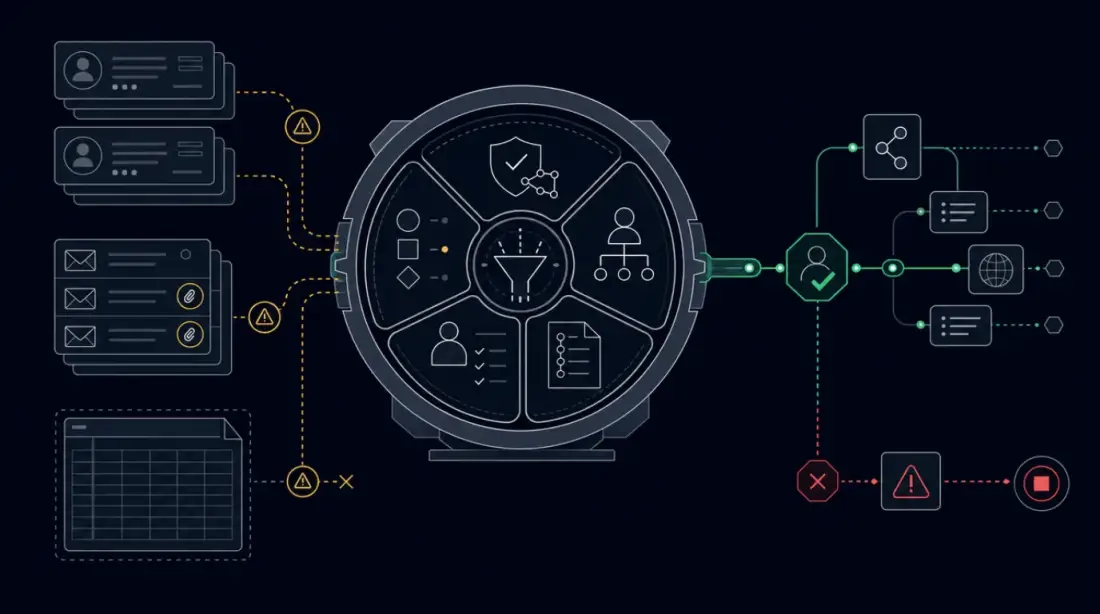
A reliable agentic workflow is more than a language model. The model is the reasoning and language layer. Underneath it, the system needs architecture for state, tools, permissions, quality checks, and human control.
The core is state-preserving execution. The agent should not solve everything inside one giant prompt. It needs to track the goal, the information already checked, open assumptions, tools used, and the next planned step. This state matters because meaningful work rarely happens in a single pass.
On top of that sits the tool layer. An agent must not act freely across the business. It needs defined capabilities: read, search, summarize, compare, draft, update a ticket, prepare a file, or request approval. Each capability has limits. Some tools only provide context. Others change live systems and therefore need stricter permissions.
The third layer is verification. Agentic workflows should not leave quality control until the end. They check during execution: Do the sources match the brief? Did the agent miss a required field? Are there conflicting data points? Is the answer merely fluent, or is it supported by evidence? Some checks can be automated. Sensitive decisions still need a human checkpoint.
Multi-agent systems add orchestration. One agent may research, another may structure, a third may run technical validation. That only helps if the roles are coordinated. Each handoff needs clear output formats, responsibility, and review criteria. Otherwise, the system creates faster confusion rather than better work.
For a business, this architecture matters more than the model name. The most capable model will still fail if it receives weak context, has unclear boundaries, and leaves no audit trail. Agentic workflows become business-ready when they are built as a digital machine: with inputs, state, checks, logs, permissions, and an exit key.
The Leverage Multiplier: A Practical Example
Imagine a small B2B company that wants to publish four expert articles, two case-study drafts, and several LinkedIn posts each month. Today, the work depends on one marketing lead. She collects topics, researches, checks internal notes, prepares briefs, drafts content, gathers feedback, and gets everything ready for publication.
Classic automation only helps around the edges: calendar reminders, folder templates, maybe a scheduled social post. The real work remains manual because it requires context, judgment, and language.
An agentic workflow can organize the process differently:
- The agent searches approved sources: older articles, service pages, support questions, sales notes, and a topic backlog.
- It suggests topics based on search intent, freshness, and positioning.
- It prepares a brief with audience, thesis, structure, internal links, and open questions.
- It checks the draft against content rules: no unsupported claims, no legal statements without approval, the correct tone for each locale, and a clear CTA.
- It flags points that need a human decision.
- Only after review does the article move toward publication.
The value is not "AI writes a blog post." The value is that repeatable preparation becomes systematic. The marketing lead spends less time searching, sorting, and formatting, and more time on positioning, subject-matter review, and final quality.
The same pattern applies outside marketing: proposal preparation, support triage, vendor review, internal knowledge search, or technical documentation. Agentic workflows create leverage where work contains many small decisions but still needs clear rules and review paths.
Sovereignty in the Age of Agents
The more agents can do, the more important it becomes to ask who they work for. A simple automation trigger moves data. An agent reads context, makes suggestions, prioritizes work, writes content, and may act inside operational systems. That makes it part of your business logic.
If that logic lives inside a closed SaaS platform, a new dependency appears. You may see the output, but you may not fully control which data was used, which rules were applied, how long logs are stored, or how the workflow can move to another provider.
This is agent sprawl: useful-looking AI features spread across tools without a central operating model. One assistant in the CRM, one in the support desk, one in the document store, one in the marketing platform. Each promises productivity. Together, they create unclear data flows, inconsistent quality standards, and blurred responsibility.
Planfold takes a different position: agentic automation belongs inside a sovereign digital headquarters. That does not mean every model or interface must be self-hosted. It means the architecture, data flows, permissions, logs, and exit options remain understandable and under your control.
Our Care-free Package combines convenience with sovereignty. Planfold handles architecture, implementation, hosting, maintenance, and continuous improvement. At the same time, you keep the exit key: code, data flows, and system logic do not become an invisible rental object. They become a business asset you can understand, audit, and port when needed.
Source-based AI review combines approved sources, bounded access, and human approvals. Errors can still occur. Evaluate quality against concrete tasks and recorded corrections.
How to Start Without Overbuilding
The first agentic workflow should not be the largest or riskiest process in the company. Start where the preparation work is heavy, the data sources are limited, and human review is already part of the process.
Good starting points include:
- research and briefing for recurring content
- pre-qualification of customer inquiries
- summarizing and routing support cases
- preparing proposals from approved building blocks
- checking internal documentation for gaps
- creating decision briefs from multiple sources
For every candidate, answer three questions:
- Which decision may the agent make, and which decision must remain human?
- Which sources are authoritative, and who owns them?
- How do we know the result is good enough?
If those questions stay open, the agent will only produce faster guessing. If they are answered, it can take on real work.
Conclusion: Agents Need Architecture
Agentic workflows are the next step after classic automation. They matter because they do not only trigger tasks. They plan work, use context, and verify outcomes.
For SMBs, that creates real leverage. Small teams can handle more complex work without building a separate department for every process. But the advantage only holds if agents are not allowed to spread as disconnected SaaS features. They need to be built as a controlled digital machine.
Planfold builds that machine with full-service responsibility and sovereignty at the core: Plan. Unfold. Stay Sovereign.
Ready for Controlled AI Automation?
If you want to find the right starting point for agentic workflows, begin with a concrete process instead of a model comparison.
Related Posts
When a Foreign Government Gates Your AI Access: Sovereign AI Procurement as a Board-Level Risk for SMEs
The Economics of Open-Weight AI: Why Self-Hosting Now Makes Business Sense for SMEs