The Cost of Convenience: Why SaaS Sprawl is Eroding Your SME's Sovereignty
SaaS sprawl costs SMEs more than subscription fees: fragmented data, context-switching drag, and vendor lock-in. Here's how to build a sovereign architecture that restores control.

Contents
SaaS sprawl costs SMEs more than subscription fees: fragmented data, context-switching drag, and vendor lock-in. Here's how to build a sovereign architecture that restores control.
Share this article
The Monday Morning When 45 Minutes Vanished
It's Monday, 8:30 AM. At a 35-person engineering services firm, a project engineer is searching for a customer record. It was entered last week — but in which system? The new CRM? The project management tool? Maybe it's buried in a Slack thread or floating in an Excel sheet somewhere in a Microsoft Teams channel.
After 45 minutes of searching across three SaaS platforms and interrupting two colleagues, the record is found. The relief doesn't last: this time loss is not an isolated incident, but the symptom of a systemic problem. The average digital knowledge worker now toggles between apps nearly 1,200 times per day 1. That is not convenience. It is an operational cost that compounds month after month.
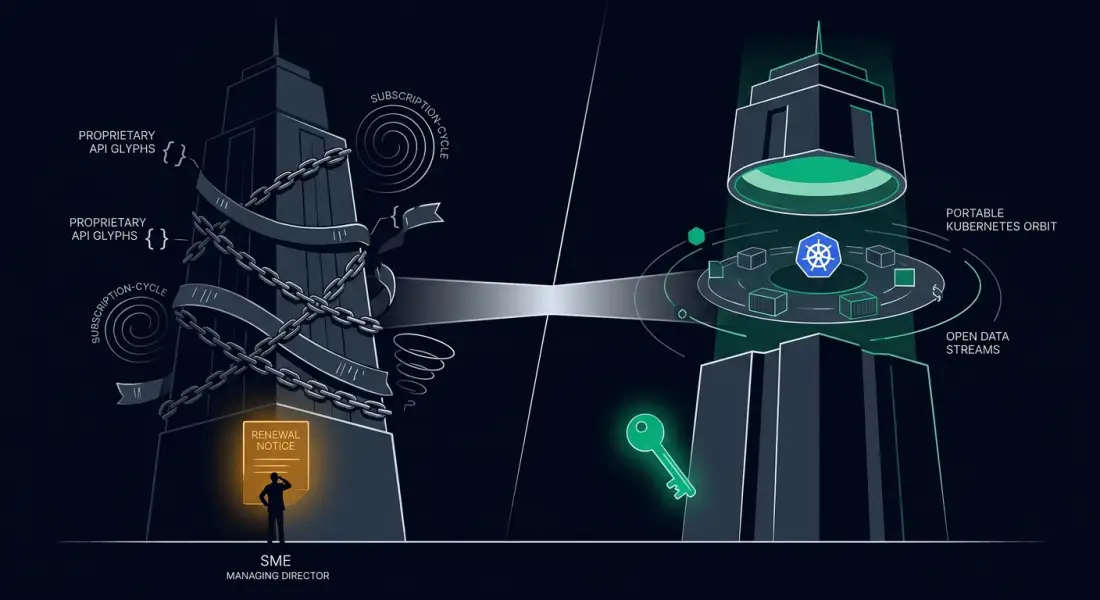
The cause is SaaS sprawl: the creeping accumulation of subscriptions, each purchased to solve a specific problem, but together creating a larger one — the fragmentation of the business itself.
The Problem: SaaS Sprawl as an Architecture Problem
SaaS sprawl describes the transition from a sensible selection of tools to an overwhelming burden of management and integration. Mid-market firms with 100–999 employees typically operate 100+ specialized applications simultaneously. For smaller SMEs with 10–100 employees, the absolute number is lower, but the ratio of managed tools to available IT capacity is often even less favorable.
Why is this a sovereignty issue? Sovereignty means controlling your own digital destiny. When mission-critical data is trapped in dozens of isolated silos, you only own it on paper. In practice, you cannot move it easily, analyze it holistically, or protect yourself against arbitrary price increases or API changes. You have surrendered control of your processes to business models that are not your own.
The Hidden Taxes of Fragmentation
The true costs of SaaS sprawl lie beyond the monthly subscription fees. They act as a hidden tax on budget, productivity, and strategic agency.
The Financial Leak: Subscription Inflation and Hidden Costs
Organizations spent an average of $4,830 per employee on SaaS solutions in 2025 — a 21.9% increase year-over-year 2. But that is only the visible tip.
Statistical analyses show that roughly 50% of all SaaS licenses remain unused for 90 days or longer 3. Shadow IT — applications used by individual departments without IT coordination — adds an estimated 30–40% to official software spend 4. Particularly frustrating for SMEs is the "SSO Tax": many vendors charge massive premiums for basic features like Single Sign-On or extended API access, forcing small companies into oversized Enterprise tiers.
The Operational Tax: Context Switching and Data Silos
The financial loss is measurable; the operational loss is more expensive over time. Context switching results in the loss of approximately five full workweeks per year per employee — roughly 9% of total annual work time 1. Research from Cornell University confirms that it takes an average of 9 minutes and 30 seconds to regain productive flow after a single app switch 5.
When employees spend an average of 59 minutes per day searching for information across fragmented data silos 6, little time remains for the core tasks they were hired to perform. Data from Asana reinforces this: 58% of the workday is consumed by "work about work" 7. For a 12-person SME team, this means hundreds of hours per year spent on coordination rather than value creation.
Diagnostic: Warning Signs of a Tool-First Mentality
Do you recognize these signals in your company? A tool-first mentality — reflexively buying software for every new problem — is often the beginning of creeping architectural erosion.
A clear warning sign is when "integration" in your company means copying and pasting data between systems. If you are also afraid to cancel a tool because you will lose access to your historical data, you are already in vendor lock-in. According to Gartner, the average enterprise wastes 30% of its SaaS budget on unused licenses, duplicate tools, and shadow IT 8 — effectively paying multiple times for similar functionality.
Technical Depth: Sovereignty Through Architecture
The sustainable solution is not to stop using modern software, but to shift from a short-sighted tool-first approach to a strategic architecture-first strategy. Sovereignty is achieved not through cancellations, but through owning the integration layer that orchestrates the tools.
The Sovereign Operating Model: Four-Field Decision Matrix
The following matrix shows how the architecture decision affects four central criteria:

| Criterion | Tool-First (Current) | Architecture-First (Target) |
|---|---|---|
| Data ownership | Vendor-held, export-limited | Self-hosted Postgres/S3, portable backups |
| Integration pattern | Point-to-point, fragile | Hub-and-spoke via n8n, version-controlled |
| Identity & access | Per-tool silos | Keycloak federation, SSO without vendor premium |
| Jurisdiction risk | US CLOUD Act exposure | EU-hosted or on-premise, GDPR-auditable |
This matrix is not an abstract model. Each field describes a concrete technical property that translates into operational costs, audit effort, and strategic flexibility.
Five-Phase Migration Framework
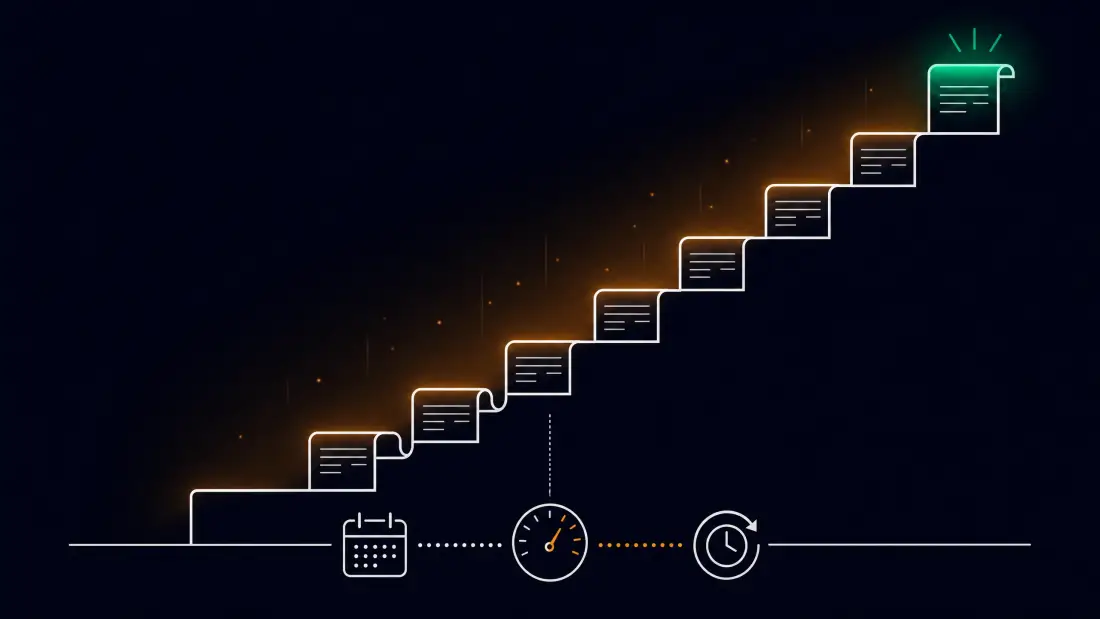
A consolidation path does not need a "big bang" migration. It needs a controlled, traceable sequence:
- Discovery (Week 1–2): Inventory all SaaS tools, map data flows, identify overlaps and shadow IT. Output: tool matrix with cost attribution.
- Anchor (Week 3–4): Select the integration hub (self-hosted n8n + Postgres) and identity layer (Keycloak). Deploy on sovereign infrastructure — DACH-hosted Kubernetes or on-premise.
- First Workflow (Week 5–8): Migrate one high-value, high-pain workflow — such as CRM → invoicing → project kickoff. Build observability and alerting from day one.
- Gradual Consolidation (Month 3–6): Rationalize overlapping tools, reclaim ghost licenses, migrate adjacent workflows onto the hub.
- Steady-State Operations (Ongoing): Cost monitoring, security patching, workflow refinement, quarterly sovereignty review.
Tradeoffs and boundaries: Hub-and-spoke introduces a single point of failure — mitigated by backup n8n instances and database replication. Self-hosting requires operational attention — which Planfold covers in its managed care model. Migration takes longer than "rip and replace" but preserves business continuity and data integrity.
Regulatory Context: Why Localization Alone Is Not Enough
The US CLOUD Act allows US authorities extraterritorial access to data regardless of physical server location 9. NIS2 and DORA expand liability for third-party IT risks to a broader range of SMEs 9. As a result, 41% of DACH companies are planning a shift to European cloud solutions to minimize jurisdictional risks 10.
The implication: storing data in Frankfurt is insufficient if the vendor is US-owned. Sovereignty requires control over vendor jurisdiction, not just geography.
Scenario: From Fragmentation to Digital HQ
[Illustrative scenario — based on composite patterns from mid-market rationalization studies, not a single verified case.]
A 35-person engineering services firm manages project requests through email, three CRMs (legacy migration residue), a standalone invoicing tool, and a manual spreadsheet for resource planning. There is no named data owner; three incompatible CRM versions create 48-hour blind spots when the operations lead is unavailable.
After Phase 1 (Plan): Tool inventory reveals 23 paid SaaS licenses, 9 with functional overlap, 4 with zero logins in 90 days. Annual spend: €47,000. Target architecture: unified CRM (Postgres-backed), n8n workflow layer, Keycloak SSO.
After Phase 2 (Unfold): One unified intake → qualification → CRM → invoicing → resource-planning workflow. Automated 48-hour alert on stalled requests. The operations lead shifts from daily triage to weekly exception review.
After Phase 3 (Resonate): 6 redundant tools canceled (€18,200/year reclaimed). Context-switching time reduced by an estimated 8 hours/week across the team. Audit preparation cut from 3 days to 4 hours because all data flows are documented and version-controlled.
The Planfold Perspective: Plan → Unfold → Resonate
At Planfold, we follow an engineering-driven methodology to make the path to digital sovereignty traceable:
Plan means auditing existing architecture. We inventory the software sprawl, identify technical debt, and map data flows. Together we define a sovereign target architecture with clear jurisdiction and portability requirements. The result is not a tool list, but a roadmap-ready decision foundation.
Unfold means building the systems. We deploy the Digital HQ — n8n for workflow orchestration, self-hosted Postgres/S3 as the single source of truth, Keycloak for identity federation. Each workflow is migrated individually to preserve business continuity. Observability, alerting, and backup are not afterthoughts; they are part of the first deployment.
Resonate means stable operations with measurable business value. Through managed services, we ensure high availability, security patching, and cost monitoring. The metrics are concrete: hours saved, licenses eliminated, shorter audit preparation. Sovereignty becomes not a project, but a permanent operating state.
Conclusion: Sovereignty Is an Architecture Decision
Digital sovereignty does not mean building every tool from scratch or avoiding the cloud. It means owning and controlling the architecture that connects tools safely and efficiently. In a market where data is competitive advantage, control over the integration layer is a structural decision — not a purely technical preference.
The way out of SaaS sprawl begins with the conscious decision to prioritize long-term architecture over short-term convenience. The technological means exist: open standards, sovereign hosting options, and orchestrable workflows. The question is not whether they are available, but whether you own the architecture that makes them work for your business.

Footnotes
-
Qatalog & Cornell University Ellis Ideas Lab (2021) — Study on app usage and context-switching costs: https://www.qatalog.com/ ↩ ↩2
-
Zylo 2024 SaaS Management Report — Average SaaS spend per employee: https://www.zylo.com/ ↩
-
Spendesk (2024) — License utilization study: approximately 50% of SaaS licenses remain unused for 90+ days. ↩
-
Zylo — Estimate of shadow IT costs: 30–40% additional to official software spend. ↩
-
Cornell University — Study on flow-state recovery after context switching (approximately 9 minutes 30 seconds). ↩
-
Conclude.io — Employees spend an average of 59 minutes/day searching for information in fragmented systems. ↩
-
Asana Anatomy of Work Global Index 2024 — 58% of the workday consumed by "work about work": https://asana.com/ ↩
-
Gartner (2024) — Average enterprise wastes 30% of SaaS budget on unused licenses, duplicate tools, and shadow IT. ↩
-
Heuking Kühn Lüer Wojtek (2025) — CLOUD Act, NIS2 and DORA in the context of third-party risks: https://www.heuking.de/ ↩ ↩2
-
A1 Digital / Eurostat trends — 41% of DACH companies plan a shift to European cloud solutions. ↩