From Monolith to Microservices: What It Actually Means for Your Business
Monoliths slow releases, scaling, and teams. Learn how to move toward microservices without a risky big-bang rewrite.
Contents
Monoliths slow releases, scaling, and teams. Learn how to move toward microservices without a risky big-bang rewrite.
Share this article
The All-or-Nothing Trap
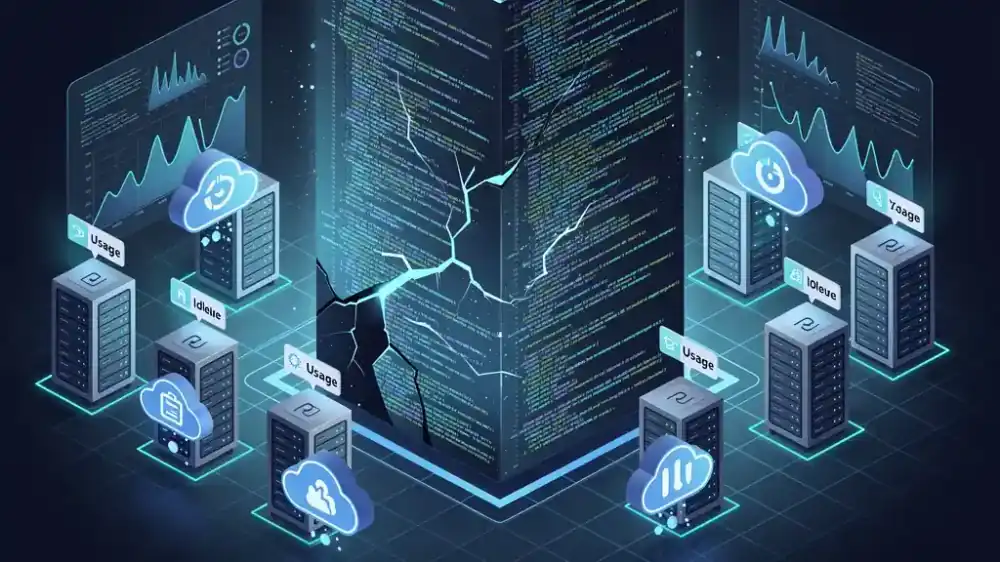
Your application is one giant codebase. When one part breaks, everything breaks. When you need to scale, you scale everything—including the parts that don't need it.
This is the monolith. And if you're running one, you're paying a hidden tax on every feature you build, every customer you serve, and every hour your team spends waiting.
The monolith isn't just a technical architecture. It's a business constraint disguised as software. It forces you to move at the speed of your slowest component. It makes your riskiest deployments all-or-nothing gambles. It turns scaling into an expensive game of overprovisioning.
Most businesses don't realize they're in this trap until they try to move fast—and discover they can't.
The Hidden Cost of "It Just Works"
That legacy system "that just works"? It's actually bleeding your business dry in four ways you might not be measuring.
1. The Deployment Anxiety Tax
Every release is a high-stakes event. Because everything is connected, changing one feature means testing everything. Regression testing takes days. Deployment windows shrink to weekends. Rollbacks require reverting the entire application.
The cost: Features that could ship in hours take weeks. Competitors who can deploy daily gain market advantage while you're still in QA.
2. The Scaling Inefficiency
Your e-commerce checkout process gets hammered during holiday sales. So you scale up your entire infrastructure—including the admin dashboard, the reporting module, and the user profile system that nobody is using at 2 AM.
The cost: You're paying for capacity you don't need because you can't scale what you do need independently.
3. The Team Bottleneck
Twenty developers working on one codebase creates a traffic jam. Every merge risks conflict. Every feature branch drifts further from main. Code reviews become bottlenecks. Senior developers spend their days resolving merge conflicts instead of architecting solutions.
The cost: Developer productivity drops as team size grows. The very growth that should accelerate you starts to slow you down.
4. The Failure Cascade
When the payment processing module has an issue, it doesn't just affect payments. It takes down the entire application. Customers can't browse. Admins can't access dashboards. Your business grinds to a halt because one component failed.
The cost: Every failure is a total outage. There's no graceful degradation, no isolation, no resilience.
What a Monolith Really Looks Like
Let me paint a picture you might recognize.
The Scenario: A mid-sized logistics company runs their operations on a system built in 2015. It's a classic monolith: WinForms desktop application, SQL Server database, business logic tangled across UI layers and stored procedures. Over the years, they've added features—customer portal, mobile app for drivers, integration with carrier APIs—by bolting them onto the existing structure.
The Daily Reality:
| Task | Time Required | Risk Level |
|---|---|---|
| Deploy new customer feature | 3-4 days (full regression test) | High (could break billing) |
| Scale for peak season | 6 weeks (provision entire stack) | Medium (expensive overprovisioning) |
| Fix driver app bug | 2-3 days (must test everything) | High (shared codebase) |
| Add new carrier integration | 4-6 weeks (touches 12 modules) | Very High (unknown dependencies) |
| Onboard new developer | 3 months (learn entire system) | N/A |
The Breaking Point: During their busiest season, a bug in the reporting module—used by exactly three people in accounting—caused a memory leak that crashed the entire system. For six hours, drivers couldn't receive assignments, customers couldn't track shipments, and the operations team was blind.
All because one rarely-used feature had an issue.
This isn't a technology problem. It's an architecture problem. And architecture problems are business problems.
Microservices: Independence Through Architecture
Microservices aren't about being trendy. They're about business agility through technical independence.
Here's what microservices actually mean in business terms:
Independent Scaling
Your checkout process needs more resources during sales events? Scale just the checkout service. Your reporting runs heavy queries at month-end? Scale just the reporting service. Every component gets exactly the resources it needs—no more, no less.
The result: 40-60% infrastructure cost reduction. You pay for what you use, when you use it.
Independent Deployment
The customer portal team ships a new feature? They deploy their service without touching the billing system, the admin dashboard, or the mobile API. Tests cover their service boundaries. Deployment takes minutes, not days.
The result: Deploy multiple times per day. Respond to market opportunities in hours, not weeks.
Independent Failure
The recommendation engine has an issue? Customers still browse, still add to cart, still check out. The failure is isolated to one service. The rest of your application keeps running.
The result: Resilience. Graceful degradation. Business continuity even when things go wrong.
Team Autonomy
Each service has a clear owner. Teams work in parallel without stepping on each other. New developers understand their service in days, not months. Code reviews happen within the team, not across the entire organization.
The result: Developer velocity increases with team size. Growth accelerates you instead of slowing you down.
The Strangler Fig Pattern: Evolution Without Disruption
Here's the objection we hear most often: "This sounds great, but we can't just rewrite our entire application. We have customers, deadlines, and a business to run."
You're absolutely right. Big-bang rewrites are where projects go to die.
That's why we use the Strangler Fig Pattern—a migration strategy that lets you modernize incrementally without ever shutting down the business.
How It Works
The strangler fig is a plant that grows around an existing tree, eventually replacing it entirely while the original tree keeps living. Software migration works the same way.
Phase 1: Identify Boundaries (Weeks 1-4)
Map your monolith's domains. Where are the natural seams? Customer management. Order processing. Inventory. Billing. Each domain becomes a candidate for extraction.
Start with the lowest-risk, highest-value boundary—usually a feature that's self-contained and causes frequent issues.
Phase 2: Extract the First Service (Weeks 5-12)
Build the new service alongside the monolith. It runs independently but integrates through APIs. The monolith still handles most operations, but the new service takes over its specific domain.
Key principle: The monolith treats the new service like any external API. No big-bang changes. No risky cutovers.
Phase 3: Gradual Traffic Migration (Weeks 13-16)
Route a small percentage of traffic to the new service. Monitor closely. If issues arise, route back to the monolith instantly. No downtime. No customer impact.
Once stable, increase traffic gradually: 10%, 25%, 50%, 100%.
Phase 4: Repeat and Decommission (Ongoing)
Extract the next service. And the next. Over months—not years—your monolith shrinks while your service architecture grows.
Eventually, the monolith is just a thin routing layer. Then it's gone entirely. Your customers never experienced a "migration." They just noticed the application getting faster and more reliable.
Technical Deep-Dive: Architecture for the Auditors
For those who want to understand the technology behind the business outcomes:
Microservices Architecture
├── Independent Services (domain-aligned, single responsibility)
├── API Gateway (unified entry, routing, rate limiting)
├── Service Mesh (inter-service communication, observability)
├── Container Orchestration (RKE2/K3s - portable, sovereign, no cloud lock-in)
├── CI/CD Pipeline (automated testing, deployment, rollback)
└── Observability Stack (metrics, logging, tracing)

The Strangler Fig Migration
├── Phase 1: Domain Analysis (identify bounded contexts)
├── Phase 2: API Facade (wrap monolith, expose clean interfaces)
├── Phase 3: Service Extraction (build alongside, not instead of)
├── Phase 4: Traffic Shifting (gradual cutover with instant rollback)
├── Phase 5: Monolith Shrinking (remove extracted logic)
└── Phase 6: Router Decommission (final cleanup)

Certifications & Standards
├── CKA (Certified Kubernetes Administrator)
├── CKAD (Certified Kubernetes Application Developer)
└── Cloud-Native Best Practices (12-factor, immutable infrastructure)
Why RKE2/K3s?
We use Rancher's RKE2 (or K3s for edge deployments) because they're sovereign by design. Unlike managed Kubernetes services that lock you into AWS, Azure, or GCP, RKE2 runs anywhere: your data center, Hetzner, a hybrid setup. Your orchestration layer is portable. Your investment is protected. Your data stays under your control.
This matters because microservices are a long-term commitment. You don't want your architecture modernization to become a new form of vendor lock-in.
Real Business Outcomes: Three Scenarios
Scenario 1: The E-Commerce Platform
Before: Monolithic PHP application. Holiday traffic meant scaling everything—including the admin panel that three people used. Monthly deployments required 2-day testing windows.
Migration: Extracted checkout, inventory, and user management into separate services over 8 months.
After:
- Infrastructure costs: -52% (scale only what needs scaling)
- Deployment frequency: Monthly → Daily
- Time to deploy new feature: 3 weeks → 4 hours
- Black Friday uptime: 99.99% (isolated failures don't cascade)
Scenario 2: The Financial Services Firm
Before: WinForms application with 2 million lines of C#. Adding a new report type required touching 15 modules. Regulatory changes took 6 months to implement.
Migration: Strangler Fig approach over 18 months. Extracted customer data, transaction processing, and reporting into services.
After:
- Regulatory compliance updates: 6 months → 3 weeks
- New market onboarding: 9 months → 6 weeks
- Developer onboarding: 4 months → 3 weeks
- System availability: 99.9% → 99.99%
Scenario 3: The SaaS Company
Before: Single Rails application. 40 engineers stepping on each other. Merge conflicts consumed senior dev time. Feature releases coordinated across 6 teams.
Migration: Domain-driven service extraction over 12 months.
After:
- Teams deploy independently: 6 coordinated releases → 40+ weekly deployments
- Lead time for changes: 3 weeks → 2 days
- Failed deployments: 15% → 2% (smaller blast radius)
- Developer satisfaction: Significant improvement (autonomy reduces friction)
The Cost of Waiting
Every month you delay modernization, you pay three costs:
- Opportunity Cost: Features that could differentiate your business stay in the backlog because they're "too risky to deploy"
- Efficiency Cost: You're paying for infrastructure capacity you don't need because you can't scale precisely
- Talent Cost: Top engineers don't want to work on legacy monoliths. They want to build modern systems. Your technical debt becomes a recruiting disadvantage.
The question isn't whether you can afford to modernize. It's whether you can afford not to.
Your Next Step
Start with an architecture audit. Map your current system's domains. Identify the boundaries where your monolith naturally wants to split. Look for the highest-pain, lowest-risk extraction candidate.
Ask your team: "If we could change one thing about our deployment process, what would have the biggest impact?" The answer usually points to your first service.
If your technical debt is blocking innovation, we can help you architect a modernization roadmap that delivers independence without disruption. The Strangler Fig approach means you modernize while you operate—no big-bang rewrites, no business downtime, no risky cutovers.
Ready to break free from the monolith? Get in touch for a confidential modernization roadmap consultation.